Chen Jie, Li Hongfei, Zhao Tingting, Chen Kun, Chen Ming-Hui, Sun Zhe, Xu Wanli, Maas Kendra, Lester Barry M, Cong Xiaomei S
College of Nursing, Florida State University, Tallahassee, FL 32306, USA.
School of Nursing, University of Connecticut, Storrs, CT 06269, USA.
Microorganisms. 2023 Mar 22;11(3):814. doi: 10.3390/microorganisms11030814.
The objective of this study is to investigate the impact of early life experiences and gut microbiota on neurobehavioral development in preterm infants during neonatal intensive care unit (NICU) hospitalization.
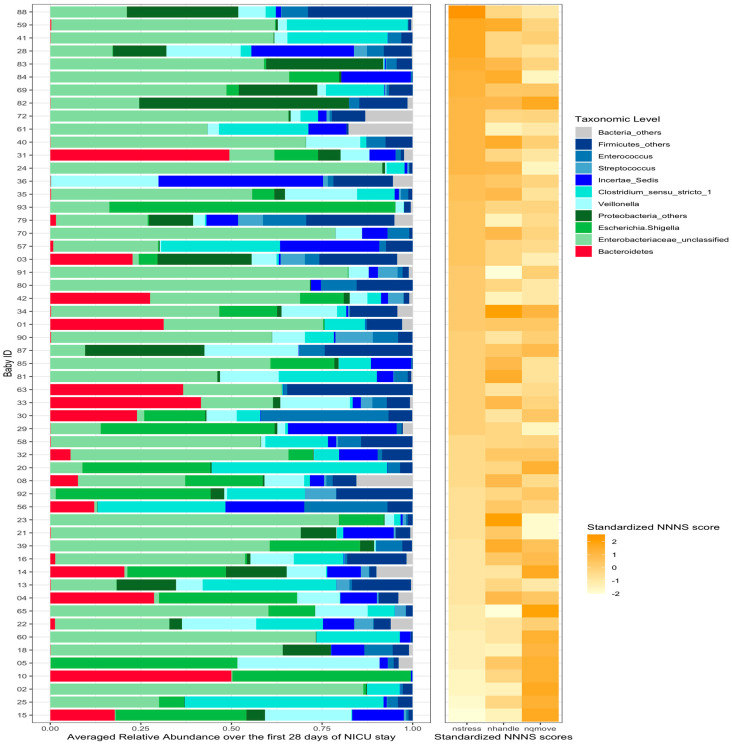
Preterm infants were followed from NICU admission until their 28th postnatal day or until discharge. Daily stool samples, painful/stressful experiences, feeding patterns, and other clinical and demographic data were collected. Gut microbiota was profiled using 16S rRNA sequencing, and operational taxonomic units (OTUs) were selected to predict the neurobehaviors. The neurobehavioral development was assessed by the Neonatal Neurobehavioral Scale (NNNS) at 36 to 38 weeks of post-menstrual age (PMA). Fifty-five infants who had NNNS measurements were included in the sparse log-contrast regression analysis.
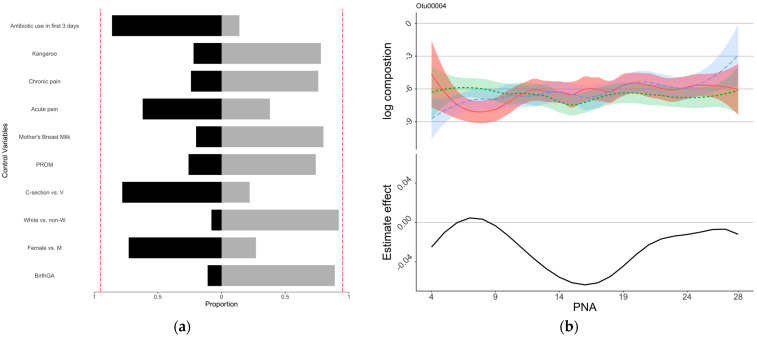
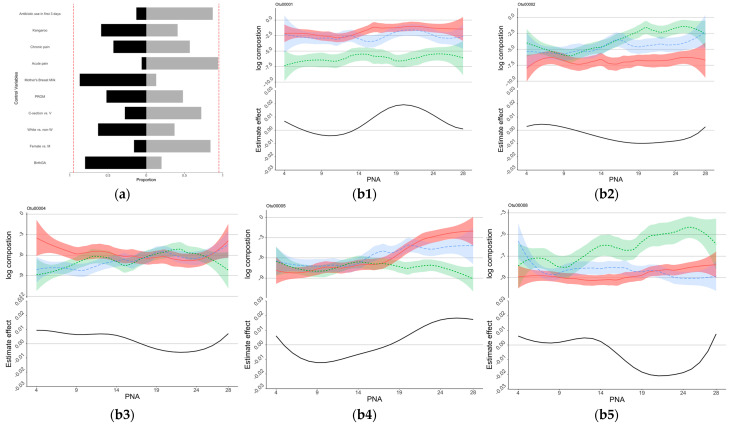
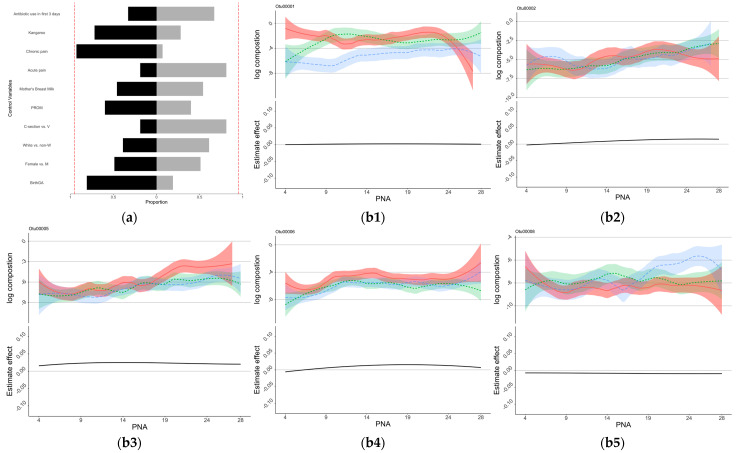
Preterm infants who experienced a high level of pain/stress during the NICU hospitalization had higher NNNS stress/abstinence scores. Eight operational taxonomic units (OTUs) were identified to be associated with NNNS subscales after controlling demographic and clinical features, feeding patterns, and painful/stressful experiences. These OTUs and taxa belonging to seven genera, i.e., , , , , , , and with five belonging to and two belonging to phylum. The enriched abundance of (OTU17) and (OTU28) were consistently associated with less optimal neurobehavioral outcomes. The other six OTUs were also associated with infant neurobehavioral responses depending on days at NICU stay.
This study explored the dynamic impact of specific OTUs on neurobehavioral development in preterm infants after controlling for early life experiences, i.e., acute and chronic pain/stress and feeding in the NICU. The gut microbiota and acute pain/stressful experiences dynamically impact the neurobehavioral development in preterm infants during their NICU hospitalization.
本研究的目的是调查新生儿重症监护病房(NICU)住院期间,早期生活经历和肠道微生物群对早产儿神经行为发育的影响。
对早产儿从入住NICU开始进行随访,直至其出生后第28天或出院。收集每日粪便样本、疼痛/应激经历、喂养模式以及其他临床和人口统计学数据。使用16S rRNA测序对肠道微生物群进行分析,并选择操作分类单元(OTU)来预测神经行为。在月经龄(PMA)36至38周时,通过新生儿神经行为量表(NNNS)评估神经行为发育。55名进行了NNNS测量的婴儿被纳入稀疏对数对比回归分析。
在NICU住院期间经历高水平疼痛/应激的早产儿,其NNNS应激/戒断评分更高。在控制了人口统计学和临床特征、喂养模式以及疼痛/应激经历后,确定了8个操作分类单元(OTU)与NNNS分量表相关。这些OTU和属于7个属的分类群,即 、 、 、 、 、 和 ,其中5个属于 ,2个属于 门。 (OTU17)和 (OTU28)的丰度增加始终与不太理想的神经行为结果相关。其他6个OTU也根据在NICU的住院天数与婴儿神经行为反应相关。
本研究在控制了早期生活经历,即NICU中的急性和慢性疼痛/应激以及喂养后,探索了特定OTU对早产儿神经行为发育的动态影响。肠道微生物群和急性疼痛/应激经历在早产儿NICU住院期间对其神经行为发育产生动态影响。