Division of Rheumatology, Department of Medicine, Emory University School of Medicine, Atlanta, GA, USA.
Rheumatology (Oxford). 2023 Mar 29;62(Suppl 1):i10-i14. doi: 10.1093/rheumatology/keac613.
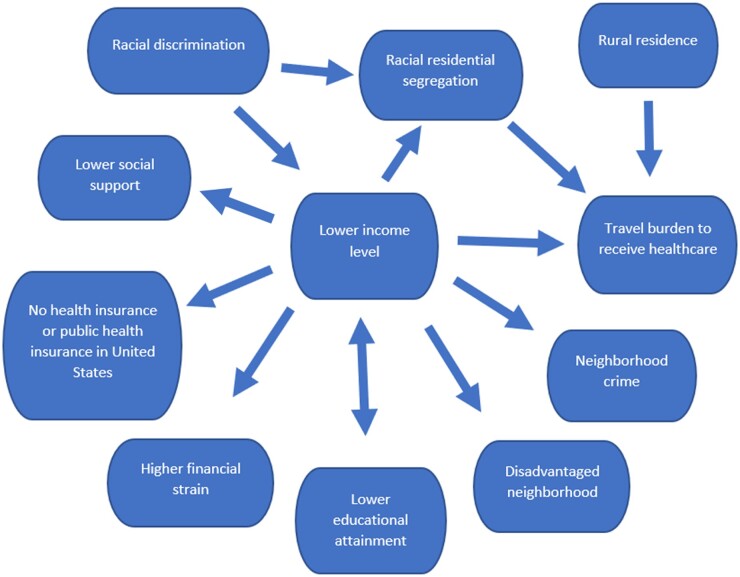
Disparities in SLE rates and outcomes have been attributed to genetic and hormonal factors, cigarette smoking and environmental pollutants. However, a growing body of research indicates that social determinants of health (SDH) also have substantial impact on the disparities that characterize SLE. According to the World Health Organization, SDH are defined as 'the conditions in which people are born, grow, work, live, and age', account for 30-55% of health outcomes, and adversely impact health outcomes among those of low socioeconomic status and stigmatized racial/ethnic groups. We reviewed the impact of key SDH on SLE presentation, management and outcomes, including income, education, neighbourhood factors, healthcare access, discrimination and social support. We found that adverse SDH conditions may lead to more severe SLE with increased morbidity and mortality, and that SDH affect SLE management by dictating the most feasible monitoring and treatment plan for each individual patient based on his or her specific life circumstances (for example, based on health insurance status, distance to nearest provider and/or drug affordability). SDH also have a significant impact on SLE outcomes, with worse disease and psychosocial outcomes associated with lower income level, lower educational attainment, disadvantaged neighbourhoods, lack of health insurance or public health insurance in the USA, travel burden to nearest provider, anti-Black racism and lower social support. Future efforts to improve the management and outcomes of patients with SLE must combat the societal, economic and political forces that perpetuate these inequities.
SLE 的发病率和结局存在差异,其原因可归结为遗传和激素因素、吸烟和环境污染物。然而,越来越多的研究表明,健康的社会决定因素(social determinants of health,SDH)对 SLE 特征的差异也有重大影响。根据世界卫生组织的定义,SDH 是指“人们出生、成长、工作、生活和衰老的环境”,占健康结果的 30-55%,并对社会经济地位较低和受歧视的种族/族裔群体的健康结果产生不利影响。我们回顾了关键 SDH 对 SLE 表现、管理和结局的影响,包括收入、教育、社区因素、医疗保健获取、歧视和社会支持。我们发现,不利的 SDH 状况可能导致 SLE 更严重,发病率和死亡率更高,并且 SDH 通过根据每个患者的具体生活环境(例如,根据健康保险状况、到最近提供者的距离和/或药物可负担性)决定最可行的监测和治疗计划来影响 SLE 的管理。SDH 对 SLE 结局也有重大影响,较低的收入水平、较低的教育程度、不利的社区环境、缺乏医疗保险或美国的公共医疗保险、到最近提供者的旅行负担、反黑人种族主义和较低的社会支持与较差的疾病和心理社会结局相关。未来改善 SLE 患者管理和结局的努力必须应对导致这些不平等现象持续存在的社会、经济和政治力量。