Coupé Pierrick, Planche Vincent, Mansencal Boris, Kamroui Reda A, Koubiyr Ismail, Manjon José V, Tourdias Thomas
CNRS, Univ. Bordeaux, Bordeaux INP, LABRI, UMR5800, F-33400 Talence, France.
Univ. Bordeaux, CNRS, UMR 5293, Institut des Maladies Neurodégénératives, F-33000 Bordeaux, France.
bioRxiv. 2023 Mar 14:2023.03.14.532535. doi: 10.1101/2023.03.14.532535.
Atrophy related to Multiple Sclerosis (MS) has been found at the early stages of the disease. However, the archetype dynamic trajectories of the neurodegenerative process, even prior to clinical diagnosis, remain unknown.
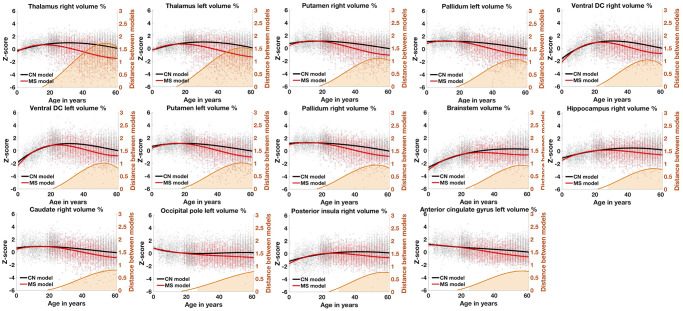
We modeled the volumetric trajectories of brain structures across the entire lifespan using 40944 subjects (38295 healthy controls and 2649 MS patients). Then, we estimated the chronological progression of MS by assessing the divergence of lifespan trajectories between normal brain charts and MS brain charts.
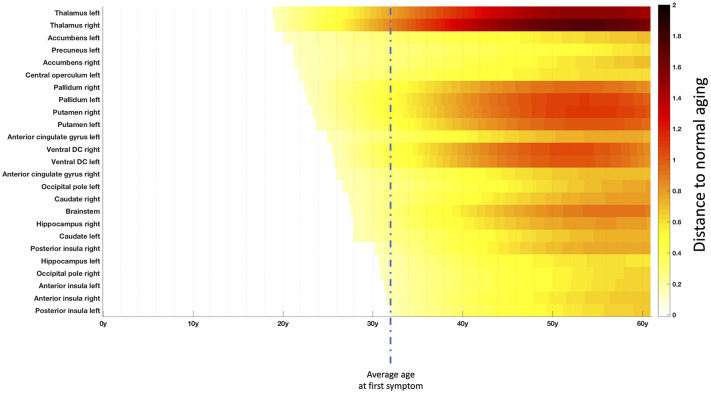
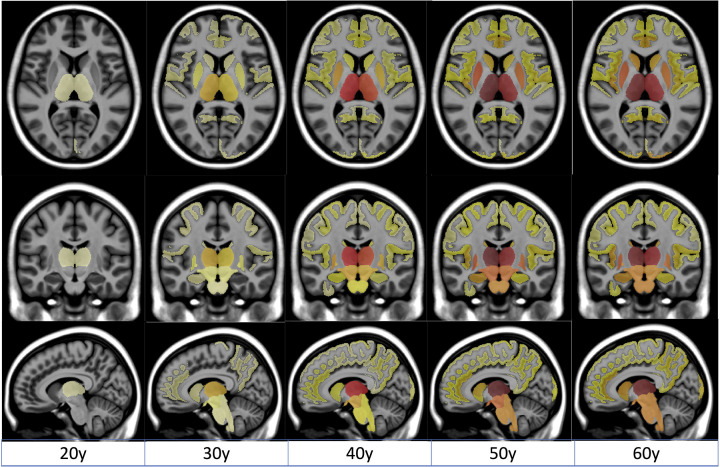
Chronologically, the first affected structure was the thalamus, then the putamen and the pallidum (3 years later), followed by the ventral diencephalon (7 years after thalamus) and finally the brainstem (9 years after thalamus). To a lesser extent, the anterior cingulate gyrus, insular cortex, occipital pole, caudate and hippocampus were impacted. Finally, the precuneus and accumbens nuclei exhibited a limited atrophy pattern.
Subcortical atrophy was more pronounced than cortical atrophy. The thalamus was the most impacted structure with a very early divergence in life. It paves the way toward utilization of these lifespan models for future preclinical/prodromal prognosis and monitoring of MS.
在多发性硬化症(MS)的早期阶段就已发现与该病相关的萎缩现象。然而,即使在临床诊断之前,神经退行性过程的典型动态轨迹仍不清楚。
我们使用40944名受试者(38295名健康对照者和2649名MS患者)对整个生命周期内脑结构的体积轨迹进行建模。然后,我们通过评估正常脑图谱和MS脑图谱之间寿命轨迹的差异来估计MS的时间进程。
按时间顺序,首先受影响的结构是丘脑,然后是壳核和苍白球(3年后),接着是腹侧间脑(丘脑后7年),最后是脑干(丘脑后9年)。前扣带回、岛叶皮质、枕极、尾状核和海马体受到的影响较小。最后,楔前叶和伏隔核表现出有限的萎缩模式。
皮质下萎缩比皮质萎缩更明显。丘脑是受影响最严重的结构,在生命早期就出现了明显差异。这为将来将这些寿命模型用于MS的临床前/前驱期预后和监测铺平了道路。