Tsuchida Connor A, Brandes Nadav, Bueno Raymund, Trinidad Marena, Mazumder Thomas, Yu Bingfei, Hwang Byungjin, Chang Christopher, Liu Jamin, Sun Yang, Hopkins Caitlin R, Parker Kevin R, Qi Yanyan, Satpathy Ansuman T, Stadtmauer Edward A, Cate Jamie H D, Eyquem Justin, Fraietta Joseph A, June Carl H, Chang Howard Y, Ye Chun Jimmie, Doudna Jennifer A
University of California, Berkeley - University of California, San Francisco Graduate Program in Bioengineering, University of California, Berkeley, Berkeley, CA, USA.
Innovative Genomics Institute, University of California, Berkeley, Berkeley, CA, USA.
bioRxiv. 2023 Mar 22:2023.03.22.533709. doi: 10.1101/2023.03.22.533709.
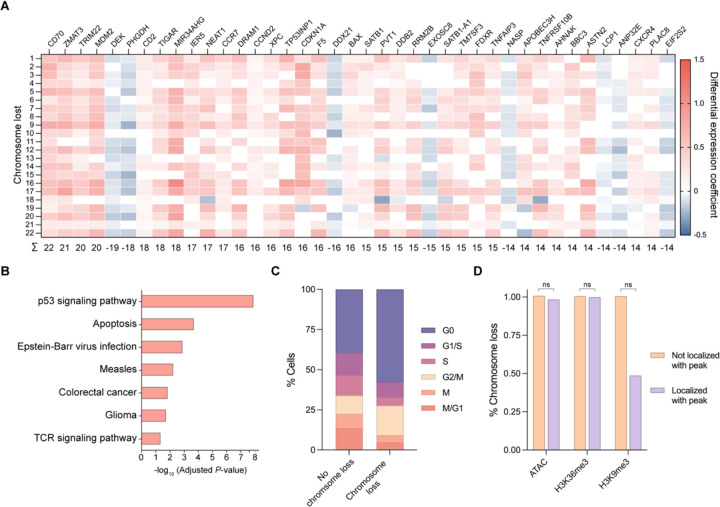
CRISPR-Cas9 genome editing has enabled advanced T cell therapies, but occasional loss of the targeted chromosome remains a safety concern. To investigate whether Cas9-induced chromosome loss is a universal phenomenon and evaluate its clinical significance, we conducted a systematic analysis in primary human T cells. Arrayed and pooled CRISPR screens revealed that chromosome loss was generalizable across the genome and resulted in partial and entire loss of the chromosome, including in pre-clinical chimeric antigen receptor T cells. T cells with chromosome loss persisted for weeks in culture, implying the potential to interfere with clinical use. A modified cell manufacturing process, employed in our first-in-human clinical trial of Cas9-engineered T cells, dramatically reduced chromosome loss while largely preserving genome editing efficacy. Expression of p53 correlated with protection from chromosome loss observed in this protocol, suggesting both a mechanism and strategy for T cell engineering that mitigates this genotoxicity in the clinic.
CRISPR-Cas9基因编辑技术推动了先进的T细胞疗法的发展,但靶向染色体偶尔出现的缺失仍是一个安全问题。为了研究Cas9诱导的染色体缺失是否是一种普遍现象并评估其临床意义,我们在原代人T细胞中进行了系统分析。阵列式和混合式CRISPR筛选显示,染色体缺失在全基因组中普遍存在,并导致染色体部分或完全缺失,包括在临床前嵌合抗原受体T细胞中。染色体缺失的T细胞在培养中持续存在数周,这意味着可能会干扰临床应用。在我们首次进行的Cas9工程化T细胞人体临床试验中采用的改良细胞制造工艺,在很大程度上保留基因组编辑效力的同时,显著减少了染色体缺失。p53的表达与该方案中观察到的对染色体缺失的保护作用相关,这提示了一种在临床上减轻这种基因毒性的T细胞工程机制和策略。