Oyesola Oyebola, Downie Alexander E, Howard Nina, Barre Ramya S, Kiwanuka Kasalina, Zaldana Kimberly, Chen Ying-Han, Menezes Arthur, Lee Soo Ching, Devlin Joseph, Mondragón-Palomino Octavio, Souza Camila Oliveira Silva, Herrmann Christin, Koralov Sergei, Cadwell Ken, Graham Andrea L, Loke P'ng
Laboratory of Parasitic Diseases, National Institute of Allergy and Infectious Diseases, National Institute of Health; Bethesda, MD, USA.
Department of Ecology and Evolutionary Biology, Princeton University; Princeton, NJ, USA.
bioRxiv. 2023 May 2:2023.03.17.533121. doi: 10.1101/2023.03.17.533121.
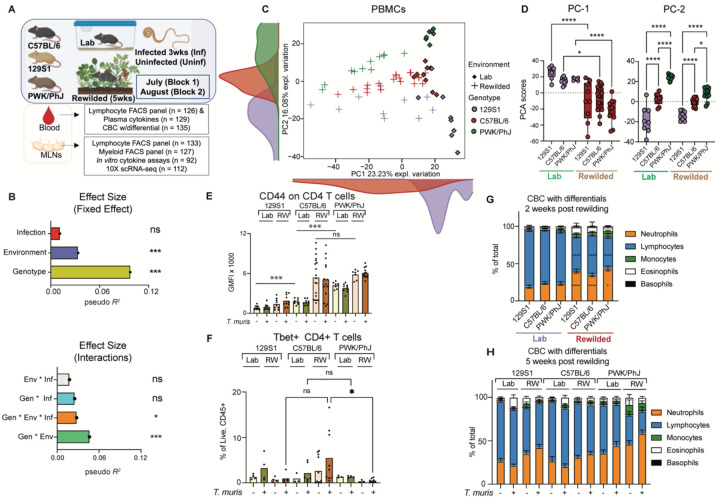
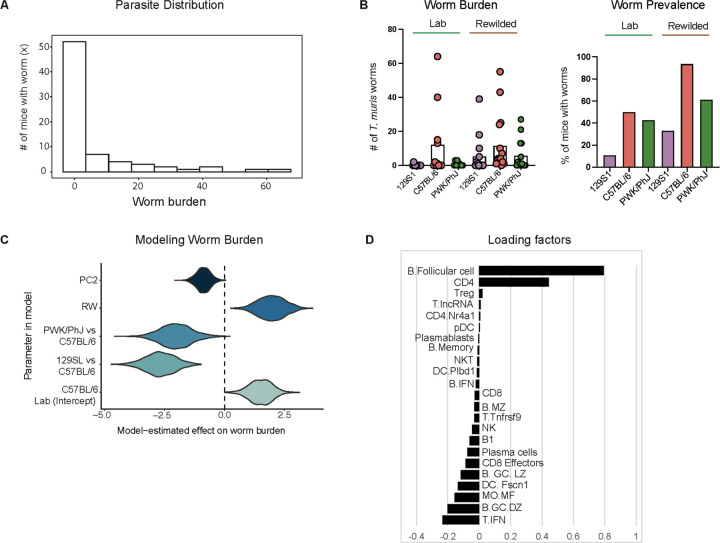
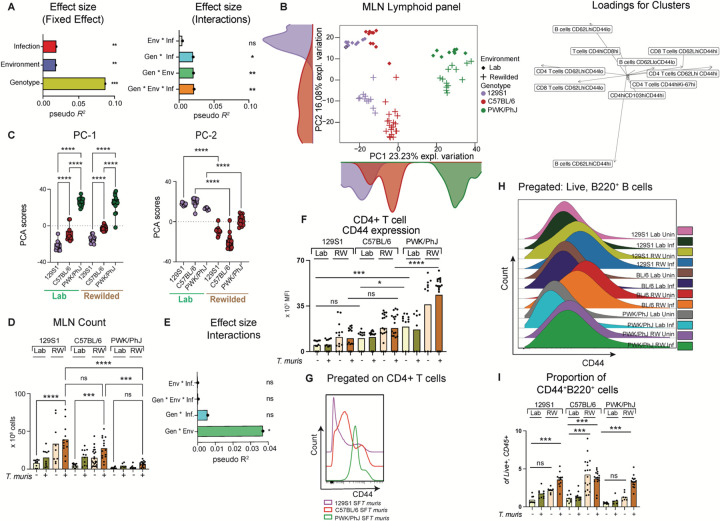
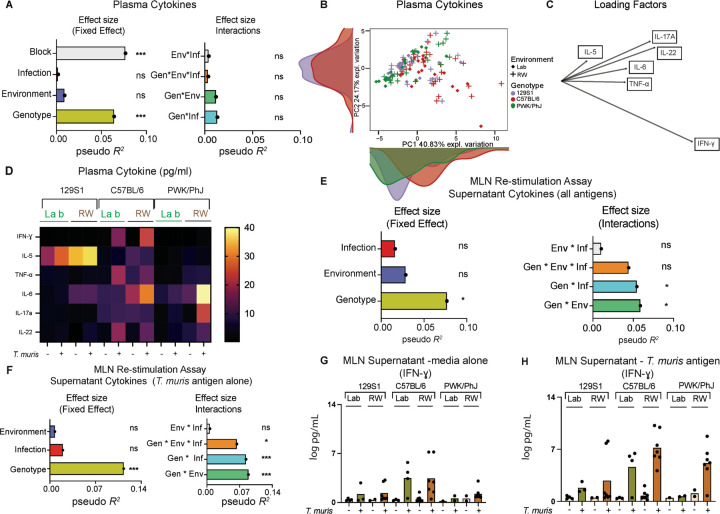
The relative and synergistic contributions of genetics and environment to inter-individual immune response variation remain unclear, despite its implications for understanding both evolutionary biology and medicine. Here, we quantify interactive effects of genotype and environment on immune traits by investigating three inbred mouse strains rewilded in an outdoor enclosure and infected with the parasite, . Whereas cytokine response heterogeneity was primarily driven by genotype, cellular composition heterogeneity was shaped by interactions between genotype and environment. Notably, genetic differences under laboratory conditions can be decreased following rewilding, and variation in T cell markers are more driven by genetics, whereas B cell markers are driven more by environment. Importantly, variation in worm burden is associated with measures of immune variation, as well as genetics and environment. These results indicate that nonheritable influences interact with genetic factors to shape immune variation, with synergistic impacts on the deployment and evolution of defense mechanisms.
尽管遗传学和环境对个体间免疫反应差异的相对及协同作用对理解进化生物学和医学都有重要意义,但其仍不清楚。在此,我们通过研究在室外围栏中野化并感染寄生虫的三种近交系小鼠品系,量化基因型和环境对免疫性状的交互作用。细胞因子反应异质性主要由基因型驱动,而细胞组成异质性则由基因型与环境之间的相互作用塑造。值得注意的是,野化后实验室条件下的遗传差异可能会减小,T细胞标志物的变异更多地由遗传学驱动,而B细胞标志物则更多地由环境驱动。重要的是,蠕虫负荷的变异与免疫变异指标以及遗传学和环境相关。这些结果表明,非遗传影响与遗传因素相互作用以塑造免疫变异,对防御机制的部署和进化具有协同影响。