Puspaningtyas Niken Wahyu, Karyanti Mulya Rahma, Paramita Tiara Nien, Sjakti Hikari Ambara, Putri Nina Dwi, Tridjaja Bambang, Yanuarso Piprim Basarah, Rinaldhy Kshetra, Yani Ahmad, Gayatri Pramita
Department of Pediatrics, Cipto Mangunkusumo National Central Hospital, Faculty of Medicine, Universitas Indonesia, Jakarta, Indonesia.
Department of Surgery, Cipto Mangunkusumo National Central Hospital, Faculty of Medicine, Universitas Indonesia, Jakarta, Indonesia.
Front Pediatr. 2023 Mar 13;11:1036993. doi: 10.3389/fped.2023.1036993. eCollection 2023.
Post-operative systemic inflammation response syndrome (SIRS) is an event that results from surgical trauma, white blood cells contact activation, and intra-surgical bacterial translocation, which is difficult to distinguish from sepsis. Presepsin is a novel biomarker that is increased since the early stages of bacterial infection and can be used to confirm the diagnosis of post-operative infectious complications. This study aimed to investigate the diagnostic performance of presepsin for post-operative infectious complications compared to other well-known biomarkers.
This cross-sectional study included 100 post-operative patients admitted to Cipto Mangunkusumo National Hospital and Bunda Hospital in Jakarta, Indonesia. The objective was to identify the optimal cutoff and trend of plasma presepsin concentration on the first and third day after surgery and to compare them with other biomarkers.
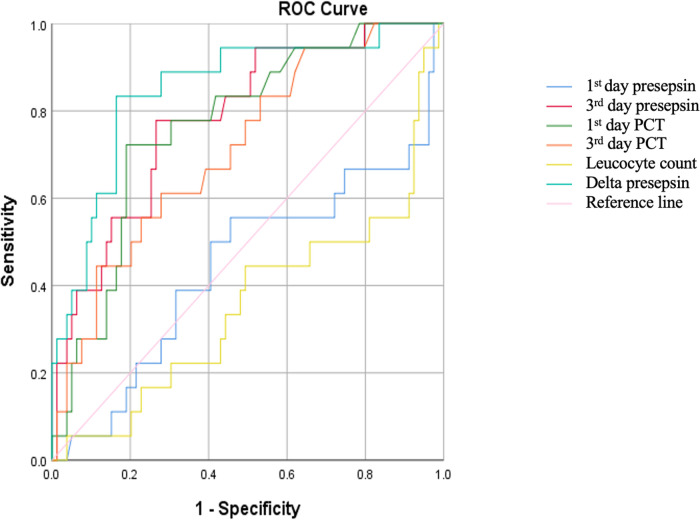
Plasma presepsin level was higher in the infection group compared to the non-infection group (median 806.5 pg/ml vs. 717 pg/ml and 980 pg/ml vs. 516 pg/ml on the first and third day, respectively). Presepsin levels tended to increase on the third post-operative day (median + 252 pg/ml) in children with infection. The opposite trend was observed in the non-infection group from the first to the third day (median -222.5 pg/ml). Presepsin delta, a three-day difference between the first and third post-operative day, had the best diagnostic performance compared to other biomarkers (Area Under the Curve 0.825). The optimal cutoff for presepsin delta to diagnose post-operative infection was +90.5 pg/ml.
Serial assessments of presepsin levels on the first and third days post-surgery and their trends are helpful diagnostic markers for clinicians to detect post-operative infectious complications in children.
术后全身炎症反应综合征(SIRS)是由手术创伤、白细胞接触激活和手术中细菌移位引起的一种情况,很难与脓毒症区分开来。可溶性髓系细胞触发受体-1(Presepsin)是一种新型生物标志物,自细菌感染早期就会升高,可用于确诊术后感染性并发症。本研究旨在探讨Presepsin与其他知名生物标志物相比,对术后感染性并发症的诊断效能。
这项横断面研究纳入了印度尼西亚雅加达的西托·曼古库苏莫国家医院和班达医院收治的100例术后患者。目的是确定术后第一天和第三天血浆Presepsin浓度的最佳临界值和变化趋势,并将其与其他生物标志物进行比较。
感染组的血浆Presepsin水平高于非感染组(第一天和第三天的中位数分别为806.5 pg/ml对717 pg/ml和980 pg/ml对516 pg/ml)。感染患儿术后第三天Presepsin水平趋于升高(中位数增加252 pg/ml)。非感染组从第一天到第三天观察到相反的趋势(中位数减少222.5 pg/ml)。与其他生物标志物相比,Presepsin增量(术后第一天和第三天的三天差值)具有最佳的诊断效能(曲线下面积为0.825)。诊断术后感染的Presepsin增量最佳临界值为+90.5 pg/ml。
术后第一天和第三天对Presepsin水平进行连续评估及其变化趋势,对临床医生检测儿童术后感染性并发症是有用的诊断标志物。