1st Department of Neurology, AHEPA University Hospital, School of Medicine, Aristotle University of Thessaloniki, Thessaloniki, Greece.
3rd Department of Internal Medicine, Papageorgiou Hospital, Aristotle University of Thessaloniki, Ring Road Nea Efkarpia, 56429, Thessaloniki, Greece.
Aging Clin Exp Res. 2023 Apr;35(4):745-761. doi: 10.1007/s40520-023-02361-7. Epub 2023 Mar 30.
The objective of this systematic review and meta-analysis is to investigate whether nocturnal blood pressure fall, expressed by dipping patterns according to 24 h ambulatory blood pressure monitoring (ABPM), is associated with abnormal cognitive function (cognitive impairment or dementia).
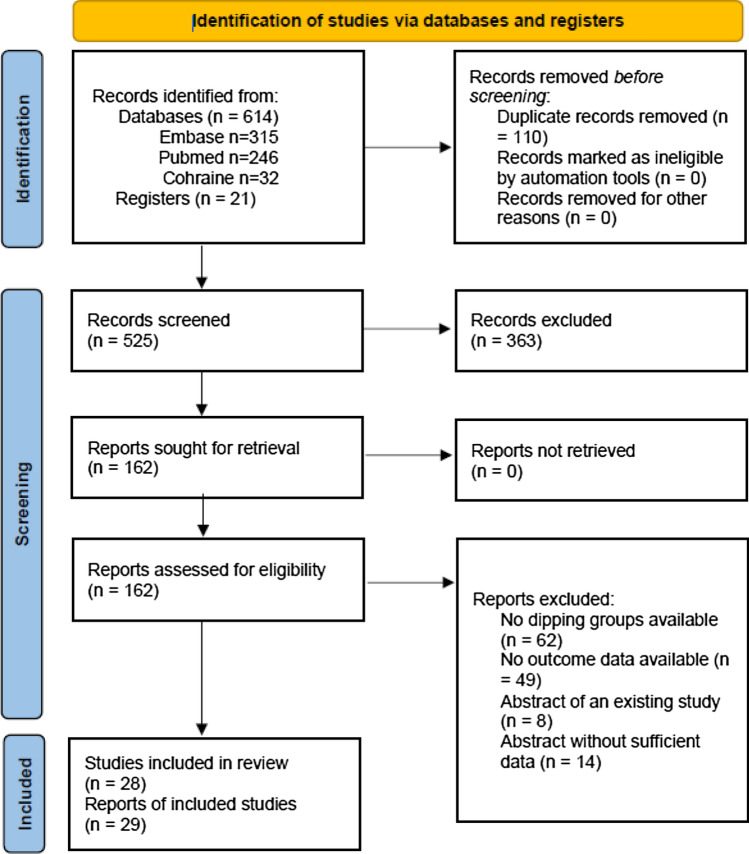
We systematically searched PubMed, Embase, and Cochrane databases to identify original articles through December 2022. We included any study with at least ten participants reporting on all-cause dementia or cognitive impairment incidence (primary outcome) or validated cognitive tests (secondary outcome) among ABPM patterns. We assessed risk of bias using Newcastle-Ottawa Quality Assessment Scale. We pooled odds ratios (OR) and standardized mean differences (SMD) using random-effect models for primary and secondary outcome, respectively.
In the qualitative synthesis, 28 studies examining 7595 patients were included. The pooled analysis of 18 studies showed that dippers had a 51% [OR 0.49(0.35-0.69)] lower risk of abnormal cognitive function and a 63% [OR 0.37(0.23-0.61)] lower risk of dementia alone, compared to non-dippers. Reverse dippers presented an up to sixfold higher risk [OR 6.06(3.15-11.64)] of abnormal cognitive function compared to dippers and an almost twofold higher risk [OR 1.81(1.26-2.6)] compared to non-dippers. Reverse dippers performed worse in global function neuropsychological tests compared with both dippers [SMD - 0.66(- 0.93 to - 0.39)] and non-dippers [SMD - 0.35(- 0.53 to - 0.16)].
Dysregulation of the normal circadian BP rhythm, specifically non-dipping and reverse dipping is associated with abnormal cognitive function. Further studies are required to determine potential underlying mechanisms and possible prognostic or therapeutic implications.
PROSPERO database (ID: CRD42022310384).
本系统评价和荟萃分析的目的是研究根据 24 小时动态血压监测(ABPM)的夜间血压下降模式,即下降模式,是否与异常认知功能(认知障碍或痴呆)相关。
我们系统地检索了 PubMed、Embase 和 Cochrane 数据库,以在 2022 年 12 月之前查找报告 ABPM 模式下全因痴呆或认知障碍发生率(主要结局)或经验证的认知测试(次要结局)的至少 10 名参与者的原始文章。我们使用纽卡斯尔-渥太华质量评估量表评估偏倚风险。我们分别使用随机效应模型对主要和次要结局进行汇总 odds 比(OR)和标准化均数差(SMD)。
在定性综合分析中,纳入了 28 项研究,共涉及 7595 名患者。对 18 项研究的汇总分析表明,与非杓型相比,杓型患者的异常认知功能风险降低 51%[OR 0.49(0.35-0.69)],痴呆风险降低 63%[OR 0.37(0.23-0.61)]。反杓型患者的异常认知功能风险增加高达 6 倍[OR 6.06(3.15-11.64)],与杓型相比,与非杓型相比,痴呆风险增加近 2 倍[OR 1.81(1.26-2.6)]。与杓型相比,反杓型在全球功能神经心理学测试中表现更差[SMD -0.66(-0.93 至-0.39)],与非杓型相比,表现更差[SMD -0.35(-0.53 至-0.16)]。
正常昼夜血压节律的失调,特别是非杓型和反杓型,与异常认知功能相关。需要进一步研究以确定潜在的潜在机制以及可能的预后或治疗意义。
PROSPERO 数据库(ID:CRD42022310384)。