Department of Epidemiology, College of Public Health and Health Professions and College of Medicine, University of Florida, 2004 Mowry Rd., Gainesville, FL, 32610, USA.
Department of Pathology, Harvard Medical School, Beth Israel Deaconess Medical Center, Boston, MA, USA.
Breast Cancer Res. 2023 Mar 30;25(1):33. doi: 10.1186/s13058-023-01638-z.
We investigated the associations of alcohol with percentage of epithelium, stroma, fibroglandular tissue (epithelium + stroma), and fat in benign breast biopsy samples.
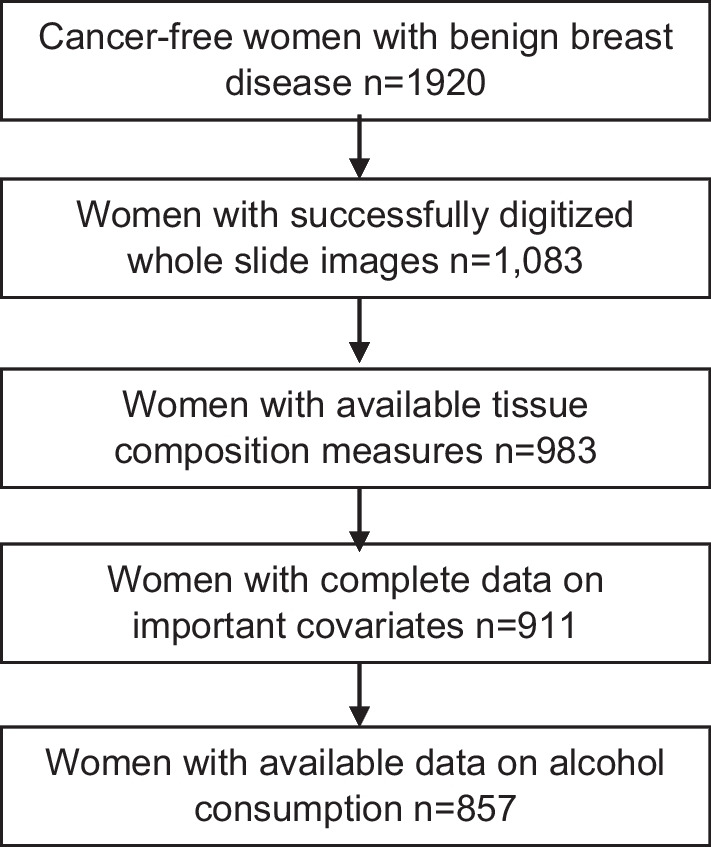
We included 857 cancer-free women with biopsy-confirmed benign breast disease within the Nurses' Health Study (NHS) and NHSII cohorts. Percentage of each tissue was measured on whole slide images using a deep-learning algorithm and then log-transformed. Alcohol consumption (recent and cumulative average) was assessed with semi-quantitative food frequency questionnaires. Regression estimates were adjusted for known breast cancer risk factors. All tests were 2-sided.
Alcohol was inversely associated with % of stroma and fibroglandular tissue (recent ≥ 22 g/day vs. none: stroma: β = - 0.08, 95% Confidence Interval [CI] - 0.13; - 0.03; fibroglandular: β = - 0.08, 95% CI - 0.13; - 0.04; cumulative ≥ 22 g/day vs. none: stroma: β = - 0.08, 95% CI - 0.13; - 0.02; fibroglandular: β = - 0.09, 95% CI - 0.14; - 0.04) and positively associated with fat % (recent ≥ 22 g/day vs. none: β = 0.30, 95% CI 0.03; 0.57; cumulative ≥ 22 g/day vs. none: β = 0.32, 95% CI 0.04; 0.61). In stratified analysis, alcohol consumption was not associated with tissue measures in premenopausal women. In postmenopausal women, cumulative alcohol use was inversely associated with % of stroma and fibroglandular tissue and positively associated with fat % (≥ 22 g/day vs. none: stroma: β = - 0.16, 95% CI - 0.28; - 0.07; fibroglandular: β = - 0.18, 95% CI - 0.28; - 0.07; fat: β = 0.61, 95% CI 0.01; 1.22), with similar results for recent alcohol use.
Our findings suggest that alcohol consumption is associated with smaller % of stroma and fibroglandular tissue and a greater % of fat in postmenopausal women. Future studies are warranted to confirm our findings and to elucidate the underlying biological mechanisms.
我们研究了酒精与良性乳腺活检样本中上皮细胞、基质、纤维-腺体组织(上皮+基质)和脂肪的百分比之间的关联。
我们纳入了来自护士健康研究(NHS)和 NHSII 队列的 857 名癌症阴性、经活检证实患有良性乳腺疾病的女性。使用深度学习算法在全切片图像上测量每种组织的百分比,然后对其进行对数转换。使用半定量食物频率问卷评估酒精摄入量(近期和累积平均)。回归估计值调整了已知的乳腺癌风险因素。所有检验均为双侧检验。
酒精与基质和纤维-腺体组织的百分比呈负相关(近期≥22 g/天与无摄入:基质:β=-0.08,95%置信区间[CI]:-0.13;-0.03;纤维-腺体:β=-0.08,95% CI:-0.13;-0.04;累积≥22 g/天与无摄入:基质:β=-0.08,95% CI:-0.13;-0.02;纤维-腺体:β=-0.09,95% CI:-0.14;-0.04),与脂肪百分比呈正相关(近期≥22 g/天与无摄入:β=0.30,95% CI:0.03;0.57;累积≥22 g/天与无摄入:β=0.32,95% CI:0.04;0.61)。在分层分析中,酒精摄入与绝经前妇女的组织指标无关。在绝经后妇女中,累积饮酒量与基质和纤维-腺体组织的百分比呈负相关,与脂肪百分比呈正相关(近期≥22 g/天与无摄入:基质:β=-0.16,95% CI:-0.28;-0.07;纤维-腺体:β=-0.18,95% CI:-0.28;-0.07;脂肪:β=0.61,95% CI:0.01;1.22),近期饮酒也有类似结果。
我们的研究结果表明,酒精摄入与绝经后妇女中基质和纤维-腺体组织的比例较小、脂肪比例较大有关。未来的研究需要证实我们的发现,并阐明潜在的生物学机制。