Perez Serge, Makshakova Olga, Angulo Jesus, Bedini Emiliano, Bisio Antonella, de Paz Jose Luis, Fadda Elisa, Guerrini Marco, Hricovini Michal, Hricovini Milos, Lisacek Frederique, Nieto Pedro M, Pagel Kevin, Paiardi Giulia, Richter Ralf, Samsonov Sergey A, Vivès Romain R, Nikitovic Dragana, Ricard Blum Sylvie
Centre de Recherche sur les Macromolecules, Vegetales, University of Grenoble-Alpes, Centre National de la Recherche Scientifique, Grenoble F-38041 France.
FRC Kazan Scientific Center of Russian Academy of Sciences, Kazan Institute of Biochemistry and Biophysics, Kazan 420111, Russia.
JACS Au. 2023 Mar 2;3(3):628-656. doi: 10.1021/jacsau.2c00569. eCollection 2023 Mar 27.
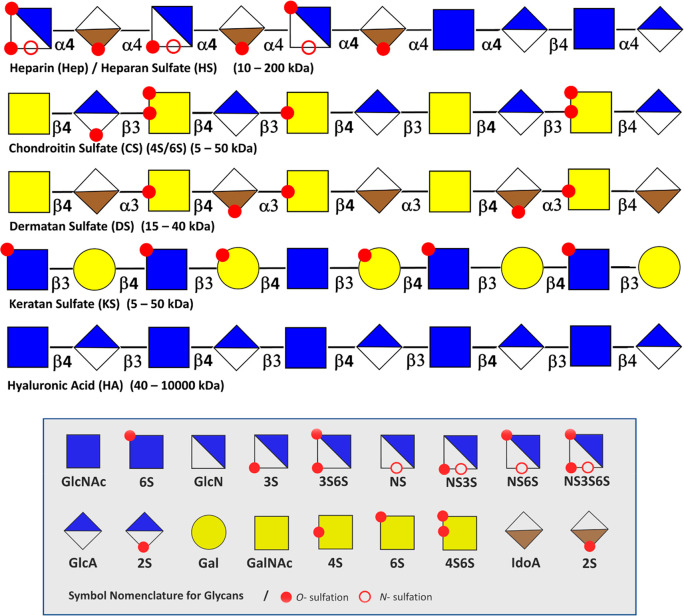
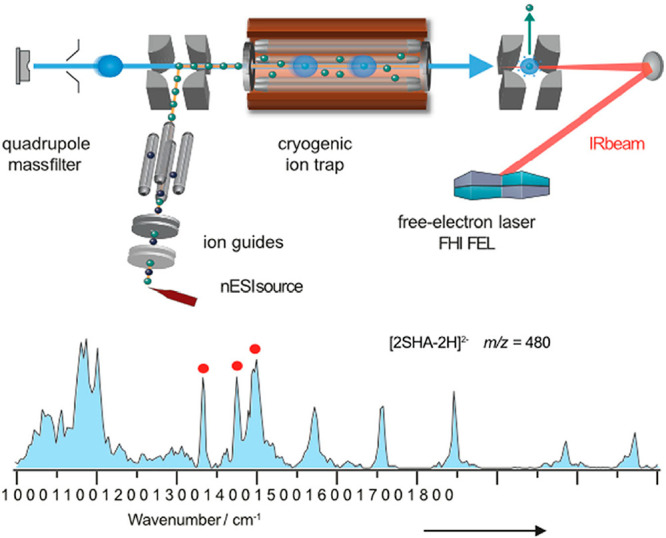
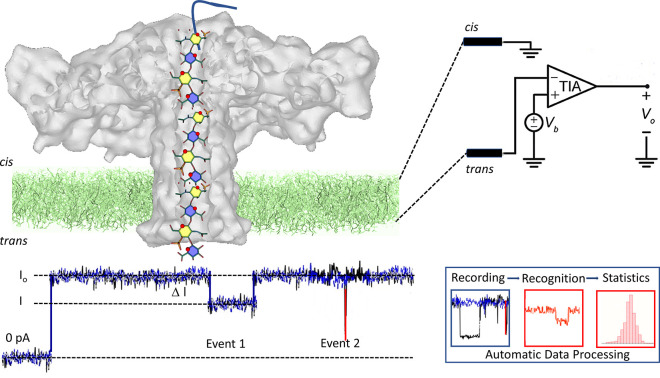
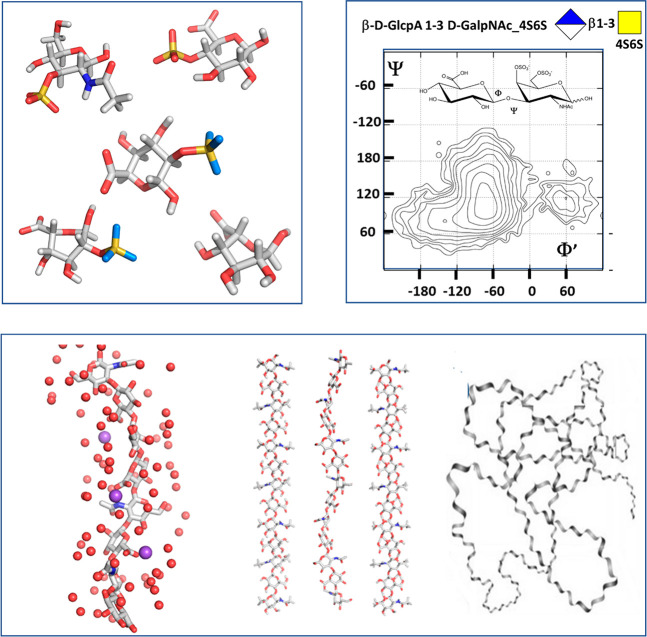
Glycosaminoglycans (GAGs) are complex polysaccharides exhibiting a vast structural diversity and fulfilling various functions mediated by thousands of interactions in the extracellular matrix, at the cell surface, and within the cells where they have been detected in the nucleus. It is known that the chemical groups attached to GAGs and GAG conformations comprise "glycocodes" that are not yet fully deciphered. The molecular context also matters for GAG structures and functions, and the influence of the structure and functions of the proteoglycan core proteins on sulfated GAGs and vice versa warrants further investigation. The lack of dedicated bioinformatic tools for mining GAG data sets contributes to a partial characterization of the structural and functional landscape and interactions of GAGs. These pending issues will benefit from the development of new approaches reviewed here, namely (i) the synthesis of GAG oligosaccharides to build large and diverse GAG libraries, (ii) GAG analysis and sequencing by mass spectrometry (, ion mobility-mass spectrometry), gas-phase infrared spectroscopy, recognition tunnelling nanopores, and molecular modeling to identify bioactive GAG sequences, biophysical methods to investigate binding interfaces, and to expand our knowledge and understanding of glycocodes governing GAG molecular recognition, and (iii) artificial intelligence for in-depth investigation of GAGomic data sets and their integration with proteomics.
糖胺聚糖(GAGs)是复杂的多糖,具有巨大的结构多样性,并在细胞外基质、细胞表面以及已在细胞核中检测到它们的细胞内,通过数千种相互作用发挥各种功能。已知附着在GAGs上的化学基团和GAG构象构成了尚未完全破译的“糖密码”。分子环境对GAG的结构和功能也很重要,蛋白聚糖核心蛋白的结构和功能对硫酸化GAGs的影响以及反之亦然,值得进一步研究。缺乏用于挖掘GAG数据集的专用生物信息学工具导致对GAG的结构、功能格局及其相互作用的部分表征。这些悬而未决的问题将受益于本文所综述的新方法的发展,即(i)合成GAG寡糖以构建大型多样的GAG文库,(ii)通过质谱(、离子淌度-质谱)、气相红外光谱、识别隧穿纳米孔和分子建模对GAG进行分析和测序,以识别生物活性GAG序列、研究结合界面的生物物理方法,并扩展我们对控制GAG分子识别的糖密码的认识和理解,以及(iii)利用人工智能深入研究GAG组学数据集及其与蛋白质组学的整合。