Martín-Chinea K, Ortega J, Gómez-González J F, Pereda E, Toledo J, Acosta L
Department of Industrial Engineering, University of La Laguna, 38071 San Cristóbal de La Laguna, Tenerife Spain.
Department of Computer and Systems Engineering, University of La Laguna, 38071 San Cristóbal de La Laguna, Tenerife Spain.
Cogn Neurodyn. 2023 Apr;17(2):385-398. doi: 10.1007/s11571-022-09832-z. Epub 2022 Jul 1.
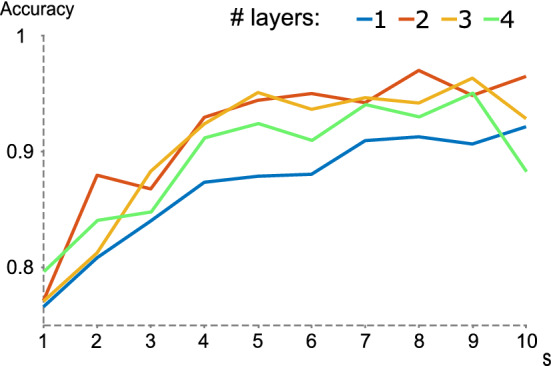
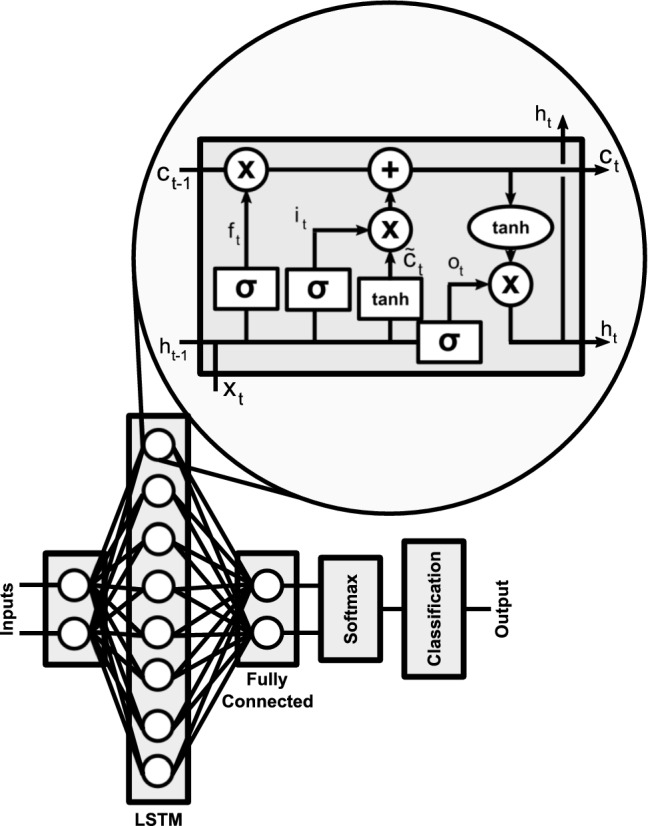
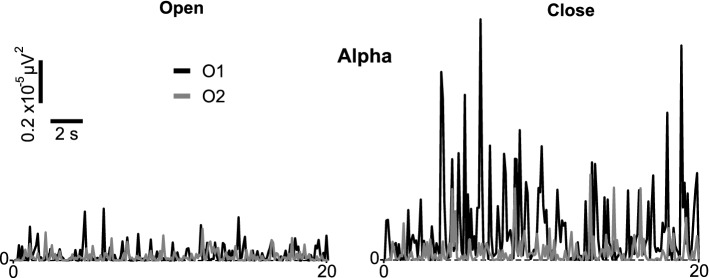
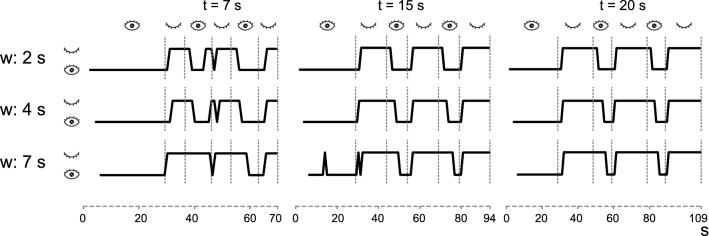
People with impaired motor function could be helped by an effective brain-computer interface (BCI) based on a real-time electroencephalogram (EEG) and artificial intelligence algorithms. However, current methodologies for interpreting patient instructions from an EEG are not accurate enough to be completely safe in a real-world situation , where a poor decision would place their physical integrity at risk, such as when traveling in an electric wheelchair in a city. For various reasons, such as the low signal-to-noise ratio of portable EEGs or the effects of signal contamination (disturbances due to user movement, temporal variation of the features of EEG signals, etc.), a long short-term memory network (LSTM) (a type of recurrent neural network) that is able to learn data flow patterns from EEG signals could improve the classification of the actions taken by the user. In this paper, the effectiveness of using an LSTM with a low-cost wireless EEG device in real time is tested, and the time window that maximizes its classification accuracy is studied. The goal is to be able to implement it in the BCI of a smart wheelchair with a simple coded command protocol, such as opening or closing the eyes, which could be executed by patients with reduced mobility. Results show a higher resolution of the LSTM with an accuracy range between 77.61 and 92.14% compared to traditional classifiers (59.71%), and an optimal time window of around 7 s for the task done by users in this work. In addition, tests in real-life contexts show that a trade-off between accuracy and response times is necessary to ensure detection.
基于实时脑电图(EEG)和人工智能算法的有效脑机接口(BCI)可以帮助运动功能受损的人。然而,目前从脑电图解读患者指令的方法在现实世界中不够准确,无法完全确保安全,在现实世界中,一个错误的决定可能会危及他们的身体安全,比如在城市中乘坐电动轮椅出行时。由于各种原因,如便携式脑电图的低信噪比或信号污染的影响(用户移动引起的干扰、脑电图信号特征的时间变化等),能够从脑电图信号中学习数据流模式的长短期记忆网络(LSTM,一种循环神经网络)可以改善对用户所采取行动的分类。在本文中,测试了实时使用低成本无线脑电图设备的LSTM的有效性,并研究了使其分类准确率最大化的时间窗口。目标是能够在具有简单编码命令协议(如睁开或闭上眼睛)的智能轮椅的BCI中实现它,行动不便的患者可以执行这些命令。结果表明,与传统分类器(59.71%)相比,LSTM具有更高的分辨率,准确率在77.61%至92.14%之间,并且在这项工作中用户完成任务的最佳时间窗口约为7秒。此外,在现实生活环境中的测试表明,为了确保检测,有必要在准确率和响应时间之间进行权衡。