Department of Psychiatry, University of Oxford, Oxford, UK.
Oxford Health NHS Foundation Trust, Oxford, UK.
Psychol Med. 2023 Mar;53(4):1233-1243. doi: 10.1017/S0033291721002713. Epub 2021 Aug 23.
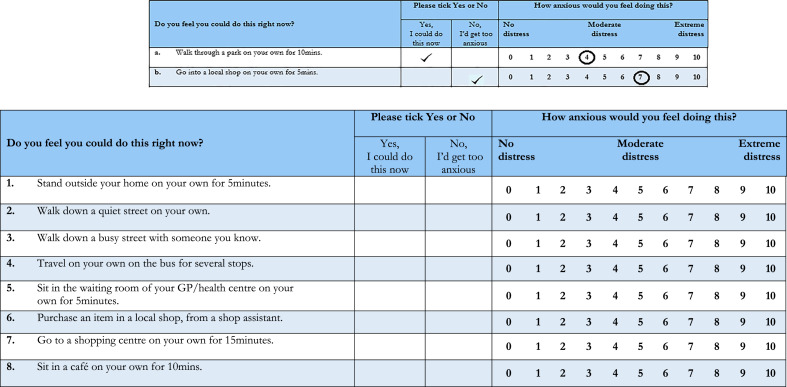
Agoraphobic avoidance of everyday situations is a common feature in many mental health disorders. Avoidance can be due to a variety of fears, including concerns about negative social evaluation, panicking, and harm from others. The result is inactivity and isolation. Behavioural avoidance tasks (BATs) provide an objective assessment of avoidance and anxiety but are challenging to administer and lack standardisation. Our aim was to draw on the principles of BATs to develop a self-report measure of agoraphobia symptoms.
The scale was developed with 194 patients with agoraphobia in the context of psychosis, 427 individuals in the general population with high levels of agoraphobia, and 1094 individuals with low levels of agoraphobia. Factor analysis, item response theory, and receiver operating characteristic analyses were used. Validity was assessed against a BAT, actigraphy data, and an existing agoraphobia measure. Test-retest reliability was assessed with 264 participants.
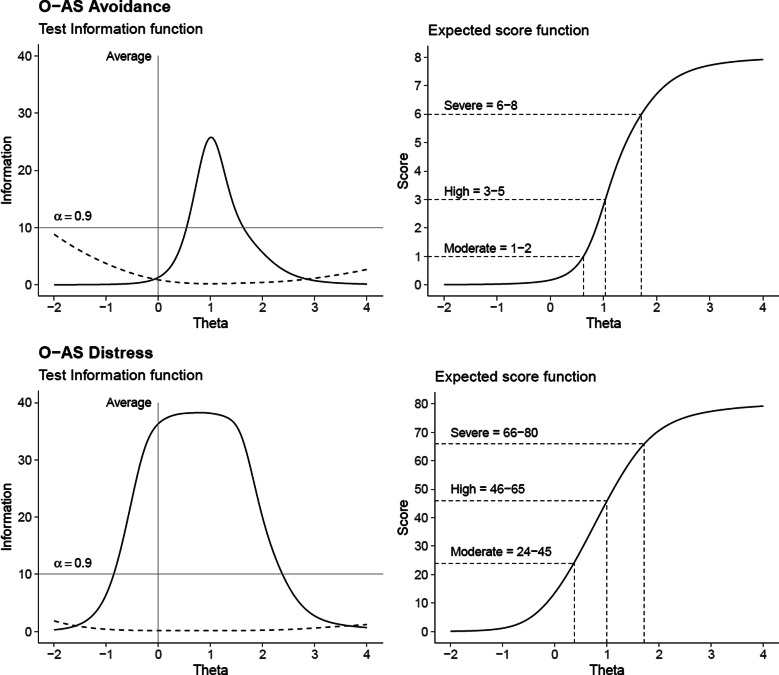
An eight-item questionnaire with avoidance and distress response scales was developed. The avoidance and distress scales each had an excellent model fit and reliably assessed agoraphobic symptoms across the severity spectrum. All items were highly discriminative (avoidance: = 1.24-5.43; distress: = 1.60-5.48), indicating that small increases in agoraphobic symptoms led to a high probability of item endorsement. The scale demonstrated good internal reliability, test-retest reliability, and validity.
The Oxford Agoraphobic Avoidance Scale has excellent psychometric properties. Clinical cut-offs and score ranges are provided. This precise assessment tool may help focus attention on the clinically important problem of agoraphobic avoidance.
广场恐惧症患者会回避日常生活中的各种情境,这是许多精神健康障碍的常见特征。回避可能源于各种恐惧,包括对负面社会评价、恐慌和他人伤害的担忧。其结果是活动减少和孤立。行为回避任务(BATs)提供了回避和焦虑的客观评估,但实施起来具有挑战性,且缺乏标准化。我们的目标是借鉴 BATs 的原理,开发一种广场恐惧症症状的自我报告量表。
该量表是在精神病患者中的 194 名广场恐惧症患者、高广场恐惧症水平的 427 名普通人群个体和低广场恐惧症水平的 1094 名个体的背景下开发的。采用因子分析、项目反应理论和受试者工作特征分析。通过与 BAT、活动记录仪数据和现有的广场恐惧症量表进行对比来评估其有效性。使用 264 名参与者评估重测信度。
开发了一个包含回避和痛苦反应量表的八分量表。回避和痛苦量表都具有极好的模型拟合度,可靠地评估了整个严重程度范围内的广场恐惧症症状。所有项目的区分度都很高(回避: = 1.24-5.43;痛苦: = 1.60-5.48),表明广场恐惧症症状的微小增加会导致项目高度认可的可能性很高。该量表具有良好的内部信度、重测信度和有效性。
牛津广场恐惧症回避量表具有极好的心理测量学特性。提供了临床切点和分数范围。这种精确的评估工具可能有助于将注意力集中在回避这一重要的临床问题上。