Cyrus Tang Hematology Center, Soochow University, Suzhou, China.
Institute of Clinical Medicine Research, Suzhou Science & Technology Town Hospital, Gusu School, Nanjing Medical University, Suzhou, China.
Elife. 2023 Apr 3;12:e80479. doi: 10.7554/eLife.80479.
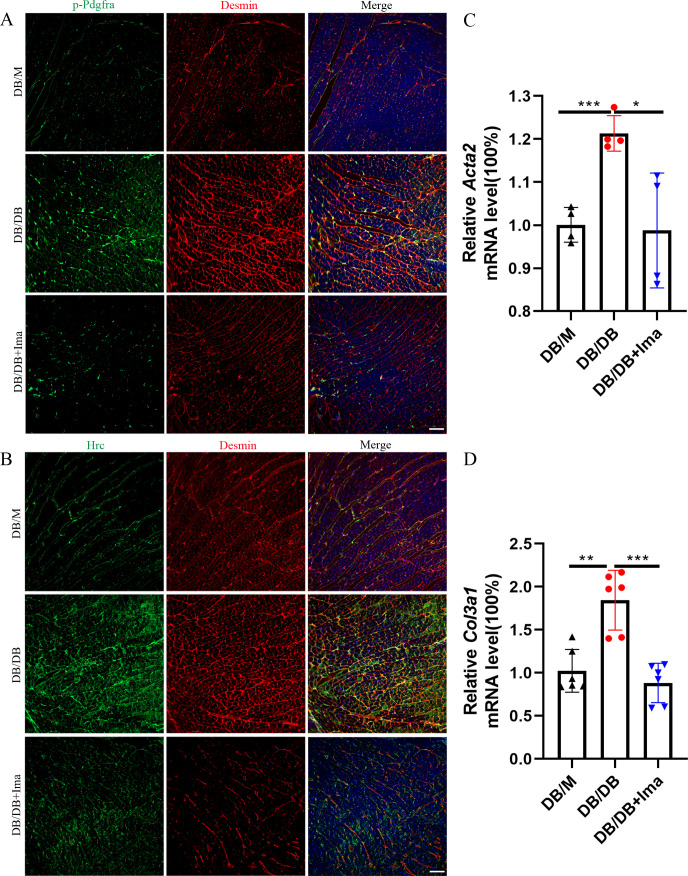
Myocardial fibrosis is the characteristic pathology of diabetes-induced cardiomyopathy. Therefore, an in-depth study of cardiac heterogeneity and cell-to-cell interactions can help elucidate the pathogenesis of diabetic myocardial fibrosis and identify treatment targets for the treatment of this disease. In this study, we investigated intercellular communication drivers of myocardial fibrosis in mouse heart with high-fat-diet/streptozotocin-induced diabetes at single-cell resolution. Intercellular and protein-protein interaction networks of fibroblasts and macrophages, endothelial cells, as well as fibroblasts and epicardial cells revealed critical changes in ligand-receptor interactions such as Pdgf(s)-Pdgfra and Efemp1-Egfr, which promote the development of a profibrotic microenvironment during the progression of and confirmed that the specific inhibition of the Pdgfra axis could significantly improve diabetic myocardial fibrosis. We also identified phenotypically distinct and fibroblast subpopulations associated with pathological extracellular matrix remodeling, of which the fibroblasts were found to be the most profibrogenic under diabetic conditions. Finally, we validated the role of the hub gene-mediated intercellular communication drivers of diabetic myocardial fibrosis in fibroblasts, and confirmed the results through AAV9-mediated knockdown in the heart of diabetic mice. In summary, cardiac cell mapping provides novel insights into intercellular communication drivers involved in pathological extracellular matrix remodeling during diabetic myocardial fibrosis.
心肌纤维化是糖尿病性心肌病的特征性病理学改变。因此,深入研究心脏异质性和细胞间相互作用有助于阐明糖尿病性心肌纤维化的发病机制,并确定治疗这种疾病的治疗靶点。在这项研究中,我们在单细胞分辨率下研究了高脂肪饮食/链脲佐菌素诱导的糖尿病小鼠心脏中细胞间通讯驱动心肌纤维化的机制。成纤维细胞和巨噬细胞、内皮细胞以及成纤维细胞和心外膜细胞的细胞间和蛋白-蛋白相互作用网络揭示了配体-受体相互作用的关键变化,如 Pdgf(s)-Pdgfra 和 Efemp1-Egfr,这些变化促进了糖尿病心肌纤维化进展过程中促纤维化微环境的发展,并证实了 Pdgfra 轴的特异性抑制可显著改善糖尿病性心肌纤维化。我们还鉴定了与病理性细胞外基质重塑相关的表型不同的成纤维细胞亚群,其中在糖尿病条件下, 成纤维细胞被发现是最具成纤维原性的。最后,我们验证了糖尿病心肌纤维化中 成纤维细胞中 基因介导的细胞间通讯驱动因子的作用,并通过在糖尿病小鼠心脏中使用 AAV9 介导的 基因敲低来证实了这一结果。总之,心脏细胞图谱为糖尿病性心肌纤维化过程中涉及病理性细胞外基质重塑的细胞间通讯驱动因素提供了新的见解。