Epilepsy Center, Neurocenter, University Medical Center, University of Freiburg, Freiburg, Germany.
NeuroModul Basic, University of Freiburg, Freiburg, Germany.
JAMA Neurol. 2023 Jun 1;80(6):588-596. doi: 10.1001/jamaneurol.2023.0066.
For the large population of people with drug-refractory epilepsy, alternative treatment approaches are needed. Clinical trial outcomes of a novel stimulation device, which is newly available in Europe for the treatment of patients with a predominant seizure focus, are reported for the first time.
To perform a pooled analysis of the results of 2 prospective, multicenter, single-arm trials, A Pilot Study to Assess the Feasibility of Neurostimulation With the EASEE System to Treat Medically Refractory Focal Epilepsy (EASEE II) and A Pilot Study to Assess the Feasibility of Patient-Controlled Neurostimulation With the EASEE System to Treat Medically Refractory Focal Epilepsy (PIMIDES I), assessing the safety and efficacy of epicranial focal cortex stimulation (FCS) with a novel implantable device (EASEE [Precisis]) as adjunctive treatment for adult patients with drug-refractory focal epilepsy.
DESIGN, SETTING, AND PARTICIPANTS: This study was a pooled analysis of 2 nonrandomized uncontrolled trials, EASEE II and PIMIDES I, which began on January 15, 2019, and January 14, 2020, respectively, and ended on July 28, 2021. EASEE II and PIMIDES I were the first in-human, prospective, single-arm trials with an 8-month evaluation period. Patients were recruited at 7 European epilepsy centers. Consecutive participants with drug-refractory focal epilepsy were enrolled. Study data were analyzed from September 29, 2021, to February 2, 2022.
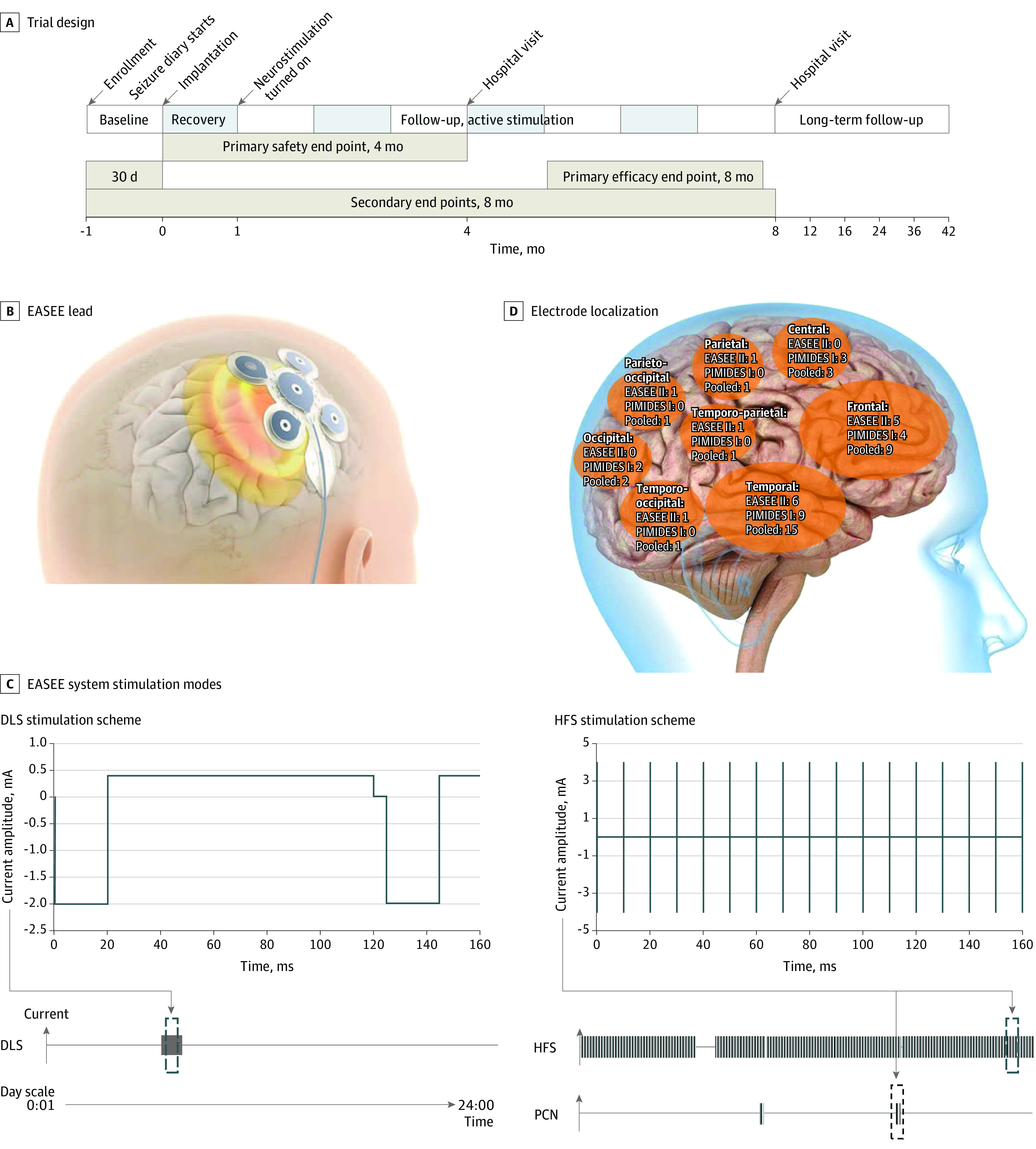
After a 1-month prospective baseline period, patients were implanted with the neurostimulation device. After a 1-month postimplantation recovery period, unblinded FCS was activated using both high-frequency and direct current (DC)-like components performed via electrode arrays placed epicranially above the individual epileptic focus region.
Efficacy was prospectively assessed by the responder rate in the sixth month of stimulation compared with baseline; safety and additional end points were assessed after device implantation and during the stimulation period.
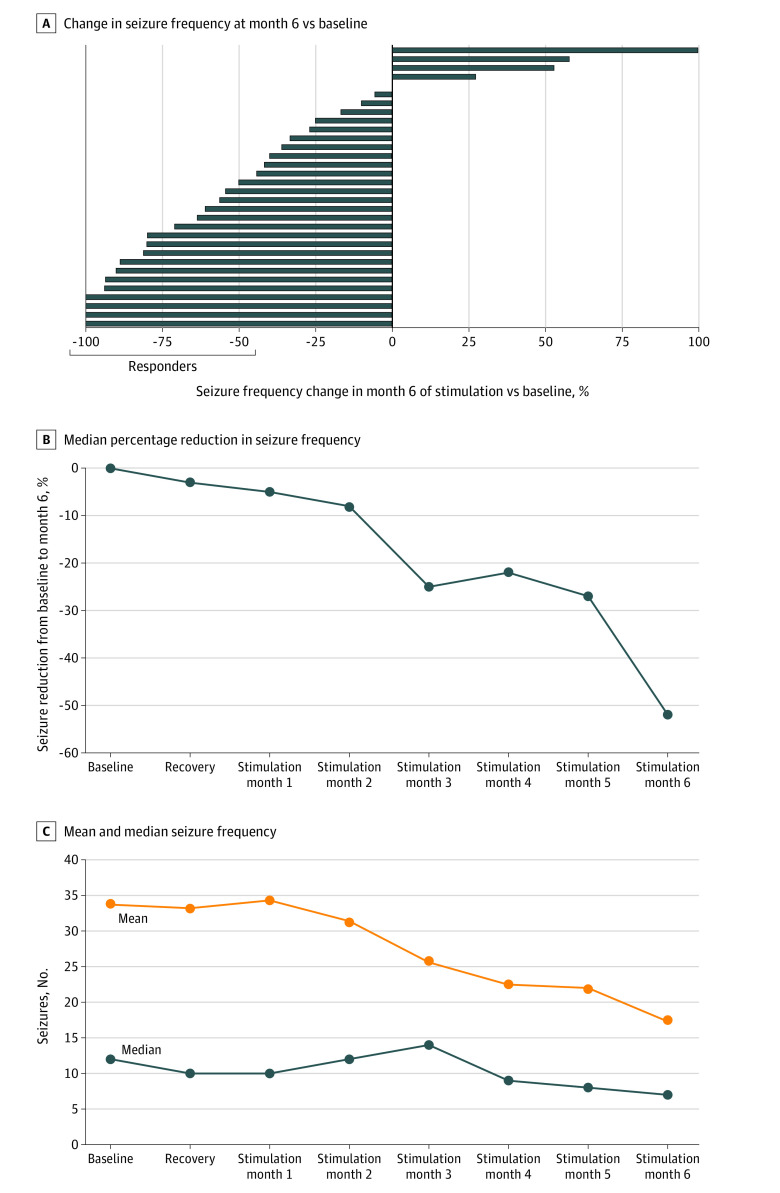
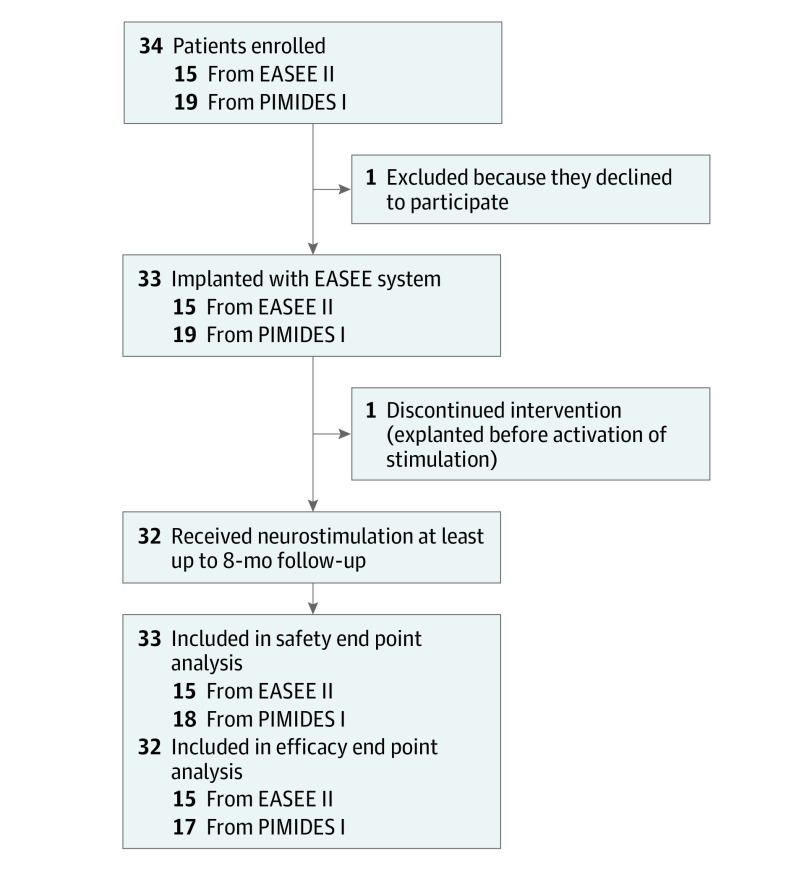
Of the 34 adult patients enrolled at 6 German and 1 Belgian investigational site, 33 (mean [SD] age, 34.6 [13.5] years; 18 male patients [54.5%]) received the neurostimulation device implant. A total of 32 patients underwent combined high-frequency direct current-like stimulation at least until the 8-month postimplant follow-up visit. After 6 months of stimulation, 17 of 32 patients (53.1%) were responders to treatment with at least a 50% reduction in seizure frequency compared with baseline, corresponding to a significant median seizure reduction by 52% (95% CI, 0.37%-0.76%; P < .001). No device- or procedure-related serious adverse events were reported (0; 95% CI, 0%-10.58%). There were no significant alterations in cognition, mood, or overall quality of life.
Results of this pooled analysis of 2 nonrandomized uncontrolled trials suggest that FCS with a novel neurostimulation device was associated with an effective reduction in seizure frequency in patients with drug-refractory focal epilepsy and may offer a promising treatment option for patients with a predominant epileptic focus.
German Clinical Trials Register: DRKS00015918 and DRKS00017833, respectively, and jointly under PROSPERO: CRD42021266440.
对于大量药物难治性癫痫患者,需要寻求替代治疗方法。本文首次报道了一种新型刺激设备的临床试验结果,该设备在欧洲新推出,用于治疗以主要癫痫灶为特征的患者。
对两项前瞻性、多中心、单臂试验的结果进行汇总分析,评估新型可植入设备(EASEE [Precisis])的颅外皮层刺激(FCS)在成人药物难治性局灶性癫痫患者中的辅助治疗的安全性和有效性。这两项试验分别为评估新型植入式设备(EASEE)辅助治疗药物难治性局灶性癫痫的可行性的 Pilot Study to Assess the Feasibility of Neurostimulation With the EASEE System to Treat Medically Refractory Focal Epilepsy(EASEE II)和 Pilot Study to Assess the Feasibility of Patient-Controlled Neurostimulation With the EASEE System to Treat Medically Refractory Focal Epilepsy(PIMIDES I)。
设计、地点和参与者:本研究是对两项非随机对照试验(EASEE II 和 PIMIDES I)的汇总分析,两项试验分别于 2019 年 1 月 15 日和 2020 年 1 月 14 日开始,于 2021 年 7 月 28 日结束。EASEE II 和 PIMIDES I 是首例为期 8 个月评估期的人体、前瞻性、单臂试验。在 7 家欧洲癫痫中心招募患者。连续招募药物难治性局灶性癫痫患者。研究数据于 2021 年 9 月 29 日至 2022 年 2 月 2 日进行分析。
在为期 1 个月的前瞻性基线期后,患者植入神经刺激装置。在植入后 1 个月的恢复期后,通过放置在个体癫痫灶区域上方的颅外电极阵列,使用高频和类似直流电(DC)成分,对 FCS 进行非盲激活。
根据第六个月的刺激反应率与基线相比,前瞻性评估疗效;在装置植入后和刺激期间评估安全性和其他终点。
在 6 家德国和 1 家比利时研究机构共纳入 34 名成年患者,其中 33 名(平均[标准差]年龄,34.6[13.5]岁;18 名男性患者[54.5%])接受了神经刺激装置植入。共有 32 名患者至少进行了 8 个月的植入后随访,联合使用高频类似直流电刺激。在刺激 6 个月后,32 名患者中有 17 名(53.1%)的癫痫发作频率减少至少 50%,与基线相比有显著的中位数癫痫发作减少 52%(95%CI,0.37%-0.76%;P<0.001)。未报告与设备或程序相关的严重不良事件(0;95%CI,0%-10.58%)。认知、情绪或整体生活质量没有明显变化。
这两项非随机对照试验的汇总分析结果表明,新型神经刺激装置的 FCS 与药物难治性局灶性癫痫患者的癫痫发作频率有效降低相关,可能为以主要癫痫灶为特征的患者提供一种有前途的治疗选择。
德国临床试验注册处:DRKS00015918 和 DRKS00017833,分别注册,并通过 PROSPERO 联合注册:CRD42021266440。