Harms Nathan E, Knight Ian A, DeRossette A Blake, Williams Dean A
Aquatic Ecology and Invasive Species Branch US Army Engineer Research and Development Center 201 E. Jones St. Lewisville Texas 75057 USA.
Aquatic Ecology and Invasive Species Branch US Army Engineer Research and Development Center 3909 Halls Ferry Rd. Vicksburg Mississippi 39180 USA.
Ecol Evol. 2023 Mar 31;13(4):e9966. doi: 10.1002/ece3.9966. eCollection 2023 Apr.
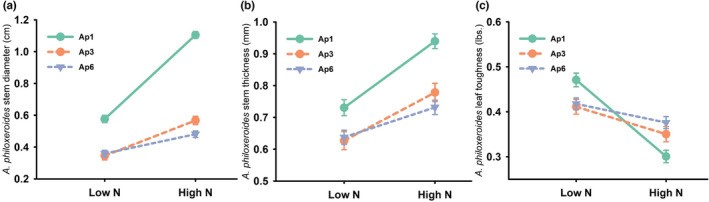
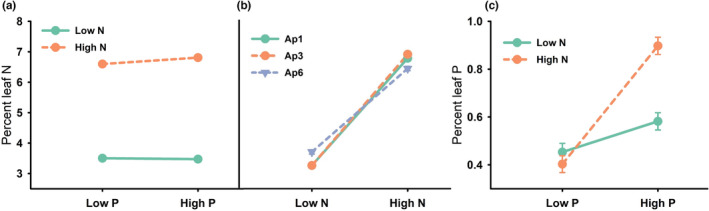
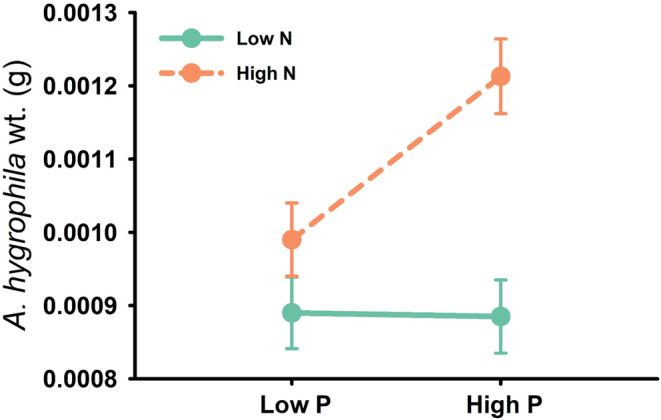
Interactions between invaders and resource availability may explain variation in their success or management efficacy. For widespread invaders, regional variation in plant response to nutrients can reflect phenotypic plasticity of the invader, genetic structure of invading populations, or a combination of the two. The wetland weed (alligatorweed) is established throughout the southeastern United States and California and has high genetic diversity despite primarily spreading clonally. Despite its history in the United States, the role of genetic variation for invasion and management success is only now being uncovered. To better understand how nutrients and genotype may influence invasion, we measured the response of plants from 26 populations (three cp haplotypes) to combinations of nitrogen (4 or 200 mg/L N) and phosphorus (0.4 or 40 mg/L P). We measured productivity (biomass accumulation and allocation), plant architecture (stem diameter and thickness, branching intensity), and foliar traits (toughness, dry matter content, percent N, and percent P). A short-term developmental assay was also conducted by feeding a subset of plants from the nutrient experiment to the biological control agent , to determine whether increased availability of N or P to its host influenced agent performance, as has been previously suggested. haplotype Ap1 was more plastic than other haplotypes in response to nutrient amendments, producing more than double the biomass from low to high N and 50%-68% higher shoot: root ratio than other haplotypes in the high N treatment. haplotypes differed in seven of 10 variables in response to increased N. We found no differences in short-term development between haplotypes but mass was 23% greater in high than low N treatments. This study is the first to explore the interplay between nutrient availability, genetic variation, and phenotypic plasticity in invasive characteristics of the global invader, .
入侵者与资源可用性之间的相互作用可能解释了它们成功与否或管理效果的差异。对于广泛分布的入侵者来说,植物对养分反应的区域差异可能反映了入侵者的表型可塑性、入侵种群的遗传结构,或两者的结合。湿地杂草(空心莲子草)在美国东南部和加利福尼亚州均有分布,尽管主要通过克隆繁殖,但仍具有较高的遗传多样性。尽管空心莲子草在美国已有一定历史,但遗传变异在其入侵和管理成功中所起的作用直到现在才被发现。为了更好地理解养分和基因型如何影响入侵,我们测量了来自26个种群(三种叶绿体单倍型)的植物对氮(4或200mg/L N)和磷(0.4或40mg/L P)组合的反应。我们测量了生产力(生物量积累和分配)、植物结构(茎直径和厚度、分枝强度)和叶片性状(韧性、干物质含量、氮含量百分比和磷含量百分比)。还通过将养分实验中的一部分植物投喂给生物防治剂进行了一项短期发育试验,以确定宿主植物中氮或磷可用性的增加是否如先前所表明的那样影响防治剂的性能。单倍型Ap1在对养分改良的反应中比其他单倍型更具可塑性,从低氮到高氮条件下产生的生物量增加了一倍多,在高氮处理中,其地上部与地下部的比值比其他单倍型高50%-68%。在对增加的氮的反应中,10个变量中有7个单倍型存在差异。我们发现单倍型之间在短期发育上没有差异,但高氮处理下的质量比低氮处理高23%。本研究首次探讨了养分可用性、遗传变异和表型可塑性在全球入侵者空心莲子草入侵特征中的相互作用。