• 文献检索
  • 文档翻译
  • 深度研究
  • 学术资讯
  • Suppr Zotero 插件Zotero 插件
  • 邀请有礼
  • 套餐&价格
  • 历史记录
应用&插件
Suppr Zotero 插件Zotero 插件浏览器插件Mac 客户端Windows 客户端微信小程序
定价
高级版会员购买积分包购买API积分包
服务
文献检索文档翻译深度研究API 文档MCP 服务
关于我们
关于 Suppr公司介绍联系我们用户协议隐私条款
关注我们

Suppr 超能文献

核心技术专利:CN118964589B侵权必究
粤ICP备2023148730 号-1Suppr @ 2026

文献检索

告别复杂PubMed语法,用中文像聊天一样搜索,搜遍4000万医学文献。AI智能推荐,让科研检索更轻松。

立即免费搜索

文件翻译

保留排版,准确专业,支持PDF/Word/PPT等文件格式,支持 12+语言互译。

免费翻译文档

深度研究

AI帮你快速写综述,25分钟生成高质量综述,智能提取关键信息,辅助科研写作。

立即免费体验

BCR-Net:一种从组织病理学图像预测乳腺癌复发的深度学习框架。

BCR-Net: A deep learning framework to predict breast cancer recurrence from histopathology images.

机构信息

Center for Biomedical Informatics, Wake Forest School of Medicine, Winston-Salem, North Carolina, United States of America.

Department of Pathology, Wake Forest University School of Medicine, Winston-Salem, North Carolina, United States of America.

出版信息

PLoS One. 2023 Apr 4;18(4):e0283562. doi: 10.1371/journal.pone.0283562. eCollection 2023.

DOI:10.1371/journal.pone.0283562
PMID:37014891
原文链接:https://pmc.ncbi.nlm.nih.gov/articles/PMC10072418/
Abstract

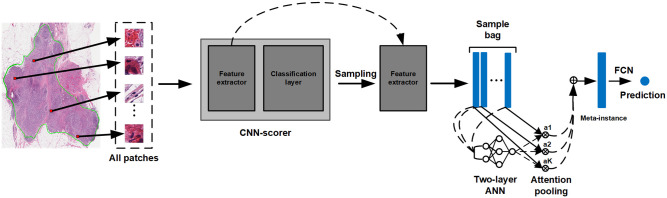
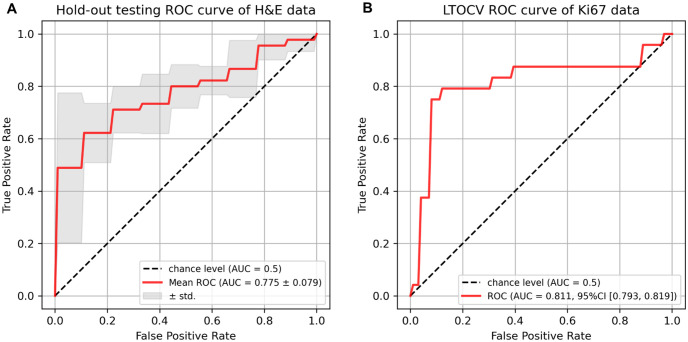
Breast cancer is the most common malignancy in women, with over 40,000 deaths annually in the United States alone. Clinicians often rely on the breast cancer recurrence score, Oncotype DX (ODX), for risk stratification of breast cancer patients, by using ODX as a guide for personalized therapy. However, ODX and similar gene assays are expensive, time-consuming, and tissue destructive. Therefore, developing an AI-based ODX prediction model that identifies patients who will benefit from chemotherapy in the same way that ODX does would give a low-cost alternative to the genomic test. To overcome this problem, we developed a deep learning framework, Breast Cancer Recurrence Network (BCR-Net), which automatically predicts ODX recurrence risk from histopathology slides. Our proposed framework has two steps. First, it intelligently samples discriminative features from whole-slide histopathology images of breast cancer patients. Then, it automatically weights all features through a multiple instance learning model to predict the recurrence score at the slide level. On a dataset of H&E and Ki67 breast cancer resection whole slides images (WSIs) from 99 anonymized patients, the proposed framework achieved an overall AUC of 0.775 (68.9% and 71.1% accuracies for low and high risk) on H&E WSIs and overall AUC of 0.811 (80.8% and 79.2% accuracies for low and high risk) on Ki67 WSIs of breast cancer patients. Our findings provide strong evidence for automatically risk-stratify patients with a high degree of confidence. Our experiments reveal that the BCR-Net outperforms the state-of-the-art WSI classification models. Moreover, BCR-Net is highly efficient with low computational needs, making it practical to deploy in limited computational settings.

摘要

乳腺癌是女性最常见的恶性肿瘤,仅在美国每年就有超过 4 万人因此死亡。临床医生通常依赖乳腺癌复发评分(Oncotype DX,ODX)对乳腺癌患者进行风险分层,将 ODX 作为个性化治疗的指南。然而,ODX 和类似的基因检测既昂贵又耗时,且具有组织破坏性。因此,开发一种基于人工智能的 ODX 预测模型,以与 ODX 相同的方式识别将从化疗中受益的患者,这将为基因检测提供一种低成本的替代方法。为了解决这个问题,我们开发了一个深度学习框架,称为乳腺癌复发网络(BCR-Net),它可以自动从乳腺癌患者的全切片组织病理学图像中预测 ODX 复发风险。我们提出的框架有两个步骤。首先,它从乳腺癌患者的全切片组织病理学图像中智能地采样有鉴别力的特征。然后,它通过多实例学习模型自动对所有特征进行加权,以预测幻灯片级别的复发评分。在来自 99 名匿名患者的 H&E 和 Ki67 乳腺癌切除全切片图像(WSI)数据集上,该框架在 H&E WSI 上的总体 AUC 为 0.775(低风险和高风险的准确率分别为 68.9%和 71.1%),在 Ki67 WSI 上的总体 AUC 为 0.811(低风险和高风险的准确率分别为 80.8%和 79.2%)。我们的研究结果为自动对患者进行高可信度的风险分层提供了有力的证据。我们的实验表明,BCR-Net 优于最先进的 WSI 分类模型。此外,BCR-Net 效率很高,计算需求低,在计算资源有限的情况下很实用。
https://cdn.ncbi.nlm.nih.gov/pmc/blobs/f6bb/10072418/96391d1bfcbc/pone.0283562.g013.jpg
https://cdn.ncbi.nlm.nih.gov/pmc/blobs/f6bb/10072418/73f314d6dc2a/pone.0283562.g001.jpg
https://cdn.ncbi.nlm.nih.gov/pmc/blobs/f6bb/10072418/531e16aad8ea/pone.0283562.g002.jpg
https://cdn.ncbi.nlm.nih.gov/pmc/blobs/f6bb/10072418/cb1baf0f73bb/pone.0283562.g003.jpg
https://cdn.ncbi.nlm.nih.gov/pmc/blobs/f6bb/10072418/75bcc2ab2a1d/pone.0283562.g004.jpg
https://cdn.ncbi.nlm.nih.gov/pmc/blobs/f6bb/10072418/20ac529caf69/pone.0283562.g005.jpg
https://cdn.ncbi.nlm.nih.gov/pmc/blobs/f6bb/10072418/fdd9d5b00cb2/pone.0283562.g006.jpg
https://cdn.ncbi.nlm.nih.gov/pmc/blobs/f6bb/10072418/267dbeeaba57/pone.0283562.g007.jpg
https://cdn.ncbi.nlm.nih.gov/pmc/blobs/f6bb/10072418/c879442af17e/pone.0283562.g008.jpg
https://cdn.ncbi.nlm.nih.gov/pmc/blobs/f6bb/10072418/630e874e012b/pone.0283562.g009.jpg
https://cdn.ncbi.nlm.nih.gov/pmc/blobs/f6bb/10072418/bc72a7ef8eb7/pone.0283562.g010.jpg
https://cdn.ncbi.nlm.nih.gov/pmc/blobs/f6bb/10072418/a8c1a3f5fb53/pone.0283562.g011.jpg
https://cdn.ncbi.nlm.nih.gov/pmc/blobs/f6bb/10072418/77c5090f8697/pone.0283562.g012.jpg
https://cdn.ncbi.nlm.nih.gov/pmc/blobs/f6bb/10072418/96391d1bfcbc/pone.0283562.g013.jpg
https://cdn.ncbi.nlm.nih.gov/pmc/blobs/f6bb/10072418/73f314d6dc2a/pone.0283562.g001.jpg
https://cdn.ncbi.nlm.nih.gov/pmc/blobs/f6bb/10072418/531e16aad8ea/pone.0283562.g002.jpg
https://cdn.ncbi.nlm.nih.gov/pmc/blobs/f6bb/10072418/cb1baf0f73bb/pone.0283562.g003.jpg
https://cdn.ncbi.nlm.nih.gov/pmc/blobs/f6bb/10072418/75bcc2ab2a1d/pone.0283562.g004.jpg
https://cdn.ncbi.nlm.nih.gov/pmc/blobs/f6bb/10072418/20ac529caf69/pone.0283562.g005.jpg
https://cdn.ncbi.nlm.nih.gov/pmc/blobs/f6bb/10072418/fdd9d5b00cb2/pone.0283562.g006.jpg
https://cdn.ncbi.nlm.nih.gov/pmc/blobs/f6bb/10072418/267dbeeaba57/pone.0283562.g007.jpg
https://cdn.ncbi.nlm.nih.gov/pmc/blobs/f6bb/10072418/c879442af17e/pone.0283562.g008.jpg
https://cdn.ncbi.nlm.nih.gov/pmc/blobs/f6bb/10072418/630e874e012b/pone.0283562.g009.jpg
https://cdn.ncbi.nlm.nih.gov/pmc/blobs/f6bb/10072418/bc72a7ef8eb7/pone.0283562.g010.jpg
https://cdn.ncbi.nlm.nih.gov/pmc/blobs/f6bb/10072418/a8c1a3f5fb53/pone.0283562.g011.jpg
https://cdn.ncbi.nlm.nih.gov/pmc/blobs/f6bb/10072418/77c5090f8697/pone.0283562.g012.jpg
https://cdn.ncbi.nlm.nih.gov/pmc/blobs/f6bb/10072418/96391d1bfcbc/pone.0283562.g013.jpg

相似文献

1
BCR-Net: A deep learning framework to predict breast cancer recurrence from histopathology images.BCR-Net:一种从组织病理学图像预测乳腺癌复发的深度学习框架。
PLoS One. 2023 Apr 4;18(4):e0283562. doi: 10.1371/journal.pone.0283562. eCollection 2023.
2
Quantitative nuclear histomorphometry predicts oncotype DX risk categories for early stage ER+ breast cancer.定量核组织形态计量学可预测早期 ER+ 乳腺癌的 Oncotype DX 风险类别。
BMC Cancer. 2018 May 30;18(1):610. doi: 10.1186/s12885-018-4448-9.
3
Computational Pathology for Accurate Prediction of Breast Cancer Recurrence: Development and Validation of a Deep Learning-based Tool.用于准确预测乳腺癌复发的计算病理学:基于深度学习工具的开发与验证
ArXiv. 2024 Sep 23:arXiv:2409.15491v1.
4
Correlation Between Oncotype DX, PREDICT and the Nottingham Prognostic Index: Implications for the Management of Early Breast Cancer.Oncotype DX、PREDICT与诺丁汉预后指数之间的相关性:对早期乳腺癌管理的启示
Cureus. 2020 Apr 6;12(4):e7552. doi: 10.7759/cureus.7552.
5
Correlation of Ki-67 proliferative index with oncotype DX recurrence score in hormone receptor-positive, human epidermal growth factor receptor 2-negative early breast cancer with low-burden axillary nodal disease - a review of 137 cases.Ki-67 增殖指数与激素受体阳性、人表皮生长因子受体 2 阴性、腋窝淋巴结低负荷早期乳腺癌中肿瘤复发评分的相关性——137 例回顾性研究。
Pol J Pathol. 2024;75(1):8-18. doi: 10.5114/pjp.2024.135859.
6
Quantitative nuclear histomorphometric features are predictive of Oncotype DX risk categories in ductal carcinoma in situ: preliminary findings.定量核组织形态计量学特征可预测导管原位癌的 Oncotype DX 风险类别:初步研究结果。
Breast Cancer Res. 2019 Oct 17;21(1):114. doi: 10.1186/s13058-019-1200-6.
7
Automated Tubule Nuclei Quantification and Correlation with Oncotype DX risk categories in ER+ Breast Cancer Whole Slide Images.自动肾小管核定量与 ER+乳腺癌全 slides 图像中 Oncotype DX 风险分类的相关性。
Sci Rep. 2016 Sep 7;6:32706. doi: 10.1038/srep32706.
8
How Does Invasive Breast Cancer Oncotype Dx Recurrence Score on Core Needle Biopsies Influence Neoadjuvant Treatment Decision? A Descriptive Study.核心针活检浸润性乳腺癌 Oncotype DX 复发评分如何影响新辅助治疗决策?一项描述性研究。
Technol Cancer Res Treat. 2021 Jan-Dec;20:15330338211035037. doi: 10.1177/15330338211035037.
9
Prediction of Oncotype DX recurrence score using deep multi-layer perceptrons in estrogen receptor-positive, HER2-negative breast cancer.基于深度多层感知器的雌激素受体阳性、HER2 阴性乳腺癌患者 Oncotype DX 复发评分预测。
Breast Cancer. 2020 Sep;27(5):1007-1016. doi: 10.1007/s12282-020-01100-4. Epub 2020 May 8.
10
Development of a nomogram to predict recurrence scores obtained using Oncotype DX in Japanese patients with breast cancer.开发一个列线图模型,用于预测日本乳腺癌患者使用 Oncotype DX 获得的复发评分。
Breast Cancer. 2024 Nov;31(6):1018-1027. doi: 10.1007/s12282-024-01616-z. Epub 2024 Jul 17.

引用本文的文献

1
HistoChat: Instruction-tuning multimodal vision language assistant for colorectal histopathology on limited data.HistoChat:用于有限数据上的结直肠癌组织病理学的指令微调多模态视觉语言助手。
Patterns (N Y). 2025 May 30;6(8):101284. doi: 10.1016/j.patter.2025.101284. eCollection 2025 Aug 8.
2
Deep Learning on Histopathological Images to Predict Breast Cancer Recurrence Risk and Chemotherapy Benefit.基于组织病理学图像的深度学习预测乳腺癌复发风险及化疗获益
medRxiv. 2025 May 16:2025.05.15.25327686. doi: 10.1101/2025.05.15.25327686.
3
Deep learning assessment of metastatic relapse risk from digitized breast cancer histological slides.

本文引用的文献

1
Contrastive Multiple Instance Learning: An Unsupervised Framework for Learning Slide-Level Representations of Whole Slide Histopathology Images without Labels.对比多实例学习:一种用于在无标签情况下学习全切片组织病理学图像的幻灯片级表示的无监督框架。
Cancers (Basel). 2022 Nov 24;14(23):5778. doi: 10.3390/cancers14235778.
2
Attention2majority: Weak multiple instance learning for regenerative kidney grading on whole slide images.关注多数:基于全切片图像的肾脏再生分级的弱多重实例学习。
Med Image Anal. 2022 Jul;79:102462. doi: 10.1016/j.media.2022.102462. Epub 2022 Apr 17.
3
Using Multi-Scale Convolutional Neural Network Based on Multi-Instance Learning to Predict the Efficacy of Neoadjuvant Chemoradiotherapy for Rectal Cancer.
基于数字化乳腺癌组织切片的深度学习转移性复发风险评估
Nat Commun. 2025 Jul 1;16(1):5876. doi: 10.1038/s41467-025-60824-z.
4
Prediction of one-year recurrence among breast cancer patients undergone surgery using artificial intelligence-based algorithms: a retrospective study on prognostic factors.使用基于人工智能的算法预测接受手术的乳腺癌患者的一年复发情况:一项关于预后因素的回顾性研究
BMC Cancer. 2025 May 26;25(1):940. doi: 10.1186/s12885-025-14369-5.
5
Deep learning-based interpretable prediction of recurrence of diffuse large B-cell lymphoma.基于深度学习的弥漫性大B细胞淋巴瘤复发的可解释性预测
BJC Rep. 2025 May 20;3(1):34. doi: 10.1038/s44276-025-00147-0.
6
Multimodal histopathologic models stratify hormone receptor-positive early breast cancer.多模态组织病理学模型对激素受体阳性早期乳腺癌进行分层。
Nat Commun. 2025 Mar 2;16(1):2106. doi: 10.1038/s41467-025-57283-x.
7
Harnessing artificial intelligence for predicting breast cancer recurrence: a systematic review of clinical and imaging data.利用人工智能预测乳腺癌复发:对临床和影像数据的系统综述
Discov Oncol. 2025 Feb 8;16(1):135. doi: 10.1007/s12672-025-01908-6.
8
Correction: BCR-Net: A deep learning framework to predict breast cancer recurrence from histopathology images.更正:BCR-Net:一种用于从组织病理学图像预测乳腺癌复发的深度学习框架。
PLoS One. 2024 Dec 5;19(12):e0315419. doi: 10.1371/journal.pone.0315419. eCollection 2024.
9
TopoTxR: A topology-guided deep convolutional network for breast parenchyma learning on DCE-MRIs.TopoTxR:一种基于拓扑的深度卷积网络,用于在 DCE-MRI 上学习乳腺实质。
Med Image Anal. 2025 Jan;99:103373. doi: 10.1016/j.media.2024.103373. Epub 2024 Oct 16.
10
Deep Learning Model for Predicting Lung Adenocarcinoma Recurrence from Whole Slide Images.用于从全切片图像预测肺腺癌复发的深度学习模型。
Cancers (Basel). 2024 Sep 6;16(17):3097. doi: 10.3390/cancers16173097.
基于多实例学习的多尺度卷积神经网络预测直肠癌新辅助放化疗疗效。
IEEE J Transl Eng Health Med. 2022 Mar 3;10:4300108. doi: 10.1109/JTEHM.2022.3156851. eCollection 2022.
4
Dual-stream Multiple Instance Learning Network for Whole Slide Image Classification with Self-supervised Contrastive Learning.基于自监督对比学习的双流多实例学习网络用于全切片图像分类
Conf Comput Vis Pattern Recognit Workshops. 2021 Jun;2021:14318-14328. doi: 10.1109/CVPR46437.2021.01409. Epub 2021 Nov 13.
5
Clinical Impact of a Novel Model Predictive of Oncotype DX Recurrence Score in Breast Cancer.新型模型预测乳腺癌 Oncotype DX 复发评分的临床影响。
In Vivo. 2021 Jul-Aug;35(4):2439-2444. doi: 10.21873/invivo.12522.
6
Deep learning predicts gene expression as an intermediate data modality to identify susceptibility patterns in Mycobacterium tuberculosis infected Diversity Outbred mice.深度学习预测基因表达作为中间数据模态,以鉴定感染分枝杆菌的多样性杂交鼠的易感性模式。
EBioMedicine. 2021 May;67:103388. doi: 10.1016/j.ebiom.2021.103388. Epub 2021 May 14.
7
AI-based pathology predicts origins for cancers of unknown primary.基于人工智能的病理学预测癌症未知原发灶的起源。
Nature. 2021 Jun;594(7861):106-110. doi: 10.1038/s41586-021-03512-4. Epub 2021 May 5.
8
Data-efficient and weakly supervised computational pathology on whole-slide images.基于全切片图像的数据高效和弱监督计算病理学。
Nat Biomed Eng. 2021 Jun;5(6):555-570. doi: 10.1038/s41551-020-00682-w. Epub 2021 Mar 1.
9
American Cancer Society Report.美国癌症协会报告。
J Nucl Med. 2021 Mar;62(3):12N.
10
Automatic discovery of clinically interpretable imaging biomarkers for Mycobacterium tuberculosis supersusceptibility using deep learning.利用深度学习自动发现结核分枝杆菌超敏的临床可解释成像生物标志物。
EBioMedicine. 2020 Dec;62:103094. doi: 10.1016/j.ebiom.2020.103094. Epub 2020 Nov 7.