Department of Radiation Oncology, Stanford University School of Medicine, 875 Blake Wilbur Drive, Stanford, CA, 94305, USA.
Vysioneer Inc, Cambridge, MA, USA.
Radiat Oncol. 2023 Apr 4;18(1):61. doi: 10.1186/s13014-023-02246-z.
Artificial intelligence-based tools can be leveraged to improve detection and segmentation of brain metastases for stereotactic radiosurgery (SRS). VBrain by Vysioneer Inc. is a deep learning algorithm with recent FDA clearance to assist in brain tumor contouring. We aimed to assess the performance of this tool by various demographic and clinical characteristics among patients with brain metastases treated with SRS.
We randomly selected 100 patients with brain metastases who underwent initial SRS on the CyberKnife from 2017 to 2020 at a single institution. Cases with resection cavities were excluded from the analysis. Computed tomography (CT) and axial T1-weighted post-contrast magnetic resonance (MR) image data were extracted for each patient and uploaded to VBrain. A brain metastasis was considered "detected" when the VBrain- "predicted" contours overlapped with the corresponding physician contours ("ground-truth" contours). We evaluated performance of VBrain against ground-truth contours using the following metrics: lesion-wise Dice similarity coefficient (DSC), lesion-wise average Hausdorff distance (AVD), false positive count (FP), and lesion-wise sensitivity (%). Kruskal-Wallis tests were performed to assess the relationships between patient characteristics including sex, race, primary histology, age, and size and number of brain metastases, and performance metrics such as DSC, AVD, FP, and sensitivity.
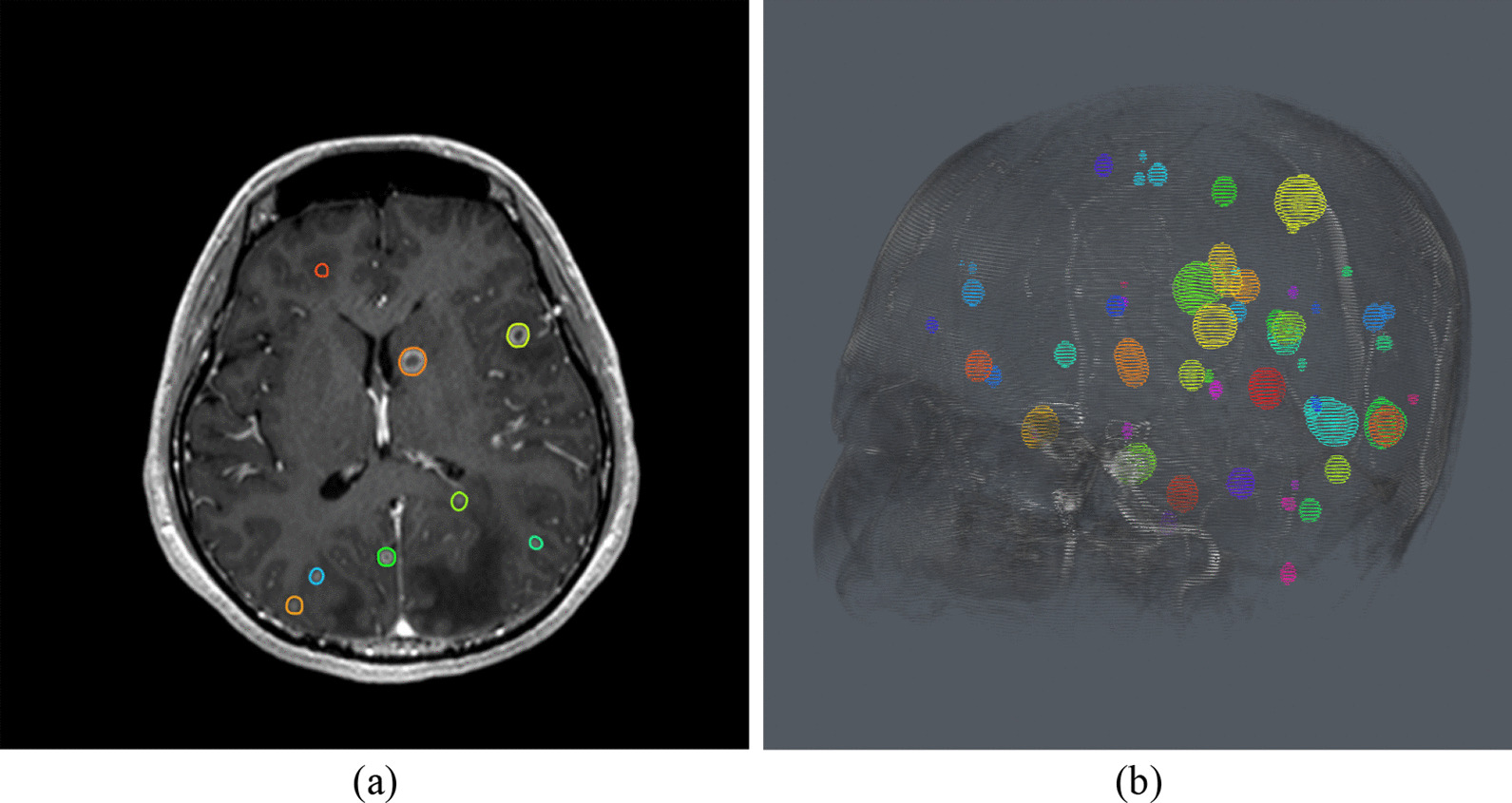
We analyzed 100 patients with 435 intact brain metastases treated with SRS. Our cohort consisted of patients with a median number of 2 brain metastases (range: 1 to 52), median age of 69 (range: 19 to 91), and 50% male and 50% female patients. The primary site breakdown was 56% lung, 10% melanoma, 9% breast, 8% gynecological, 5% renal, 4% gastrointestinal, 2% sarcoma, and 6% other, while the race breakdown was 60% White, 18% Asian, 3% Black/African American, 2% Native Hawaiian or other Pacific Islander, and 17% other/unknown/not reported. The median tumor size was 0.112 c.c. (range: 0.010-26.475 c.c.). We found mean lesion-wise DSC to be 0.723, mean lesion-wise AVD to be 7.34% of lesion size (0.704 mm), mean FP count to be 0.72 tumors per case, and lesion-wise sensitivity to be 89.30% for all lesions. Moreover, mean sensitivity was found to be 99.07%, 97.59%, and 96.23% for lesions with diameter equal to and greater than 10 mm, 7.5 mm, and 5 mm, respectively. No other significant differences in performance metrics were observed across demographic or clinical characteristic groups.
In this study, a commercial deep learning algorithm showed promising results in segmenting brain metastases, with 96.23% sensitivity for metastases with diameters of 5 mm or higher. As the software is an assistive AI, future work of VBrain integration into the clinical workflow can provide further clinical and research insights.
人工智能工具可用于提高立体定向放射外科(SRS)中脑转移瘤的检测和分割。Vysioneer 公司的 VBrain 是一种具有最近 FDA 批准的深度学习算法,可协助脑肿瘤勾画。我们旨在通过 SRS 治疗的脑转移患者的各种人口统计学和临床特征来评估该工具的性能。
我们随机选择了 2017 年至 2020 年在一家机构接受 CyberKnife 初始 SRS 的 100 例脑转移患者。排除了有切除术腔的病例。从每位患者中提取 CT 和轴向 T1 加权对比磁共振(MR)图像数据,并上传到 VBrain。当 VBrain-“预测”轮廓与相应医生的“地面真实”轮廓重叠时,我们认为脑转移瘤“被检测到”。我们使用以下指标评估 VBrain 对地面真实轮廓的性能:病变层面的 Dice 相似系数(DSC)、病变层面平均 Hausdorff 距离(AVD)、假阳性计数(FP)和病变层面灵敏度(%)。进行 Kruskal-Wallis 检验,以评估包括性别、种族、原发组织学、年龄以及脑转移瘤数量和大小等患者特征与 DSC、AVD、FP 和灵敏度等性能指标之间的关系。
我们分析了 100 例接受 SRS 治疗的 435 个完整脑转移瘤患者。我们的队列包括中位数为 2 个脑转移瘤(范围:1-52)、中位数年龄为 69 岁(范围:19-91)、50%为男性和 50%为女性的患者。主要部位的分布为 56%为肺癌,10%为黑色素瘤,9%为乳腺癌,8%为妇科肿瘤,5%为肾癌,4%为胃肠道癌,2%为肉瘤,6%为其他,而种族分布为 60%为白人,18%为亚洲人,3%为黑人/非裔美国人,2%为夏威夷原住民或其他太平洋岛民,17%为其他/未知/未报告。肿瘤中位数大小为 0.112 c.c.(范围:0.010-26.475 c.c.)。我们发现平均病变层面 DSC 为 0.723,平均病变层面 AVD 为病变大小的 7.34%(0.704 mm),平均 FP 计数为每个病例 0.72 个肿瘤,病变层面灵敏度为所有病变的 89.30%。此外,对于直径等于或大于 10 mm、7.5 mm 和 5 mm 的病变,平均灵敏度分别为 99.07%、97.59%和 96.23%。在人口统计学或临床特征组中未观察到其他性能指标的显著差异。
在这项研究中,一种商业深度学习算法在分割脑转移瘤方面表现出良好的效果,对于直径为 5 mm 或更大的转移瘤,灵敏度为 96.23%。由于该软件是一种辅助人工智能,因此未来 VBrain 集成到临床工作流程中可以提供进一步的临床和研究见解。