Division of Oncology, Department of Clinical Sciences in Lund, Lund University and Skåne University Hospital, Barngatan 4, 221 85, Lund, Sweden.
Department of Hematology, Oncology and Radiation Physics, Skåne University Hospital, Lund and Malmö, Sweden.
Breast Cancer Res Treat. 2023 Jun;199(2):335-347. doi: 10.1007/s10549-023-06919-x. Epub 2023 Apr 5.
Caveolin-1 (CAV1) has been implicated in breast cancer oncogenesis and metastasis and may be a potential prognosticator, especially for non-distant events. CAV1 functions as a master regulator of membrane transport and cell signaling. Several CAV1 SNPs have been linked to multiple cancers, but the prognostic impact of CAV1 SNPs in breast cancer remains unclear. Here, we investigated CAV1 polymorphisms in relation to clinical outcomes in breast cancer.
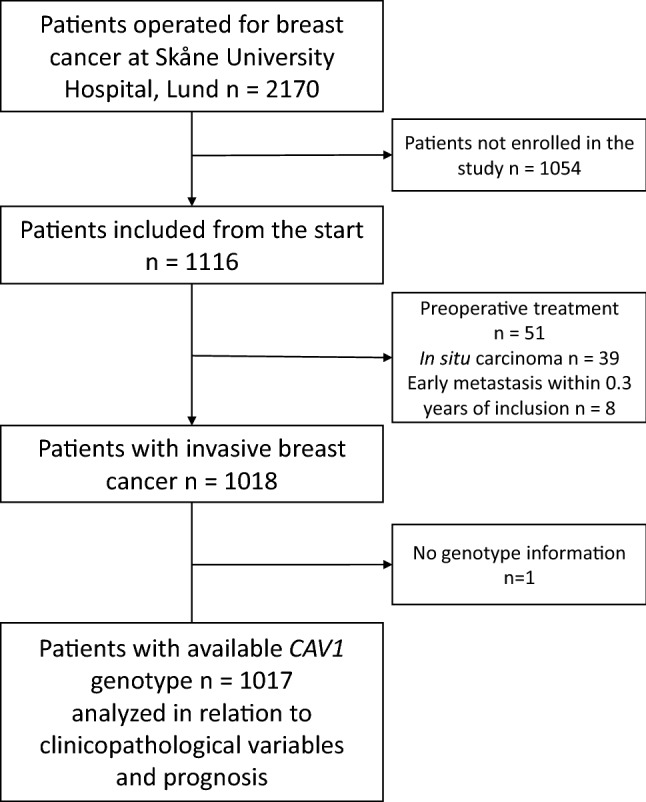
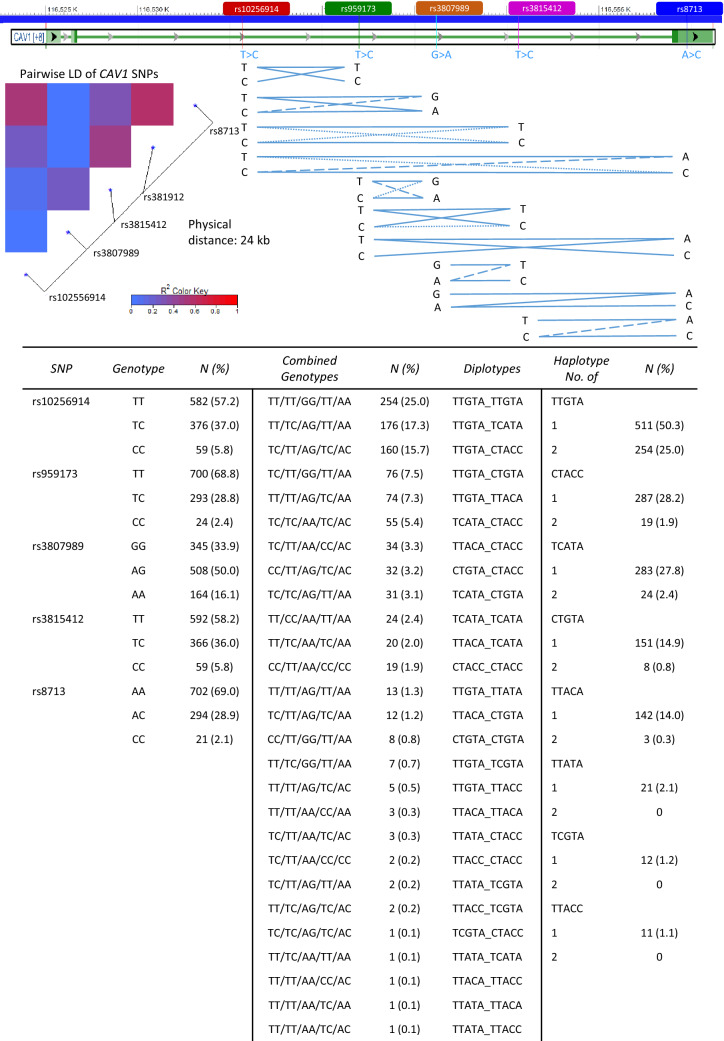
A cohort of 1017 breast cancer patients (inclusion 2002-2012, Sweden) were genotyped using Oncoarray by Ilumina. Patients were followed for up to 15 years. Five out of six CAV1 SNPs (rs10256914, rs959173, rs3807989, rs3815412, and rs8713) passed quality control and were used for haplotype construction. CAV1 genotypes and haplotypes in relation to clinical outcomes were assessed with Cox regression and adjusted for potential confounders (age, tumor characteristics, and adjuvant treatments).
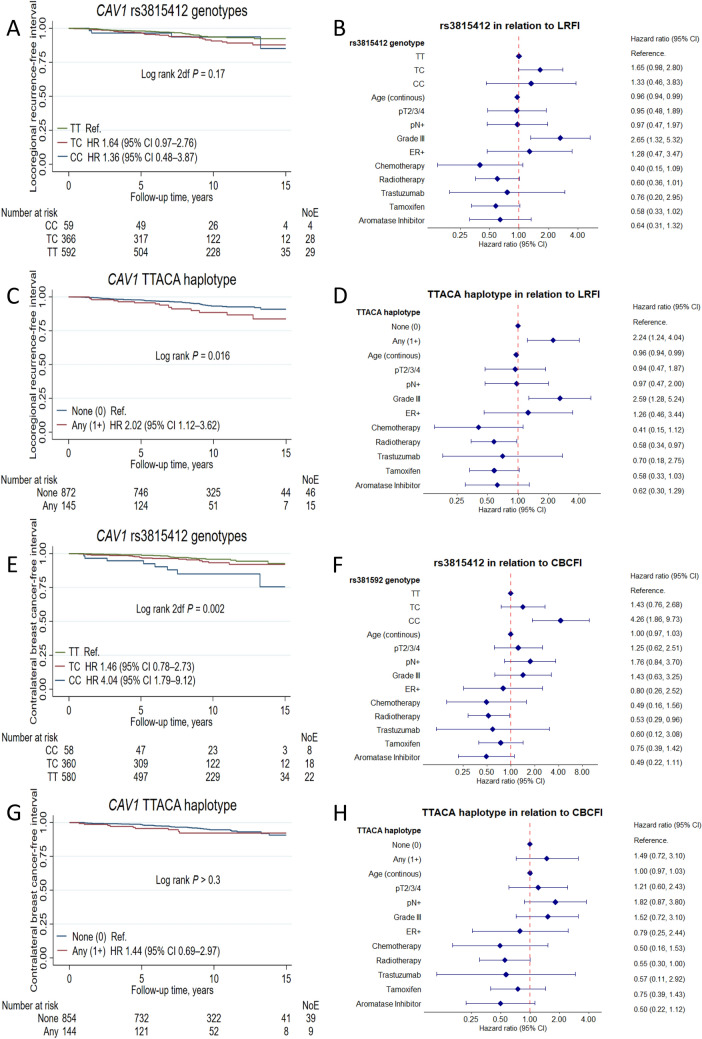
Only one SNP was associated with lymph node status, no other SNPs or haplotypes were associated with tumor characteristics. The CAV1 rs3815412 CC genotype (5.8% of patients) was associated with increased risk of contralateral breast cancer, adjusted hazard ratio (HR) 4.26 (95% CI 1.86-9.73). Moreover, the TTACA haplotype (13% of patients) conferred an increased risk for locoregional recurrence HR 2.24 (95% CI 1.24-4.04). No other genotypes or haplotypes were associated with clinical outcome.
CAV1 polymorphisms were associated with increased risk for locoregional recurrence and contralateral breast cancer. These findings may identify patients that could derive benefit from more tailored treatment to prevent non-distant events, if confirmed.
小窝蛋白-1(CAV1)已被牵连到乳腺癌的发生和转移中,可能是一个潜在的预后标志物,特别是对于非远处事件。CAV1 作为膜转运和细胞信号的主要调节剂发挥作用。已有多项 CAV1 单核苷酸多态性与多种癌症相关,但 CAV1 SNPs 在乳腺癌中的预后影响仍不清楚。在这里,我们研究了 CAV1 多态性与乳腺癌临床结局的关系。
1017 名乳腺癌患者(纳入时间 2002-2012 年,瑞典)的队列使用 Illumina 的 Oncoarray 进行基因分型。对患者进行了长达 15 年的随访。通过质量控制后,有 6 个 CAV1 SNP 中的 5 个(rs10256914、rs959173、rs3807989、rs3815412 和 rs8713)被用于构建单体型。使用 Cox 回归评估 CAV1 基因型和单体型与临床结局的关系,并调整了潜在混杂因素(年龄、肿瘤特征和辅助治疗)。
只有一个 SNP 与淋巴结状态相关,没有其他 SNP 或单体型与肿瘤特征相关。CAV1 rs3815412 CC 基因型(占患者的 5.8%)与对侧乳腺癌风险增加相关,调整后的危险比(HR)为 4.26(95%可信区间 1.86-9.73)。此外,TTACA 单体型(占患者的 13%)增加了局部区域复发的风险,HR 为 2.24(95%可信区间 1.24-4.04)。没有其他基因型或单体型与临床结局相关。
CAV1 多态性与局部区域复发和对侧乳腺癌的风险增加相关。如果得到证实,这些发现可能可以确定哪些患者可以从更个体化的治疗中获益,以预防非远处事件。