Vall d'Hebron Institute of Oncology (VHIO), Barcelona; Department of Medical Oncology, Vall d'Hebron University Hospital, Barcelona, Spain.
Vall d'Hebron Institute of Oncology (VHIO), Barcelona; Department of Medical Oncology, Vall d'Hebron University Hospital, Barcelona, Spain.
ESMO Open. 2023 Apr;8(2):101204. doi: 10.1016/j.esmoop.2023.101204. Epub 2023 Apr 3.
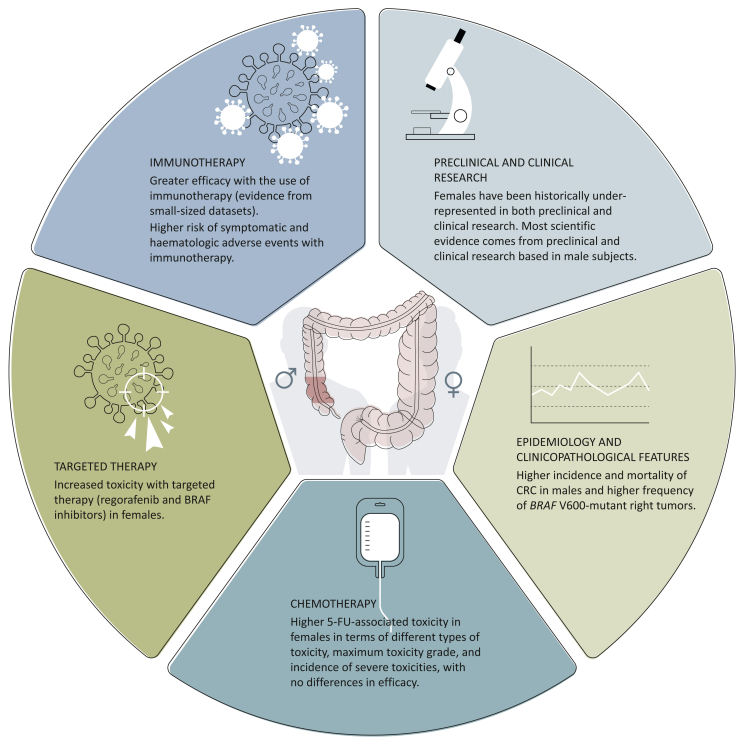
Historically women were frequently excluded from clinical trials and drug usage to protect unborn babies from potential harm. As a consequence, the impact of sex and gender on both tumour biology and clinical outcomes has been largely underestimated. Although interrelated and often used interchangeably, sex and gender are not equivalent concepts. Sex is a biological attribute that defines species according to their chromosomal makeup and reproductive organ, while gender refers to a chosen sexual identity. Sex dimorphisms are rarely taken into account, in either preclinical or clinical research, with inadequate analysis of differences in outcomes according to sex or gender still widespread, reflecting a gap in our knowledge for a large proportion of the target population. Underestimation of sex-based differences in study design and analyses has invariably led to 'one-drug' treatment regimens for both males and females. For patients with colorectal cancer (CRC), sex also has an impact on the disease incidence, clinicopathological features, therapeutic outcomes, and tolerability to anticancer treatments. Although the global incidence of CRC is higher in male subjects, the proportion of patients presenting right-sided tumours and BRAF mutations is higher among females. Concerning sex-related differences in treatment efficacy and toxicity, drug dosage does not take into account sex-specific differences in pharmacokinetics. Toxicity associated with fluoropyrimidines, targeted therapies, and immunotherapies has been reported to be more extensive for females with CRC than for males, although evidence about differences in efficacy is more controversial. This article aims to provide an overview of the research achieved so far into sex and gender differences in cancer and summarize the growing body of literature illustrating the sex and gender perspective in CRC and their impact in relation to tumour biology and treatment efficacy and toxicity. We propose endorsing research on how biological sex and gender influence CRC as an added value for precision oncology.
从历史上看,为了保护胎儿免受潜在伤害,女性经常被排除在临床试验和药物使用之外。因此,性别对肿瘤生物学和临床结果的影响在很大程度上被低估了。尽管性别和性别是相互关联的,并且经常互换使用,但它们不是等同的概念。性别是一种生物属性,根据染色体组成和生殖器官来定义物种,而性别则指的是选择的性身份。性二态性很少被考虑到,无论是在临床前研究还是临床研究中,根据性别或性别对结果的差异进行的分析不足仍然很普遍,这反映了我们对目标人群中很大一部分人的知识存在差距。在研究设计和分析中低估性别差异,不可避免地导致了针对男性和女性的“一药治疗”方案。对于结直肠癌(CRC)患者,性别也会影响疾病的发病率、临床病理特征、治疗效果以及对癌症治疗的耐受性。尽管全球 CRC 的发病率在男性中较高,但女性中出现右侧肿瘤和 BRAF 突变的患者比例较高。关于治疗效果和毒性的性别差异,药物剂量并没有考虑到性别特异性的药代动力学差异。与氟嘧啶、靶向治疗和免疫疗法相关的毒性已被报道在患有 CRC 的女性中比男性更为广泛,尽管关于疗效差异的证据更具争议性。本文旨在概述迄今为止在癌症中的性别差异研究,并总结越来越多的文献,阐明 CRC 中的性别视角及其对肿瘤生物学、治疗效果和毒性的影响。我们建议支持关于生物性别和性别如何影响 CRC 的研究,将其作为精准肿瘤学的附加值。