Nursing Research Institute, St Vincent's Health Network Sydney, St Vincent's Hospital Melbourne & Australian Catholic University, Sydney, NSW, Australia.
School of Nursing, Midwifery and Paramedicine, Australian Catholic University, Sydney, Australia.
Eur Stroke J. 2023 Mar;8(1):132-147. doi: 10.1177/23969873221126027. Epub 2022 Oct 24.
Poor adoption of stroke guidelines is a problem internationally. The Quality in Acute Stroke Care (QASC) trial demonstrated significant reduction in death and disability with facilitated implementation of nurse-initiated.
This was a multi-country, multi-centre, pre-test/post-test study (2017-2021) comparing post implementation data with historically collected pre-implementation data. Hospital clinical champions, supported by the Angels Initiative conducted multidisciplinary workshops discussing pre-implementation medical record audit results, barriers and facilitators to FeSS Protocol implementation, developed action plans and provided education, with ongoing support co-ordinated remotely from Australia. Prospective audits were conducted 3-month after FeSS Protocol introduction. Pre-to-post analysis and country income classification comparisons were adjusted for clustering by hospital and country controlling for age/sex/stroke severity.
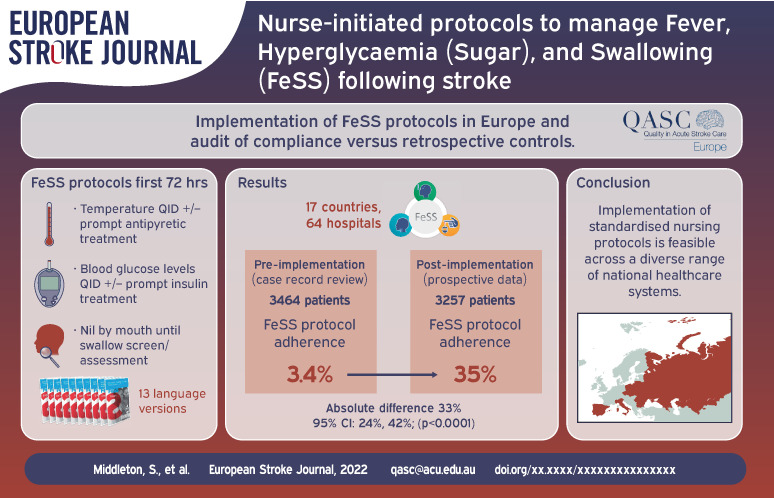
Data from 64 hospitals in 17 countries (3464 patients pre-implementation and 3257 patients post-implementation) showed improvement pre-to-post implementation in measurement recording of all three FeSS components, all < 0.0001: fever elements (pre: 17%, post: 51%; absolute difference 33%, 95% CI 30%, 37%); hyperglycaemia elements (pre: 18%, post: 52%; absolute difference 34%; 95% CI 31%, 36%); swallowing elements (pre: 39%, post: 67%; absolute difference 29%, 95% CI 26%, 31%) and thus in overall FeSS Protocol adherence (pre: 3.4%, post: 35%; absolute difference 33%, 95% CI 24%, 42%). In exploratory analysis of FeSS adherence by countries' economic status, high-income versus middle-income countries improved to a comparable extent.
Our collaboration resulted in successful rapid implementation and scale-up of FeSS Protocols into countries with vastly different healthcare systems.
国际上普遍存在对卒中指南采用不足的问题。Quality in Acute Stroke Care(QASC)试验表明,通过促进实施护士主导的治疗方案,可以显著降低死亡率和残疾率。
这是一项多国家、多中心、预测试/后测试研究(2017-2021 年),比较实施后的数据与历史上收集的实施前数据。医院临床冠军在 Angels Initiative 的支持下,开展多学科研讨会,讨论实施前病历审核结果、实施 FeSS 方案的障碍和促进因素、制定行动计划并提供教育,同时由澳大利亚远程协调持续支持。FeSS 方案引入后 3 个月进行前瞻性审核。对预到后分析和国家收入分类比较进行了调整,以控制医院和国家的聚类,并考虑了年龄/性别/卒中严重程度。
来自 17 个国家的 64 家医院(实施前 3464 例患者,实施后 3257 例患者)的数据显示,FeSS 三个组成部分的所有指标在实施前到实施后的测量记录中均有所改善,所有指标均<0.0001:发热元素(实施前:17%,实施后:51%;绝对差异 33%,95%CI 30%,37%);高血糖元素(实施前:18%,实施后:52%;绝对差异 34%,95%CI 31%,36%);吞咽元素(实施前:39%,实施后:67%;绝对差异 29%,95%CI 26%,31%),因此整体 FeSS 方案依从性(实施前:3.4%,实施后:35%;绝对差异 33%,95%CI 24%,42%)得到改善。对按国家经济状况分析的 FeSS 依从性进行探索性分析发现,高收入国家和中等收入国家的改善程度相当。
我们的合作促成了 FeSS 方案在具有截然不同医疗体系的国家的快速成功实施和扩大规模。