Department of Mathematics, University of California, Los Angeles, CA, 90095, USA.
Department of Physics and Astronomy, California NanoSystems Institute, University of California, Los Angeles, CA, 90095, USA.
Sci Rep. 2023 Apr 6;13(1):5624. doi: 10.1038/s41598-023-31124-7.
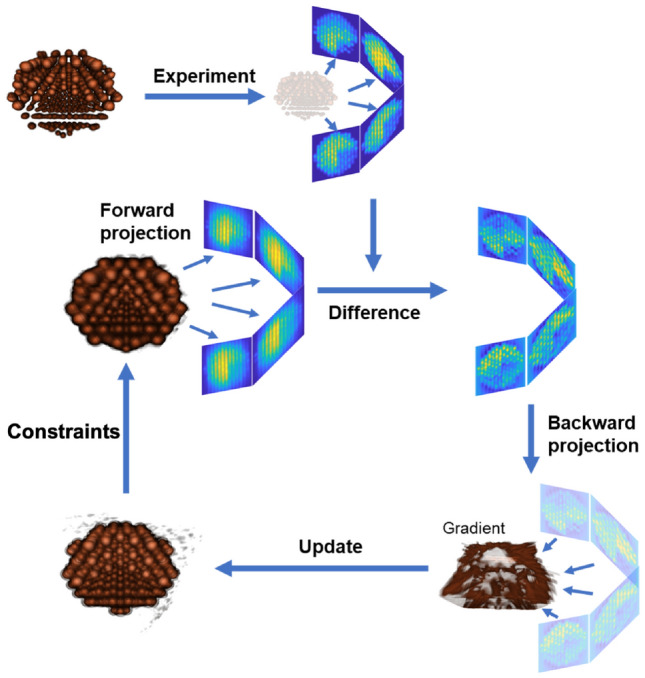
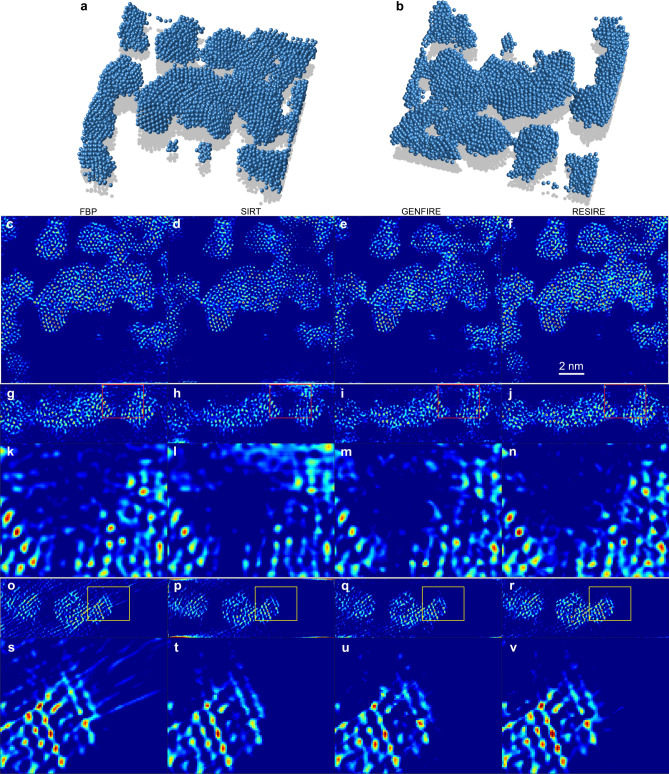
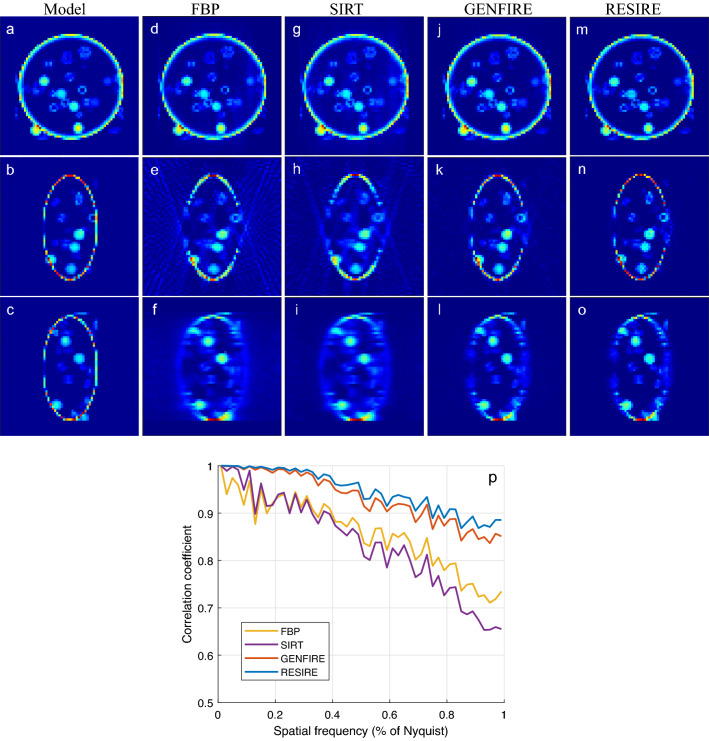
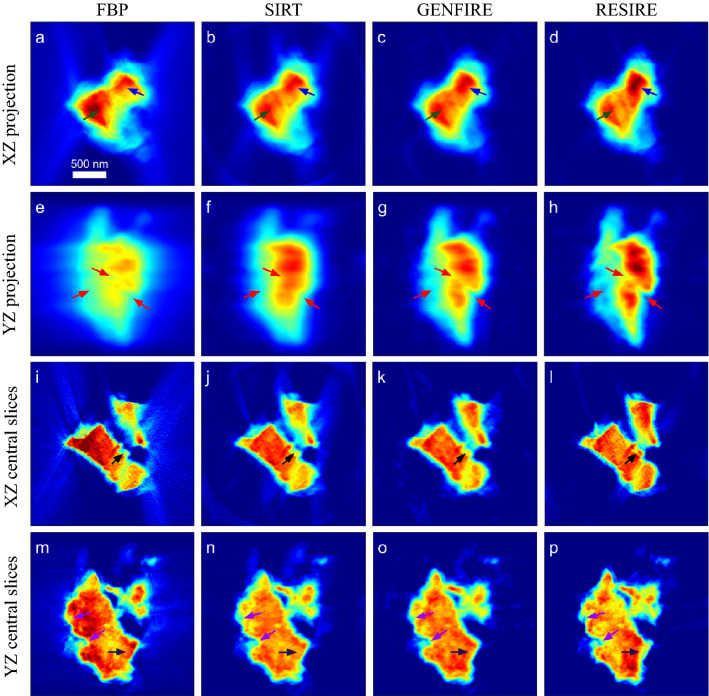
Tomography has made a revolutionary impact on the physical, biological and medical sciences. The mathematical foundation of tomography is to reconstruct a three-dimensional (3D) object from a set of two-dimensional (2D) projections. As the number of projections that can be measured from a sample is usually limited by the tolerable radiation dose and/or the geometric constraint on the tilt range, a main challenge in tomography is to achieve the best possible 3D reconstruction from a limited number of projections with noise. Over the years, a number of tomographic reconstruction methods have been developed including direct inversion, real-space, and Fourier-based iterative algorithms. Here, we report the development of a real-space iterative reconstruction (RESIRE) algorithm for accurate tomographic reconstruction. RESIRE iterates between the update of a reconstructed 3D object and the measured projections using a forward and back projection step. The forward projection step is implemented by the Fourier slice theorem or the Radon transform, and the back projection step by a linear transformation. Our numerical and experimental results demonstrate that RESIRE performs more accurate 3D reconstructions than other existing tomographic algorithms, when there are a limited number of projections with noise. Furthermore, RESIRE can be used to reconstruct the 3D structure of extended objects as demonstrated by the determination of the 3D atomic structure of an amorphous Ta thin film. We expect that RESIRE can be widely employed in the tomography applications in different fields. Finally, to make the method accessible to the general user community, the MATLAB source code of RESIRE and all the simulated and experimental data are available at https://zenodo.org/record/7273314 .
断层摄影术对物理、生物和医学科学产生了革命性的影响。断层摄影术的数学基础是从一组二维(2D)投影重建三维(3D)物体。由于从样本中可以测量的投影数量通常受到可容忍的辐射剂量和/或倾斜范围的几何限制,因此断层摄影术的一个主要挑战是在存在噪声的情况下从有限数量的投影中实现最佳的 3D 重建。多年来,已经开发了许多断层重建方法,包括直接反演、实空间和基于傅里叶的迭代算法。在这里,我们报告了一种用于精确断层重建的实空间迭代重建(RESIRE)算法的开发。RESIRE 在使用前向和后向投影步骤更新重建的 3D 对象和测量的投影之间进行迭代。前向投影步骤通过傅里叶切片定理或 Radon 变换实现,后向投影步骤通过线性变换实现。我们的数值和实验结果表明,在存在噪声的有限数量的投影时,RESIRE 比其他现有的断层重建算法进行更准确的 3D 重建。此外,RESIRE 可用于重建扩展物体的 3D 结构,如通过确定非晶 Ta 薄膜的 3D 原子结构来证明。我们期望 RESIRE 可以广泛应用于不同领域的断层摄影术应用。最后,为了使该方法能够为普通用户群体所使用,RESIRE 的 MATLAB 源代码和所有模拟及实验数据均可在 https://zenodo.org/record/7273314 上获得。