• 文献检索
  • 文档翻译
  • 深度研究
  • 学术资讯
  • Suppr Zotero 插件Zotero 插件
  • 邀请有礼
  • 套餐&价格
  • 历史记录
应用&插件
Suppr Zotero 插件Zotero 插件浏览器插件Mac 客户端Windows 客户端微信小程序
定价
高级版会员购买积分包购买API积分包
服务
文献检索文档翻译深度研究API 文档MCP 服务
关于我们
关于 Suppr公司介绍联系我们用户协议隐私条款
关注我们

Suppr 超能文献

核心技术专利:CN118964589B侵权必究
粤ICP备2023148730 号-1Suppr @ 2026

文献检索

告别复杂PubMed语法,用中文像聊天一样搜索,搜遍4000万医学文献。AI智能推荐,让科研检索更轻松。

立即免费搜索

文件翻译

保留排版,准确专业,支持PDF/Word/PPT等文件格式,支持 12+语言互译。

免费翻译文档

深度研究

AI帮你快速写综述,25分钟生成高质量综述,智能提取关键信息,辅助科研写作。

立即免费体验

护士与聊天机器人——一项赋权计划对乳腺癌患者化疗相关副作用及自我护理行为的影响:一项随机对照试验

A nurse versus a chatbot ‒ the effect of an empowerment program on chemotherapy-related side effects and the self-care behaviors of women living with breast Cancer: a randomized controlled trial.

作者信息

Tawfik Elham, Ghallab Eman, Moustafa Amel

机构信息

Community Health Nursing Department, Faculty of Nursing, Damanhour University, Damanhour, Egypt.

Community Health Nursing Department, Faculty of Nursing, The British University in Egypt, Cairo, Egypt.

出版信息

BMC Nurs. 2023 Apr 6;22(1):102. doi: 10.1186/s12912-023-01243-7.

DOI:10.1186/s12912-023-01243-7
PMID:37024875
原文链接:https://pmc.ncbi.nlm.nih.gov/articles/PMC10077642/
Abstract

BACKGROUND

The high levels of unmet needs in relation to provision of self-care information reported by women living with breast cancer suggests that pre-chemotherapy education is suboptimal. Chatbots are emerging as a promising platform to provide education to patients helping them self-manage their symptoms at home. However, evidence from empirical studies on the effect of chatbots education on women living with breast cancer self-care behaviors and symptoms management are scarce.

METHODS

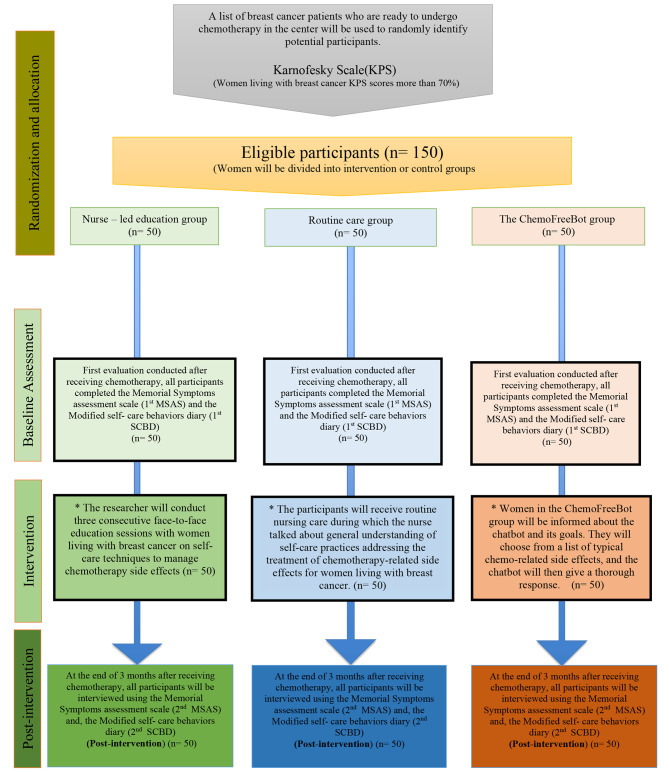
This three-arm randomized controlled trial was performed in a chemotherapy day care center within an oncology center in Egypt. A total of 150 women living with breast cancer were randomly selected and randomized into three groups: the ChemoFreeBot group (n = 50), the nurse-led education group (n = 50), and the routine care group (n = 50). In the ChemoFreeBot group, women were given a link to interact with ChemoFreeBot and ask questions about their symptoms and self-care interventions by typing questions or keywords at any time. On the same day as their first day of chemotherapy, the nurse-led education group received face to face teaching sessions from the researcher (nurse) about side effects and self-care interventions. The routine care group received general knowledge during their chemotherapy session about self-care interventions. The self-care behaviors effectiveness and the frequency, severity and distress of chemotherapy side effects were measured at baseline and postintervention for the three groups. The ChemoFreeBot's usability was assessed.

RESULTS

The mixed design repeated measures ANOVA analyses revealed a statistically significant both group effect and interaction effect of group*time, indicating a significant difference between the three groups in terms of the physical symptoms frequency (F = 76.075, p < .001, F = 147, p < .001, respectively), severity (F = 96.440, p < .001, F = 220.462, p < .001), and distress (F = 77.171, p < .001, F = 189.680, p < .001); the psychological symptoms frequency (F = 63.198, p < .001, F = 137.908, p < .001), severity (F = 62.137, p < .001), (F = 136.740, p < .001), and distress (F = 43.003, p < .001, F = 168.057, p < .001), and the effectiveness of self-care behaviors (F = 20.134, p < .001, F = 24.252, p < .001, respectively). The Post hoc analysis with Bonferroni adjustment in showed that women in the ChemoFreeBot group experienced a statistically significant less frequent, less severe and less distressing physical and psychological symptoms and higher effective self-care behaviors than those in the nurse-led education and routine care groups (p > .001).

CONCLUSION

ChemoFreeBot was a useful and cost-effective tool to improve increase self-care behavior and reduce chemotherapy side effects in women living with breast cancer through the provision of personalized education and the improvement of the accessibility to real-time and high-quality information compared to "one size fits all" approach used by nurses to provide the information. ChemoFreeBot can be an empowering tool to assist nurses to educate women with breast cancer and allow women to take an active role in managing their symptom.

TRIAL REGISTRATION

This study was retrospectively registered in the University hospital Medical Information Network (UMIN) Center, Clinical Trials Registry on 26/09/2022; Registration No:R000055389,Trial ID:UMIN000048955.
https://cdn.ncbi.nlm.nih.gov/pmc/blobs/5029/10077642/0c2bbafce4d0/12912_2023_1243_Fig1_HTML.jpg
摘要

背景

乳腺癌患者报告的自我护理信息未满足需求水平较高,这表明化疗前教育并不理想。聊天机器人正在成为一个有前景的平台,可为患者提供教育,帮助他们在家中自我管理症状。然而,关于聊天机器人教育对乳腺癌患者自我护理行为和症状管理效果的实证研究证据很少。

方法

这项三臂随机对照试验在埃及一家肿瘤中心的化疗日间护理中心进行。总共随机选择了150名乳腺癌患者,并将其随机分为三组:ChemoFreeBot组(n = 50)、护士主导教育组(n = 50)和常规护理组(n = 50)。在ChemoFreeBot组中,患者被提供一个链接,可随时通过输入问题或关键词与ChemoFreeBot互动,询问有关其症状和自我护理干预措施的问题。在化疗第一天,护士主导教育组接受研究人员(护士)关于副作用和自我护理干预措施的面对面教学课程。常规护理组在化疗期间接受关于自我护理干预措施的一般知识。在基线和干预后测量三组的自我护理行为有效性以及化疗副作用的频率、严重程度和困扰程度。评估了ChemoFreeBot的可用性。

结果

混合设计重复测量方差分析显示,组效应和组*时间交互效应均具有统计学意义,表明三组在身体症状频率(F分别为76.075,p <.(此处原文有误,推测应为p <.001),F为147,p <.001)、严重程度(F为96.440,p <.001,F为220.462,p <.001)和困扰程度(F为77.171,p <.001,F为189.680,p <.001);心理症状频率(F为63.198,p <.001,F为137.908,p <.001)、严重程度(F为62.137,p <.001),(F为136.740,p <.001)和困扰程度(F为43.003,p <.001,F为168.057,p <.001)以及自我护理行为有效性(F分别为20.134,p <.001,F为24.252,p <.001)方面存在显著差异。使用Bonferroni校正的事后分析表明,与护士主导教育组和常规护理组相比,ChemoFreeBot组的患者在身体和心理症状方面经历的频率、严重程度和困扰程度在统计学上显著更低,自我护理行为更有效(p >.001)。

结论

与护士采用的“一刀切”信息提供方式相比,ChemoFreeBot是一种有用且具有成本效益的工具,通过提供个性化教育并改善获取实时和高质量信息机会,可提高乳腺癌患者的自我护理行为并减少化疗副作用。ChemoFreeBot可以成为一种增强能力的工具,协助护士教育乳腺癌患者,并使患者在管理症状方面发挥积极作用。

试验注册

本研究于2022年9月26日在大学医院医学信息网络(UMIN)中心临床试验注册处进行回顾性注册;注册号:R0000(此处原文有误,推测应为R000055389),试验编号:UMIN000048955。

相似文献

1
A nurse versus a chatbot ‒ the effect of an empowerment program on chemotherapy-related side effects and the self-care behaviors of women living with breast Cancer: a randomized controlled trial.护士与聊天机器人——一项赋权计划对乳腺癌患者化疗相关副作用及自我护理行为的影响:一项随机对照试验
BMC Nurs. 2023 Apr 6;22(1):102. doi: 10.1186/s12912-023-01243-7.
2
Folic acid supplementation and malaria susceptibility and severity among people taking antifolate antimalarial drugs in endemic areas.在流行地区,服用抗叶酸抗疟药物的人群中,叶酸补充剂与疟疾易感性和严重程度的关系。
Cochrane Database Syst Rev. 2022 Feb 1;2(2022):CD014217. doi: 10.1002/14651858.CD014217.
3
Telephone interventions for symptom management in adults with cancer.针对成年癌症患者症状管理的电话干预措施。
Cochrane Database Syst Rev. 2020 Jun 2;6(6):CD007568. doi: 10.1002/14651858.CD007568.pub2.
4
A Nurse-Led mHealth Self-Management Program (mChemotherapy) for Breast Cancer Patients Undergoing Chemotherapy: Study Protocol of a Randomized Controlled Pilot Study.基于护士主导的移动医疗自我管理方案(mChemotherapy)的乳腺癌化疗患者随机对照预试验研究方案
Cancer Control. 2022 Jan-Dec;29:10732748221115469. doi: 10.1177/10732748221115469.
5
The Effects of Nurse-Led Supportive Care Program on Quality of Life in Women with Breast Cancer Receiving Adjuvant Chemotherapy: A Randomized Controlled Pilot Study.护士主导的支持性护理方案对接受辅助化疗的乳腺癌女性生活质量的影响:一项随机对照的初步研究。
Semin Oncol Nurs. 2024 Apr;40(2):151609. doi: 10.1016/j.soncn.2024.151609. Epub 2024 Mar 2.
6
7
Promoting and supporting self-management for adults living in the community with physical chronic illness: A systematic review of the effectiveness and meaningfulness of the patient-practitioner encounter.促进和支持社区中患有慢性身体疾病的成年人进行自我管理:对医患互动的有效性和意义的系统评价。
JBI Libr Syst Rev. 2009;7(13):492-582. doi: 10.11124/01938924-200907130-00001.
8
A nurse- and peer-led support program to assist women in gynaecological oncology receiving curative radiotherapy, the PeNTAGOn study (peer and nurse support trial to assist women in gynaecological oncology): study protocol for a randomised controlled trial.一种由护士和同伴主导的支持计划,旨在帮助接受根治性放疗的妇科肿瘤患者,PeNTAGOn 研究(同伴和护士支持试验以帮助妇科肿瘤患者):一项随机对照试验的研究方案。
Trials. 2013 Feb 11;14:39. doi: 10.1186/1745-6215-14-39.
9
Educational interventions for the management of cancer-related fatigue in adults.针对成人癌症相关疲劳管理的教育干预措施。
Cochrane Database Syst Rev. 2016 Nov 24;11(11):CD008144. doi: 10.1002/14651858.CD008144.pub2.
10
Efficacy of Early Health Intervention Programs on Adverse Effects of Chemotherapy Among Women With Breast Cancer: A Randomized Controlled Trial.早期健康干预计划对乳腺癌女性化疗不良反应的疗效:一项随机对照试验
Cureus. 2024 Jul 1;16(7):e63604. doi: 10.7759/cureus.63604. eCollection 2024 Jul.

引用本文的文献

1
Artificial intelligence as treatment support in breast cancer: current perspectives.人工智能在乳腺癌治疗支持中的应用:当前观点
Breast. 2025 Aug 22;83:104564. doi: 10.1016/j.breast.2025.104564.
2
Knowledge, attitudes, and awareness of breast self-examination among female university students in three Arab countries: a multi-center cross-sectional study.三个阿拉伯国家女大学生对乳房自我检查的知识、态度和认知:一项多中心横断面研究。
BMC Public Health. 2025 Aug 27;25(1):2961. doi: 10.1186/s12889-025-23932-5.
3
Conversational Agents Supporting Self-Management in People With a Chronic Disease: Systematic Review.

本文引用的文献

1
Application of Personalized Education in the Mobile Medical App for Breast Self-Examination.个性化教育在移动自检乳腺医学 APP 中的应用。
Int J Environ Res Public Health. 2022 Apr 8;19(8):4482. doi: 10.3390/ijerph19084482.
2
Health chatbots acceptability moderated by perceived stigma and severity: A cross-sectional survey.健康聊天机器人的可接受性受感知耻辱感和严重程度的调节:一项横断面调查。
Digit Health. 2021 Dec 8;7:20552076211063012. doi: 10.1177/20552076211063012. eCollection 2021 Jan-Dec.
3
Chatbot for Health Care and Oncology Applications Using Artificial Intelligence and Machine Learning: Systematic Review.
支持慢性病患者自我管理的对话代理:系统评价
J Med Internet Res. 2025 Aug 26;27:e72309. doi: 10.2196/72309.
4
Study protocol for a pragmatic randomised controlled trial in Belgian primary care and hospital settings on the effectiveness of an eHealth self-management support programme consisting of pain education and coaching of activity needs in breast cancer survivors with persistent pain: the PECAN trial.一项关于比利时初级保健和医院环境中电子健康自我管理支持计划有效性的实用随机对照试验的研究方案,该计划包括对患有持续性疼痛的乳腺癌幸存者进行疼痛教育和活动需求指导:PECAN试验。
BMJ Open. 2025 Aug 22;15(8):e099241. doi: 10.1136/bmjopen-2025-099241.
5
Artificial Intelligence in Nursing Support for Families: A Rapid Review.人工智能在为家庭提供护理支持方面的应用:一项快速综述。
JMA J. 2025 Jul 15;8(3):961-964. doi: 10.31662/jmaj.2024-0434. Epub 2025 May 30.
6
The Effectiveness and Feasibility of Conversational Agents in Supporting Care for Patients With Cancer: Systematic Review and Meta-Analysis.对话代理在支持癌症患者护理中的有效性和可行性:系统评价与荟萃分析
J Med Internet Res. 2025 Aug 8;27:e76968. doi: 10.2196/76968.
7
Empowering breast cancer clients through AI chatbots: transforming knowledge and attitudes for enhanced nursing care.通过人工智能聊天机器人增强乳腺癌患者的能力:转变知识和态度以提升护理质量。
BMC Nurs. 2025 Jul 29;24(1):994. doi: 10.1186/s12912-025-03585-w.
8
Breast and prostate cancer survivors' understanding of risk and management of cardiovascular and musculoskeletal side effects of treatment: findings from focus groups.乳腺癌和前列腺癌幸存者对治疗相关心血管及肌肉骨骼副作用风险与管理的理解:焦点小组研究结果
Support Care Cancer. 2025 Jun 21;33(7):608. doi: 10.1007/s00520-025-09642-z.
9
Women's Preferences and Willingness to Pay for AI Chatbots in Women's Health: Discrete Choice Experiment Study.女性健康领域中女性对人工智能聊天机器人的偏好及支付意愿:离散选择实验研究
J Med Internet Res. 2025 Jun 10;27:e67303. doi: 10.2196/67303.
10
AI Applications for Chronic Condition Self-Management: Scoping Review.人工智能在慢性病自我管理中的应用:范围综述
J Med Internet Res. 2025 Apr 8;27:e59632. doi: 10.2196/59632.
使用人工智能和机器学习的医疗保健与肿瘤学应用聊天机器人:系统综述
JMIR Cancer. 2021 Nov 29;7(4):e27850. doi: 10.2196/27850.
4
Factors associated with sleep disturbances in women undergoing treatment for early-stage breast cancer.早期乳腺癌治疗女性睡眠障碍的相关因素。
Support Care Cancer. 2022 Jan;30(1):157-166. doi: 10.1007/s00520-021-06373-9. Epub 2021 Jul 10.
5
Global Cancer Statistics 2020: GLOBOCAN Estimates of Incidence and Mortality Worldwide for 36 Cancers in 185 Countries.《全球癌症统计数据 2020:全球 185 个国家和地区 36 种癌症的发病率和死亡率估计》。
CA Cancer J Clin. 2021 May;71(3):209-249. doi: 10.3322/caac.21660. Epub 2021 Feb 4.
6
Relationship between chemotherapy-induced adverse reactions and health-related quality of life in patients with breast cancer.乳腺癌患者化疗引起的不良反应与健康相关生活质量之间的关系
Medicine (Baltimore). 2020 Aug 14;99(33):e21695. doi: 10.1097/MD.0000000000021695.
7
A Smartphone-Based Health Care Chatbot to Promote Self-Management of Chronic Pain (SELMA): Pilot Randomized Controlled Trial.基于智能手机的健康护理聊天机器人促进慢性疼痛的自我管理(SELMA):试验性随机对照试验。
JMIR Mhealth Uhealth. 2020 Apr 3;8(4):e15806. doi: 10.2196/15806.
8
A qualitative approach in determining the patient-centered information and supportive care needs of cancer patients in Singapore.在新加坡,一种确定以患者为中心的癌症患者信息和支持性护理需求的定性方法。
BMJ Open. 2020 Feb 28;10(2):e034178. doi: 10.1136/bmjopen-2019-034178.
9
A Chatbot Versus Physicians to Provide Information for Patients With Breast Cancer: Blind, Randomized Controlled Noninferiority Trial.聊天机器人与医生为乳腺癌患者提供信息的比较:盲法、随机对照非劣效性试验。
J Med Internet Res. 2019 Nov 27;21(11):e15787. doi: 10.2196/15787.
10
Use of the Chatbot "Vivibot" to Deliver Positive Psychology Skills and Promote Well-Being Among Young People After Cancer Treatment: Randomized Controlled Feasibility Trial.使用聊天机器人“Vivibot”为癌症治疗后的年轻人提供积极心理学技能和促进幸福感:随机对照可行性试验。
JMIR Mhealth Uhealth. 2019 Oct 31;7(10):e15018. doi: 10.2196/15018.