Brennan Cliona, Illingworth Sarah, Cini Erica, Bhakta Dee
South London and Maudsley NHS Trust, Maudsley Hospital, De Crespigny Park, London, SE5 8AZ, UK.
London Metropolitan University, 166-220 Holloway Road, London, N7 8DB, UK.
J Eat Disord. 2023 Apr 6;11(1):58. doi: 10.1186/s40337-023-00779-y.
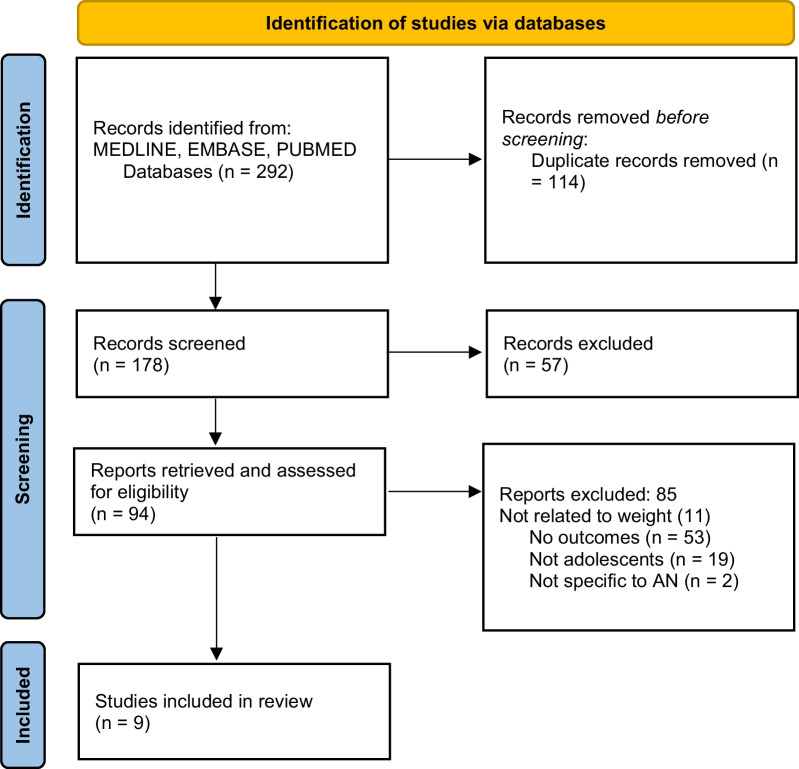
This review investigates the relationship between weight and risk of medical instability (specifically bradycardia, hypotension, hypothermia, and hypophosphatemia) in adolescents with typical and atypical anorexia nervosa. Atypical anorexia nervosa, listed as an example under the DSM-5 category of Other Specified Feeding and Eating Disorders (OSFED), describes patients who are not clinically underweight but otherwise meet criteria for anorexia nervosa. There is a lack of empirical evidence exploring medical complications in adolescents presenting with atypical anorexia nervosa. The small number of studies that do exist in this area indicate that medical instability exists across a range of weights, with weight loss being associated with increased medical risk, independent of underweight. The aim of this review was to collate and analyse results from available studies and identify indicators of medical risk in these two groups of adolescents with restrictive eating disorders. Studies were identified by systematic electronic search of medical databases, including PubMed and EMBASE. All studies investigated the relationship between weight and medical instability and included adolescents diagnosed with anorexia nervosa or atypical anorexia nervosa. One randomised controlled trial, five cohort studies and three chart reviews were included, with a total sample size of 2331 participants. Between 29 and 42% of participants presented with medical instability requiring hospitalisation, in the absence of underweight. Underweight adolescents were significantly more likely to have lower blood pressures (p < 0.0001) and bradycardia was significantly associated with greater weight loss (p < 0.05). There were no statistically significant associations found between degree of underweight and heart rate, temperature, or rate of weight loss (p = 0.31, p = 0.46 and p = 0.16, respectively). Adolescents that were less than 70% median body mass index were significantly more likely to have hypophosphatemia (p < 0.05). The findings of this review support the hypothesis that medical instability can occur across a range of weights in adolescent eating disorders, with rapid weight loss being an important indicator of increasing medical risk. Results were limited by the small number of existing studies that contained data for statistical analysis. Rapid weight loss should be considered as an important indicator of medical instability in adolescents presenting with both typical and atypical anorexia nervosa.
本综述调查了患有典型和非典型神经性厌食症的青少年体重与医疗不稳定风险(具体为心动过缓、低血压、体温过低和低磷血症)之间的关系。非典型神经性厌食症被列为《精神疾病诊断与统计手册》第5版“其他特定的喂养及进食障碍”(OSFED)类别下的一个示例,描述的是那些临床上体重未低于正常水平但在其他方面符合神经性厌食症标准的患者。目前缺乏对患有非典型神经性厌食症的青少年的医疗并发症进行探究的实证证据。该领域现存的少量研究表明,在一系列体重范围内均存在医疗不稳定情况,体重减轻与医疗风险增加相关,且与体重过轻无关。本综述的目的是整理和分析现有研究的结果,并确定这两组患有限制性进食障碍的青少年的医疗风险指标。通过对包括PubMed和EMBASE在内的医学数据库进行系统的电子检索来确定研究。所有研究均调查了体重与医疗不稳定之间的关系,且纳入了被诊断为神经性厌食症或非典型神经性厌食症的青少年。纳入了一项随机对照试验、五项队列研究和三项病历回顾,总样本量为2331名参与者。在不存在体重过轻的情况下,29%至42%的参与者出现了需要住院治疗的医疗不稳定情况。体重过轻的青少年更有可能血压较低(p<0.0001),且心动过缓与更大程度的体重减轻显著相关(p<0.05)。体重过轻的程度与心率、体温或体重减轻率之间未发现统计学上的显著关联(分别为p = 0.31、p =