Meethal Arjun C, Chathoth Anuradha T, Anaswara Naveen
Government of Kerala, Health Service Department, District Medical Office (Health), Kozhikode, Kerala, India.
J Family Med Prim Care. 2023 Jan;12(1):133-138. doi: 10.4103/jfmpc.jfmpc_1172_22. Epub 2023 Feb 15.
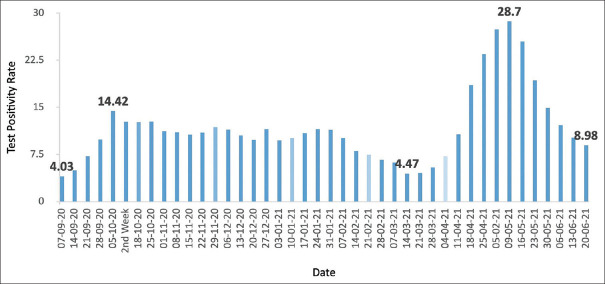
The coronavirus disease 2019 (COVID-19) pandemic has seen multiple surges globally since its emergence in 2019. The second wave of the pandemic was generally more aggressive than the first, with more cases and deaths. This study compares the epidemiological features of the first and second COVID-19 waves in Kozhikode district of Kerala and identifies the factors associated with this change.
A comparative cross-sectional study was conducted in Kozhikode district. A total of 132,089 cases from each wave were selected for the study using a consecutive sampling method. Data were collected from the District COVID-19 line list using a semistructured proforma and analyzed using Statistical Package for Social Sciences (SPSS) ver. 18.
The second wave had a higher proportion of symptomatic cases (17.3%; 20.1%), cases with severe symptoms (0.3%; 0.6%), intensive care unit (ICU) admissions (11.2%; 17.9%), and case fatality rate (0.69%; 0.72%). Significant difference was noted in the age, gender, locality, source of infection, comorbidity profile, symptom, and the pattern of admission in various healthcare settings between the first and second wave. Among the deceased, gender, duration between onset of symptoms and death, comorbidity status, and cause of death were significantly different in both waves.
The presence of the severe acute respiratory syndrome coronavirus 2 (SARS-CoV-2) Delta variant, as well as changes in human behavior and threat perception as the pandemic progressed, resulted in significant differences in various epidemiological features of the pandemic in both waves, indicating the need for continued vigilance during each COVID-19 wave.
自2019年新型冠状病毒肺炎(COVID-19)疫情出现以来,全球已出现多次高峰。疫情的第二波通常比第一波更具侵袭性,病例和死亡人数更多。本研究比较了喀拉拉邦科泽科德区第一波和第二波COVID-19疫情的流行病学特征,并确定了与这种变化相关的因素。
在科泽科德区进行了一项比较横断面研究。采用连续抽样方法,从每一波疫情中选取132,089例病例进行研究。使用半结构化表格从地区COVID-19病例清单中收集数据,并使用社会科学统计软件包(SPSS)18.0版进行分析。
第二波疫情中,有症状病例的比例更高(17.3%;20.1%),重症病例的比例更高(0.3%;0.6%),入住重症监护病房(ICU)的比例更高(11.2%;17.9%),病死率更高(0.69%;0.72%)。在第一波和第二波疫情之间,年龄、性别、地点、感染源、合并症情况、症状以及在各种医疗机构的入院模式存在显著差异。在死亡病例中,两波疫情的性别、症状出现至死亡的持续时间、合并症状况和死亡原因均存在显著差异。
严重急性呼吸综合征冠状病毒2(SARS-CoV-2)德尔塔变异株的出现,以及随着疫情发展人类行为和威胁认知的变化,导致两波疫情的各种流行病学特征存在显著差异,这表明在每一波COVID-19疫情期间都需要持续保持警惕。