Pharmacology Department, Faculty of Veterinary Medicine, Suez Canal University, Ismailia, 41522, Egypt.
Pharmacognosy Department, Faculty of Pharmacy, Cairo University, Kasr el Aini St., Cairo, 11562, Egypt.
Inflammopharmacology. 2023 Jun;31(3):1529-1538. doi: 10.1007/s10787-023-01208-x. Epub 2023 Apr 8.
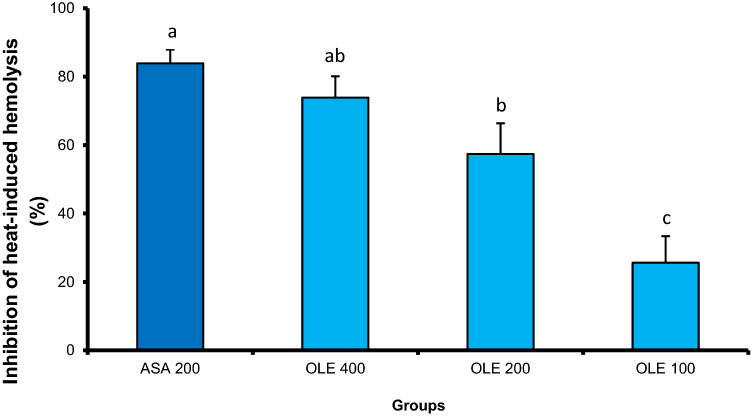
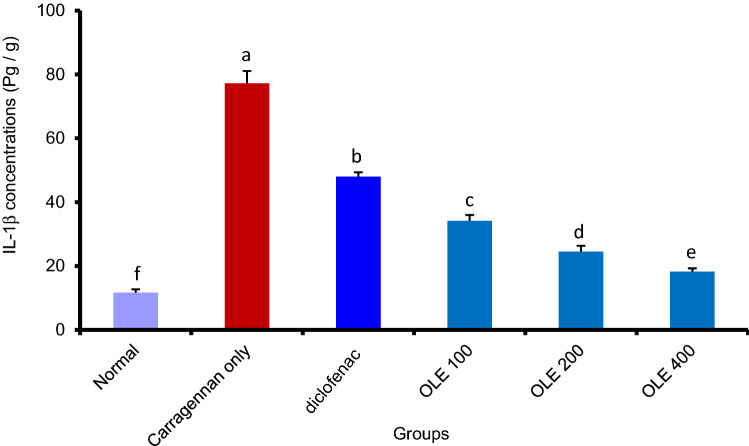
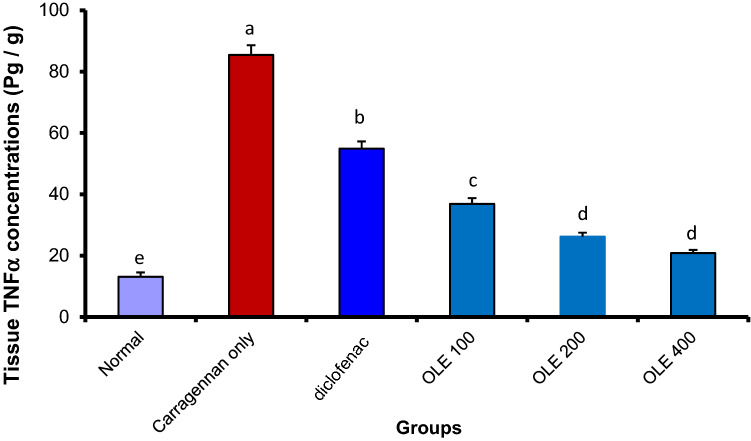
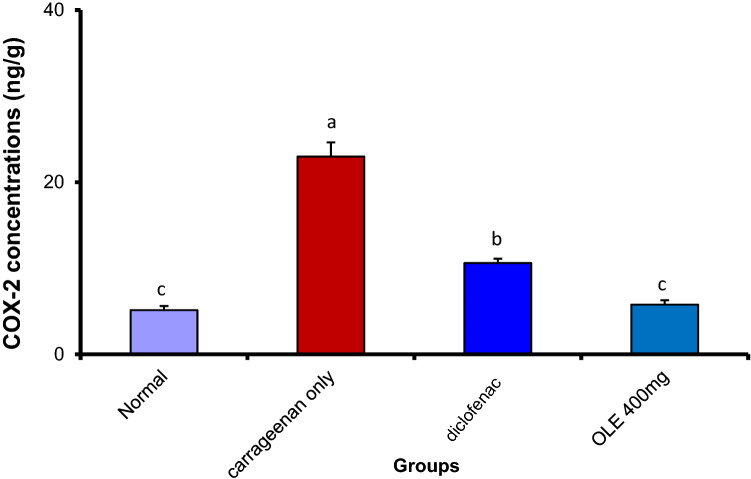
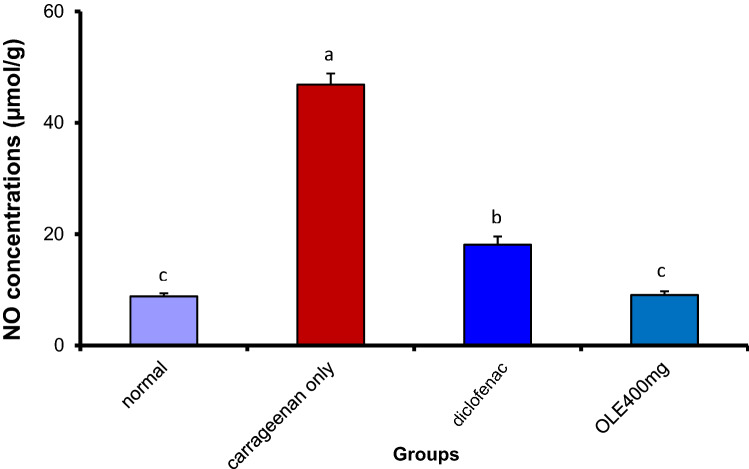
Inflammation is a complex and crucial process that protects the body against pathogens. Here in our study, we propose to scientifically justify the anti-inflammatory activity of olive leaf (OL). Initially, we ensured the safety of olive leaf extract (OLE) through acute oral administration of graded doses up to 4 g\kg in Wistar rats. Thus, the extract was considered generally safe. We also evaluated the ability of the extract to reduce carrageenan-induced rat paw edema. Compared to diclofenac sodium (10 mg/kg PO), OLE showed significant (P < 0.05) anti-inflammatory activity, showing the maximum inhibition percentage at the fifth hour of measurement at 42.31% and 46.99%, at doses of 200 and 400 m/kg, respectively, compared to 63.81% for the standard drug. To elucidate the potential mechanism, we measured TNF, IL-1, COX-2 and NO inside the paw tissue. Interestingly, OLE at all tested doses reduced the concentration of TNF and IL-1 to a level that was lower than that obtained by the standard drug. Additionally, OLE at the dose of 400 mg/kg reduced the levels of COX-2 and NO inside the paw tissue to a level that was statistically equivalent to the level observed in the normal control group. Finally, olive leaf extract at doses of 100, 200 and 400 mg/kg doses significantly (P < 0.05) inhibited the heat-induced hemolysis of RBCs membrane by 25.62, 57.40 and 73.88%, respectively, compared to 83.89% produced by aspirin. Consequently, we concluded that olive leaf extract has a significant anti-inflammatory activity through the reduction of TNF, IL-1, COX-2 and NO.
炎症是一种复杂而关键的过程,可保护身体免受病原体侵害。在我们的研究中,我们旨在从科学上证实橄榄叶(OL)的抗炎活性。首先,我们通过在 Wistar 大鼠中口服给予递增剂量高达 4 g/kg 的橄榄叶提取物(OLE)来确保提取物的安全性。因此,该提取物被认为是一般安全的。我们还评估了提取物减轻角叉菜胶诱导的大鼠足肿胀的能力。与双氯芬酸钠(10 mg/kg PO)相比,OLE 表现出显著的(P<0.05)抗炎活性,在测量的第五小时,分别在 200 和 400 m/kg 剂量下显示出最大抑制百分比,为 42.31%和 46.99%,而标准药物为 63.81%。为了阐明潜在的机制,我们测量了爪组织中的 TNF、IL-1、COX-2 和 NO。有趣的是,OLE 在所有测试剂量下均降低了 TNF 和 IL-1 的浓度,使其低于标准药物的水平。此外,OLE 在 400 mg/kg 剂量下降低了爪组织中 COX-2 和 NO 的水平,使其与正常对照组观察到的水平相当。最后,橄榄叶提取物在 100、200 和 400 mg/kg 剂量下分别显著(P<0.05)抑制了由热诱导的 RBC 膜溶血,抑制率分别为 25.62%、57.40%和 73.88%,而阿司匹林的抑制率为 83.89%。因此,我们得出结论,橄榄叶提取物通过降低 TNF、IL-1、COX-2 和 NO 具有显著的抗炎活性。