Chen Kai, Zhu Chun-Yan, Bai Jia-Ying, Xiao Feng, Tan Song, Zhou Qiao, Zeng Li
Department of Neurology, Sichuan Academy of Medical Science and Sichuan Provincial People's Hospital, University of Electronic Science and Technology of China, Chengdu, China.
Sichuan Provincial Key Laboratory for Human Disease Gene Study, Chengdu, China.
Comput Struct Biotechnol J. 2023 Mar 15;21:2228-2240. doi: 10.1016/j.csbj.2023.03.019. eCollection 2023.
Immune-mediated necrotizing myopathy (IMNM), a subgroup of idiopathic inflammatory myopathies (IIMs), is characterized by severe proximal muscle weakness and prominent necrotic fibers but no infiltration of inflammatory cells. IMNM pathogenesis is unclear. This study investigated key biomarkers and potential pathways for IMNM using high-throughput sequencing and bioinformatics technology.
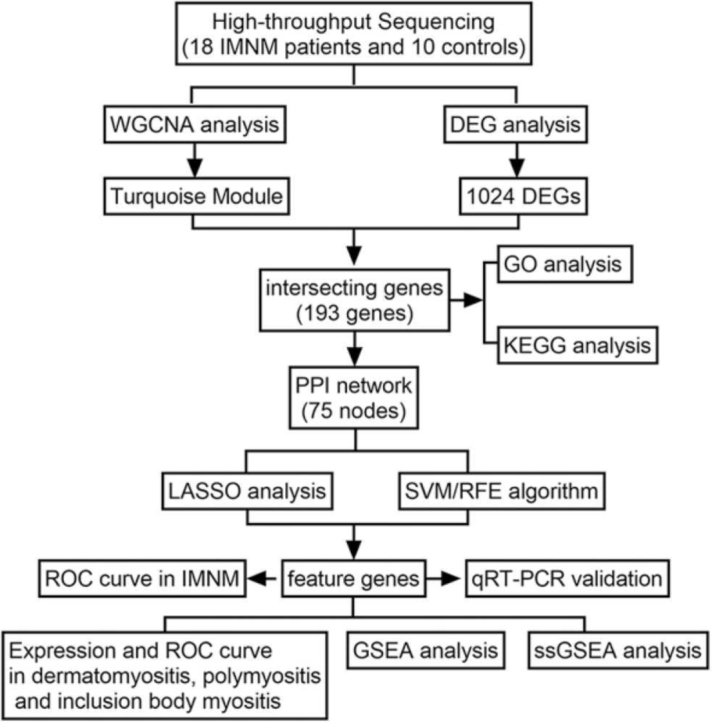
RNA sequencing was conducted in 18 IMNM patients and 10 controls. A combination of weighted gene coexpression network analysis (WGCNA) and differentially expressed gene (DEG) analysis was conducted to identify IMNM-related DEGs. Feature genes were screened out by employing the protein-protein interaction (PPI) network, support vector machine-recursive feature elimination (SVM-RFE), and least absolute shrinkage selection operator (LASSO). Quantitative real-time polymerase chain reaction (qRT-PCR) was performed to verify their differential expression, and the receiver operating characteristic curve (ROC) was used to evaluate their diagnostic efficiency. Functional enrichment analysis was applied to reveal the hidden functions of feature genes. Furthermore, 28 immune cell abundance patterns in IMNM samples were measured.
We identified 193 IMNM-related DEGs that were aberrantly upregulated in the IMNM population and were closely associated with immune-inflammatory responses, regulation of skeletal and cardiac muscle contraction, and lipoprotein metabolism. With the help of the PPI network and the LASSO and SVM-RFE algorithms, three feature genes, , , and were identified and further confirmed by qRT-PCR. ROC curves among IMNM, dermatomyositis (DM), inclusion body myositis (IBM), and polymyositis (PM) samples validated the and genes as IMNM-specific feature markers. In addition, all three genes had a notable association with the autophagy-lysosome pathway and immune-inflammatory responses. Ultimately, IMNM displayed a marked immune-cell infiltrative microenvironment. The most significant correlation was found between CD4 T cells, CD8 T cells, macrophages, natural killer (NK) cells, and dendritic cells (DCs).
, , and were identified as potential key molecules for IMNM and are believed to play a role in the autophagy-lysosome pathway and muscle inflammation.
免疫介导的坏死性肌病(IMNM)是特发性炎性肌病(IIM)的一个亚组,其特征为严重的近端肌无力和显著的坏死纤维,但无炎性细胞浸润。IMNM的发病机制尚不清楚。本研究使用高通量测序和生物信息学技术研究IMNM的关键生物标志物和潜在途径。
对18例IMNM患者和10例对照进行RNA测序。采用加权基因共表达网络分析(WGCNA)和差异表达基因(DEG)分析相结合的方法来鉴定与IMNM相关的DEG。通过蛋白质-蛋白质相互作用(PPI)网络、支持向量机递归特征消除(SVM-RFE)和最小绝对收缩选择算子(LASSO)筛选特征基因。进行定量实时聚合酶链反应(qRT-PCR)以验证它们的差异表达,并使用受试者工作特征曲线(ROC)评估它们的诊断效率。应用功能富集分析来揭示特征基因的潜在功能。此外,还测量了IMNM样本中28种免疫细胞丰度模式。
我们鉴定出193个与IMNM相关的DEG,这些基因在IMNM人群中异常上调,并且与免疫炎症反应、骨骼肌和心肌收缩调节以及脂蛋白代谢密切相关。借助PPI网络以及LASSO和SVM-RFE算法,鉴定出三个特征基因, 、 和 ,并通过qRT-PCR进一步证实。IMNM、皮肌炎(DM)、包涵体肌炎(IBM)和多发性肌炎(PM)样本的ROC曲线验证了 和 基因作为IMNM特异性特征标志物。此外,所有三个基因都与自噬-溶酶体途径和免疫炎症反应有显著关联。最终,IMNM表现出明显的免疫细胞浸润微环境。发现CD4 T细胞、CD8 T细胞、巨噬细胞、自然杀伤(NK)细胞和树突状细胞(DC)之间的相关性最为显著。
、 和 被鉴定为IMNM的潜在关键分子,并且被认为在自噬-溶酶体途径和肌肉炎症中起作用。