Human Nutrition Research Unit, Department of Agricultural, Food, & Nutritional Science, University of Alberta, 113 Street and 87 Avenue NW, 2-004 Li Ka Shing Center for Health Research Innovation, Edmonton, Alberta, Canada.
Department of Geriatrics, Neurosciences and Orthopaedics, Catholic University of the Sacred Heart, Rome, Italy; Geriatric Department, Fondazione Policlinico Universitario Agostino Gemelli' IRCCS, Rome, Italy; Department of Translational and Precision Medicine, Sapienza University of Rome, Rome, Italy; Center for Geriatric Medicine (Ce.M.I.), Università Cattolica del Sacro Cuore, L.go F. Vito 1, Rome 00168, Italy.
Clin Geriatr Med. 2022 Aug;38(3):545-557. doi: 10.1016/j.cger.2022.03.004. Epub 2022 Mar 21.
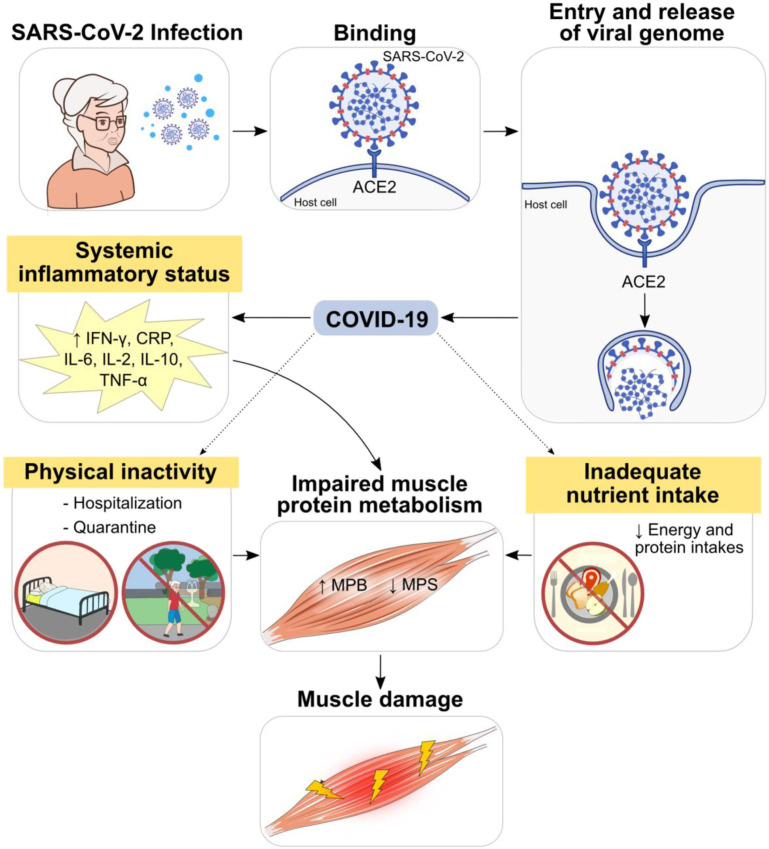
COVID-19 negatively impacts several organs and systems weeks or months after initial diagnosis. Skeletal muscle can be affected, leading to fatigue, lower mobility, weakness, and poor physical performance. Older adults are at increased risk of developing musculoskeletal symptoms during long COVID. Systemic inflammation, physical inactivity, and poor nutritional status are some of the mechanisms leading to muscle dysfunction in individuals with long COVID. Current evidence suggests that long COVID negatively impacts body composition, muscle function, and quality of life. Muscle mass and function assessments can contribute toward the identification, diagnosis, and management of poor muscle health resulting from long COVID.
COVID-19 会在初始诊断数周或数月后对多个器官和系统产生负面影响。骨骼肌可能会受到影响,导致疲劳、活动能力下降、虚弱和身体机能不佳。在长新冠期间,老年人发生肌肉骨骼症状的风险增加。全身性炎症、身体活动减少和营养状况不佳是导致长新冠患者肌肉功能障碍的一些机制。目前的证据表明,长新冠对身体成分、肌肉功能和生活质量产生负面影响。肌肉质量和功能评估有助于识别、诊断和管理长新冠导致的肌肉健康不良。