Stevanovic Djordje, Zdravkovic Vladimir, Poskurica Mina, Petrovic Marina, Cekerevac Ivan, Zdravkovic Nemanja, Mijailovic Sara, Todorovic Dusan, Divjak Ana, Bozic Dunja, Marinkovic Milos, Jestrovic Aleksandra, Azanjac Anja, Miloradovic Vladimir
Department of Internal Medicine, Faculty of Medical Sciences, University of Kragujevac, Kragujevac, Serbia.
Cardiology Clinic, University Clinical Center Kragujevac, Kragujevac, Serbia.
Front Nutr. 2022 Jul 11;9:906659. doi: 10.3389/fnut.2022.906659. eCollection 2022.
Published data regarding the impact of obesity on COVID-19 outcomes are inconsistent. However, in most studies, body composition was assessed using body mass index (BMI) alone, thus neglecting the presence and distribution of adipose tissue. Therefore, we aimed to investigate the impact of body and visceral fat on COVID-19 outcomes.
Observational, prospective cohort study included 216 consecutive COVID-19 patients hospitalized at University Clinical Center Kragujevac (Serbia) from October to December 2021. Body composition was assessed using the BMI, body fat percentage (%BF), and visceral fat (VF) bioelectrical impedance analysis (BIA). In addition to anthropometric measurements, variables in the research were socio-demographic and medical history data, as well as admission inflammatory biomarkers. Primary end-points were fatal outcomes and intensive care unit (ICU) admission.
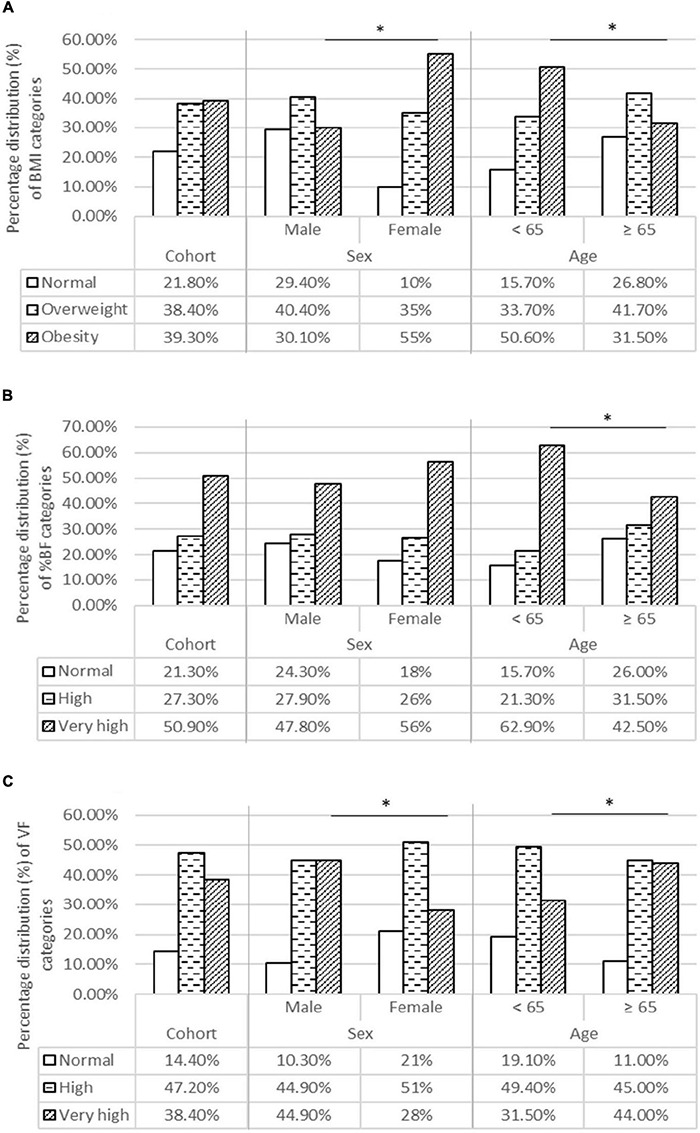
The overall prevalence of obesity was 39.3% according to BMI and 50.9% according to % BF, while 38.4% of patients had very high VF levels. After adjusting odds ratio values for cofounding variables and obesity-related conditions, all three anthropometric parameters were significant predictors of primary end-points. However, we note that % BF and VF, compared to BMI, were stronger predictors of both mortality (aOR 3.353, aOR 3.05, and aOR 2.387, respectively) and ICU admission [adjusted odds ratio (aOR) 7.141, aOR 3.424, and aOR 3.133, respectively].
Obesity is linked with COVID-19 mortality and ICU admission, with BIA measurements being stronger predictors of outcome compared to BMI use alone.
关于肥胖对新冠病毒疾病(COVID-19)结局影响的已发表数据并不一致。然而,在大多数研究中,仅使用体重指数(BMI)评估身体成分,从而忽略了脂肪组织的存在和分布。因此,我们旨在研究身体脂肪和内脏脂肪对COVID-19结局的影响。
观察性前瞻性队列研究纳入了2021年10月至12月在克拉古耶瓦茨大学临床中心(塞尔维亚)住院的216例连续COVID-19患者。使用BMI、体脂百分比(%BF)和内脏脂肪(VF)生物电阻抗分析(BIA)评估身体成分。除人体测量外,研究中的变量还包括社会人口统计学和病史数据,以及入院时的炎症生物标志物。主要终点是死亡结局和重症监护病房(ICU)入院。
根据BMI,肥胖的总体患病率为39.3%,根据%BF为50.9%,而38.4%的患者内脏脂肪水平非常高。在对混杂变量和肥胖相关疾病的比值比进行调整后,所有三个人体测量参数都是主要终点的显著预测因素。然而,我们注意到,与BMI相比,%BF和VF是死亡率(调整后比值比分别为3.353、3.05和2.387)和ICU入院(调整后比值比分别为7.141、3.424和3.133)更强的预测因素。
肥胖与COVID-19死亡率和ICU入院有关,与单独使用BMI相比,BIA测量是结局更强的预测因素。