Department of Psychology, Heidelberg University, Heidelberg, Germany.
Department of Psychology, Washington University in St. Louis, St. Louis, MO, USA.
Behav Res Methods. 2024 Mar;56(3):1604-1639. doi: 10.3758/s13428-023-02111-7. Epub 2023 Apr 11.
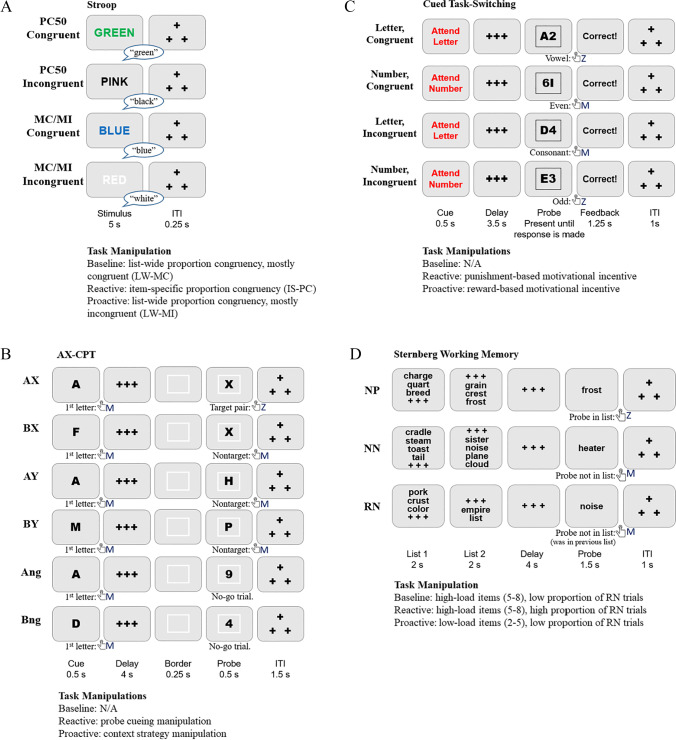
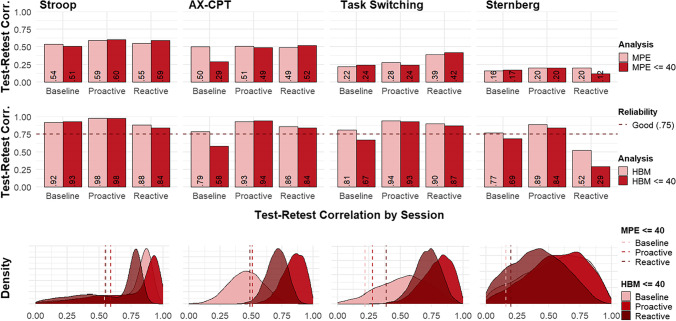
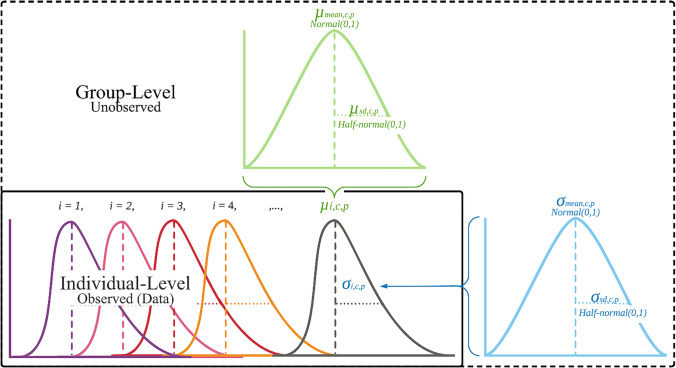
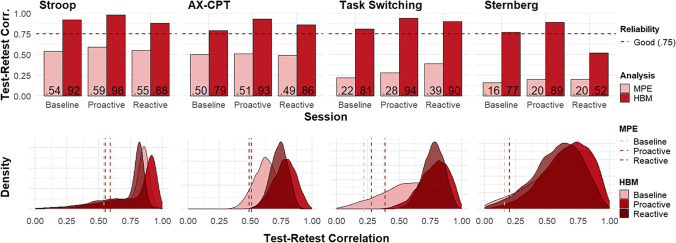
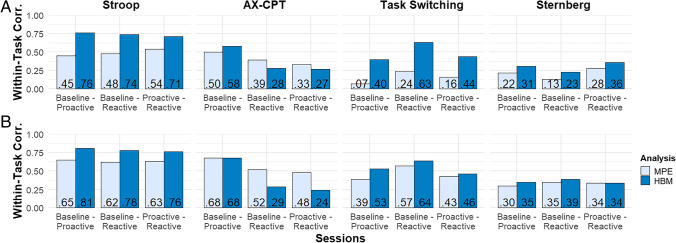
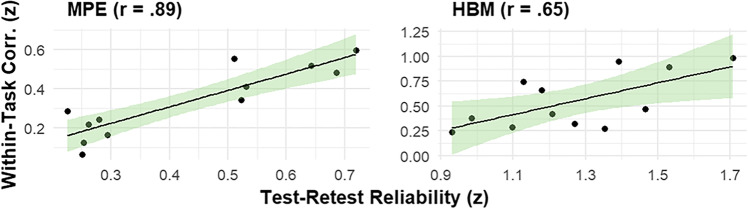
The domain of cognitive control has been a major focus of experimental, neuroscience, and individual differences research. Currently, however, no theory of cognitive control successfully unifies both experimental and individual differences findings. Some perspectives deny that there even exists a unified psychometric cognitive control construct to be measured at all. These shortcomings of the current literature may reflect the fact that current cognitive control paradigms are optimized for the detection of within-subject experimental effects rather than individual differences. In the current study, we examine the psychometric properties of the Dual Mechanisms of Cognitive Control (DMCC) task battery, which was designed in accordance with a theoretical framework that postulates common sources of within-subject and individual differences variation. We evaluated both internal consistency and test-retest reliability, and for the latter, utilized both classical test theory measures (i.e., split-half methods, intraclass correlation) and newer hierarchical Bayesian estimation of generative models. Although traditional psychometric measures suggested poor reliability, the hierarchical Bayesian models indicated a different pattern, with good to excellent test-retest reliability in almost all tasks and conditions examined. Moreover, within-task, between-condition correlations were generally increased when using the Bayesian model-derived estimates, and these higher correlations appeared to be directly linked to the higher reliability of the measures. In contrast, between-task correlations remained low regardless of theoretical manipulations or estimation approach. Together, these findings highlight the advantages of Bayesian estimation methods, while also pointing to the important role of reliability in the search for a unified theory of cognitive control.
认知控制领域一直是实验、神经科学和个体差异研究的主要焦点。然而,目前没有一种认知控制理论能够成功地将实验和个体差异的发现统一起来。一些观点甚至否认存在可以被测量的统一的心理认知控制结构。当前文献的这些缺陷可能反映了这样一个事实,即当前的认知控制范式是针对检测个体内的实验效应而优化的,而不是针对个体差异。在本研究中,我们考察了双机制认知控制(DMCC)任务电池的心理测量特性,该任务电池是根据一个理论框架设计的,该框架假设了个体内和个体差异变化的共同来源。我们评估了内部一致性和重测信度,对于后者,我们既使用了传统的心理测量测量方法(即半分法、组内相关),也使用了新的生成模型的分层贝叶斯估计。虽然传统的心理测量测量方法表明信度较差,但分层贝叶斯模型显示出不同的模式,几乎所有被检查的任务和条件都具有良好到极好的重测信度。此外,在使用贝叶斯模型推导的估计值时,任务内、条件间的相关性通常会增加,而这些更高的相关性似乎与测量的更高可靠性直接相关。相比之下,无论理论操作或估计方法如何,任务间的相关性仍然较低。这些发现共同强调了贝叶斯估计方法的优势,同时也指出了可靠性在寻找认知控制统一理论中的重要作用。