• 文献检索
  • 文档翻译
  • 深度研究
  • 学术资讯
  • Suppr Zotero 插件Zotero 插件
  • 邀请有礼
  • 套餐&价格
  • 历史记录
应用&插件
Suppr Zotero 插件Zotero 插件浏览器插件Mac 客户端Windows 客户端微信小程序
定价
高级版会员购买积分包购买API积分包
服务
文献检索文档翻译深度研究API 文档MCP 服务
关于我们
关于 Suppr公司介绍联系我们用户协议隐私条款
关注我们

Suppr 超能文献

核心技术专利:CN118964589B侵权必究
粤ICP备2023148730 号-1Suppr @ 2026

文献检索

告别复杂PubMed语法,用中文像聊天一样搜索,搜遍4000万医学文献。AI智能推荐,让科研检索更轻松。

立即免费搜索

文件翻译

保留排版,准确专业,支持PDF/Word/PPT等文件格式,支持 12+语言互译。

免费翻译文档

深度研究

AI帮你快速写综述,25分钟生成高质量综述,智能提取关键信息,辅助科研写作。

立即免费体验

无症状和有症状的睑板腺功能障碍以及干眼症之间的差异特征。

Differential characteristics among asymptomatic and symptomatic meibomian gland dysfunction and those with dry eye.

机构信息

Department of Ophthalmology, Taipei Veterans General Hospital, Taipei, Taiwan.

Faculty of Medicine, School of Medicine, National Yang Ming Chiao Tung University, Hsinchu, 30010, Taiwan.

出版信息

BMC Ophthalmol. 2023 Apr 11;23(1):154. doi: 10.1186/s12886-023-02878-5.

DOI:10.1186/s12886-023-02878-5
PMID:37041510
原文链接:https://pmc.ncbi.nlm.nih.gov/articles/PMC10091660/
Abstract

PURPOSE

To identify the characteristics of asymptomatic meibomian gland dysfunction (MGD), symptomatic MGD, and MGD coexisting with dry eye disease (DED).

METHODS

This cross sectional study enrolled a total of 153 eyes of 87 MGD patients. Participants filled in ocular surface disease index (OSDI) questionnaires. Age, gender, Schirmer's test, meibomian gland (MG) related parameters, lipid layer thickness (LLT) and blinking were compared among patients with asymptomatic MGD, symptomatic MGD, and MGD with DED. Multivariate regression was used to analyze the significant factor of DED in MGD. Spearman's rank correlation analysis was used to evaluate the association between the significant factors and MG function.

RESULTS

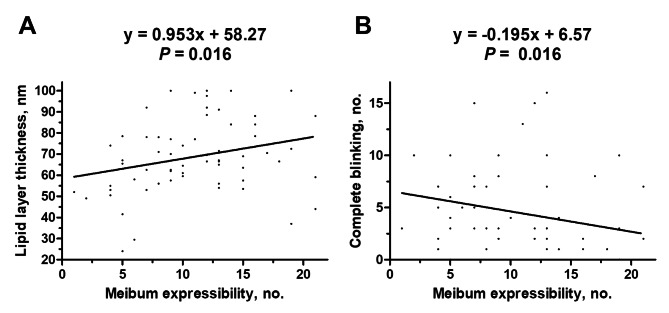
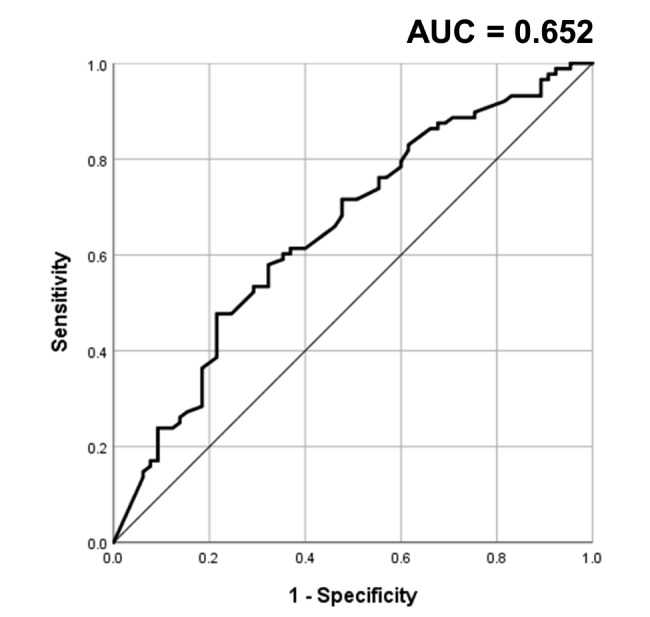
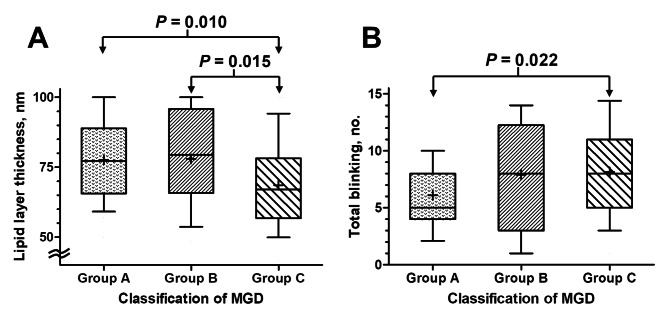
There was no difference in age, Schirmer's test, lid changes, MG secretion, and MG morphology among three groups. The OSDI of asymptomatic MGD, symptomatic MGD and MGD coexisting with DED were 8.5 ± 2.9, 28.5 ± 12.8 and 27.9 ± 10.5, respectively. Patients with MGD coexisting with DED exhibited more frequent eye blinking than that of patients with asymptomatic MGD (8.1 ± 4.1 vs. 6.1 ± 3.5 blinks/20 sec, P = 0.022), and reduced LLT than that of patients with asymptomatic MGD (68.6 ± 17.2 vs. 77.6 ± 14.5 nm, P = 0.010) and symptomatic MGD (78.0 ± 17.1 nm, P = 0.015). Multivariate analysis identified LLT (per nm, OR = 0.96, 95% CI = 0.93-0.99, P = 0.002) as a significant factor associated with DED development in MGD. The number of expressible MG was positively correlated with LLT (Spearman's correlation coefficient = 0.299, P = 0.016) but negatively correlated with the number of blinking (Spearman's correlation coefficient = -0.298, P = 0.016) in MGD patients with DED, and these findings were not identified in those without DED.

CONCLUSIONS

Asymptomatic MGD, symptomatic MGD, and MGD coexisting with DED share similar characteristics, including meibum secretion and morphology, but MGD patients coexisting with DED exhibited significantly reduced LLT.

摘要

目的

确定无症状性睑板腺功能障碍(MGD)、有症状性 MGD 和 MGD 合并干眼(DED)的特征。

方法

本横断面研究共纳入 87 例 MGD 患者的 153 只眼。参与者填写眼表疾病指数(OSDI)问卷。比较无症状性 MGD、有症状性 MGD 和 MGD 合并 DED 患者的年龄、性别、泪液分泌试验(Schirmer 试验)、睑板腺(MG)相关参数、脂质层厚度(LLT)和眨眼情况。采用多元回归分析 MGD 中 DED 的显著因素。采用 Spearman 秩相关分析评估显著因素与 MG 功能之间的相关性。

结果

三组患者的年龄、Schirmer 试验、眼睑变化、MG 分泌和 MG 形态均无差异。无症状性 MGD、有症状性 MGD 和 MGD 合并 DED 的 OSDI 分别为 8.5±2.9、28.5±12.8 和 27.9±10.5。与无症状性 MGD 患者相比,MGD 合并 DED 患者的眨眼频率更高(8.1±4.1 次/20 秒 vs. 6.1±3.5 次/20 秒,P=0.022),LLT 更低(68.6±17.2 纳米 vs. 77.6±14.5 纳米,P=0.010;78.0±17.1 纳米,P=0.015)。多因素分析发现 LLT(每纳米,OR=0.96,95%CI=0.93-0.99,P=0.002)是 MGD 患者发生 DED 的显著相关因素。MG 可挤出数量与 LLT 呈正相关(Spearman 相关系数=0.299,P=0.016),但与 DED 患者的眨眼次数呈负相关(Spearman 相关系数=-0.298,P=0.016),而在无 DED 的患者中则没有发现这种相关性。

结论

无症状性 MGD、有症状性 MGD 和 MGD 合并 DED 具有相似的特征,包括睑脂分泌和形态,但 MGD 合并 DED 的患者 LLT 明显降低。
https://cdn.ncbi.nlm.nih.gov/pmc/blobs/c743/10091660/2cbf23b426b7/12886_2023_2878_Fig3_HTML.jpg
https://cdn.ncbi.nlm.nih.gov/pmc/blobs/c743/10091660/0eeb1ea5198a/12886_2023_2878_Fig1_HTML.jpg
https://cdn.ncbi.nlm.nih.gov/pmc/blobs/c743/10091660/5d61cb1ea1e2/12886_2023_2878_Fig2_HTML.jpg
https://cdn.ncbi.nlm.nih.gov/pmc/blobs/c743/10091660/2cbf23b426b7/12886_2023_2878_Fig3_HTML.jpg
https://cdn.ncbi.nlm.nih.gov/pmc/blobs/c743/10091660/0eeb1ea5198a/12886_2023_2878_Fig1_HTML.jpg
https://cdn.ncbi.nlm.nih.gov/pmc/blobs/c743/10091660/5d61cb1ea1e2/12886_2023_2878_Fig2_HTML.jpg
https://cdn.ncbi.nlm.nih.gov/pmc/blobs/c743/10091660/2cbf23b426b7/12886_2023_2878_Fig3_HTML.jpg

相似文献

1
Differential characteristics among asymptomatic and symptomatic meibomian gland dysfunction and those with dry eye.无症状和有症状的睑板腺功能障碍以及干眼症之间的差异特征。
BMC Ophthalmol. 2023 Apr 11;23(1):154. doi: 10.1186/s12886-023-02878-5.
2
Evaluation of incomplete blinking as a measurement of dry eye disease.评估不完全眨眼作为干眼症的测量指标。
Ocul Surf. 2019 Jul;17(3):440-446. doi: 10.1016/j.jtos.2019.05.007. Epub 2019 May 29.
3
Assessment of tear film lipid layer thickness in patients with Meibomian gland dysfunction at different ages.不同年龄睑板腺功能障碍患者泪膜脂质层厚度的评估。
BMC Ophthalmol. 2020 Oct 6;20(1):394. doi: 10.1186/s12886-020-01667-8.
4
Objective optical assessment of tear-film quality dynamics in patients with meibomian gland dysfunction and aqueous-deficient dry eye optical quality changes in different dry eye subtypes.目的 评估患有睑板腺功能障碍的患者的泪膜质量动态和不同干眼亚型的水样液缺乏性干眼的光学质量变化。
Indian J Ophthalmol. 2019 May;67(5):599-603. doi: 10.4103/ijo.IJO_1278_18.
5
Dry eye disease and meibomian gland dysfunction among a clinical sample of type 2 diabetes patients in Ghana.加纳 2 型糖尿病患者临床样本中的干眼疾病和睑板腺功能障碍。
Afr Health Sci. 2022 Mar;22(1):293-302. doi: 10.4314/ahs.v22i1.36.
6
Increased Tear Fluid Production as a Compensatory Response to Meibomian Gland Loss: A Multicenter Cross-sectional Study.泪液分泌增加作为麦氏腺缺失的代偿反应:一项多中心横断面研究。
Ophthalmology. 2015 May;122(5):925-33. doi: 10.1016/j.ophtha.2014.12.018. Epub 2015 Jan 24.
7
Human precorneal tear film and lipid layer dynamics in meibomian gland dysfunction.人眼角膜前泪膜和睑板腺功能障碍的脂质层动力学。
Ocul Surf. 2021 Jul;21:250-256. doi: 10.1016/j.jtos.2021.03.006. Epub 2021 Mar 23.
8
Lateral Canthal Sling Procedure for Meibomian Gland Dysfunction? Results of a Pilot Study.外侧眦吊带术治疗睑板腺功能障碍?一项初步研究的结果。
Curr Eye Res. 2021 Oct;46(10):1489-1494. doi: 10.1080/02713683.2021.1896741. Epub 2021 Mar 22.
9
Categorization of Meibomian Gland Dysfunction Using Lipid Layer Thickness and Meibomian Gland Dropout in Dry Eye Patients: A Retrospective Study.干眼症患者通过脂质层厚度和睑板腺缺失程度进行睑板腺功能障碍分类:一项回顾性研究。
Korean J Ophthalmol. 2024 Feb;38(1):64-70. doi: 10.3341/kjo.2023.0126. Epub 2023 Dec 27.
10
Image-based quantitative analysis of tear film lipid layer thickness for meibomian gland evaluation.基于图像的泪膜脂质层厚度定量分析用于评估睑板腺。
Biomed Eng Online. 2017 Nov 23;16(1):135. doi: 10.1186/s12938-017-0426-8.

引用本文的文献

1
A Comprehensive Assessment of Tear-Film-Oriented Diagnosis (TFOD) in a Dacryoadenectomy Dry Eye Model.泪膜导向诊断(TFOD)在干燥性眼模型中的全面评估。
Int J Mol Sci. 2023 Nov 20;24(22):16510. doi: 10.3390/ijms242216510.

本文引用的文献

1
Autoimmunity in dry eye disease - An updated review of evidence on effector and memory Th17 cells in disease pathogenicity.干燥性眼疾中的自身免疫 - 对效应器和记忆性 Th17 细胞在疾病发病机制中作用的证据的最新综述。
Autoimmun Rev. 2021 Nov;20(11):102933. doi: 10.1016/j.autrev.2021.102933. Epub 2021 Sep 9.
2
Assessment of tear film lipid layer thickness in patients with Meibomian gland dysfunction at different ages.不同年龄睑板腺功能障碍患者泪膜脂质层厚度的评估。
BMC Ophthalmol. 2020 Oct 6;20(1):394. doi: 10.1186/s12886-020-01667-8.
3
A New Perspective on Dry Eye Classification: Proposal by the Asia Dry Eye Society.
干眼分类的新视角:亚洲干眼学会的建议。
Eye Contact Lens. 2020 Jan;46 Suppl 1(1):S2-S13. doi: 10.1097/ICL.0000000000000643.
4
Pigment epithelium-derived factor peptide reverses mouse age-related meibomian gland atrophy.色素上皮衍生因子肽逆转小鼠年龄相关性睑板腺萎缩。
Exp Eye Res. 2019 Aug;185:107678. doi: 10.1016/j.exer.2019.05.018. Epub 2019 May 23.
5
Meibomian Gland Dysfunction and Dry Eye Are Similar but Different Based on a Population-Based Study: The Hirado-Takushima Study in Japan.基于一项基于人群的研究:日本平户岛-对马岛研究显示,睑板腺功能障碍和干眼症相似但不同。
Am J Ophthalmol. 2019 Nov;207:410-418. doi: 10.1016/j.ajo.2019.02.024. Epub 2019 Mar 7.
6
Characterization of the thickness of the tear film lipid layer using high resolution microscopy.使用高分辨率显微镜对泪膜脂质层的厚度进行特征描述。
Ocul Surf. 2019 Apr;17(2):356-359. doi: 10.1016/j.jtos.2018.12.003. Epub 2018 Dec 15.
7
Human meibum chain branching variability with age, gender and meibomian gland dysfunction.人眼脂链分支的可变性与年龄、性别和睑板腺功能障碍有关。
Ocul Surf. 2019 Apr;17(2):327-335. doi: 10.1016/j.jtos.2018.12.005. Epub 2018 Dec 12.
8
Therapeutic efficacy of intense pulsed light in patients with refractory meibomian gland dysfunction.强脉冲光治疗难治性睑板腺功能障碍的疗效。
Ocul Surf. 2019 Jan;17(1):104-110. doi: 10.1016/j.jtos.2018.11.004. Epub 2018 Nov 13.
9
The prevalence of meibomian gland dysfunction, tear film and ocular surface parameters in an Austrian dry eye clinic population.在奥地利干眼症诊所人群中,睑板腺功能障碍、泪膜和眼表面参数的流行情况。
Acta Ophthalmol. 2018 Sep;96(6):e707-e711. doi: 10.1111/aos.13732. Epub 2018 Apr 15.
10
The significance of meibomian gland changes in asymptomatic children.无症状儿童的睑板腺变化的意义。
Ocul Surf. 2018 Jul;16(3):301-305. doi: 10.1016/j.jtos.2018.03.006. Epub 2018 Mar 21.