National Institute of Polar Research, Tachikawa, Tokyo, Japan.
Department of Polar Science, The Graduate University for Advanced Studies, SOKENDAI, Tachikawa, Tokyo, Japan.
Nat Commun. 2023 Apr 12;14(1):2054. doi: 10.1038/s41467-023-37637-z.
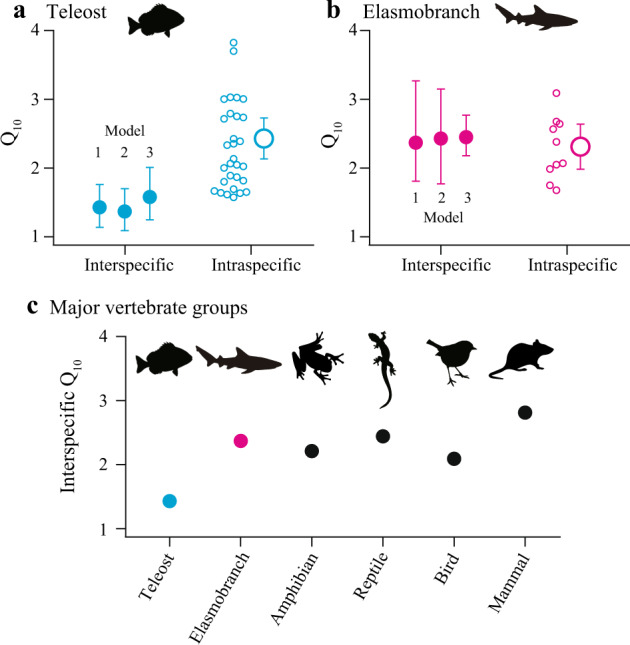
Environmental temperature affects physiological functions, representing a barrier for the range expansions of ectothermic species. To understand the link between thermal physiology and biogeography, a key question is whether among-species thermal sensitivity of metabolic rates is mechanistically constrained or buffered through physiological remodeling over evolutionary time. The former conception, the Universal Temperature Dependence hypothesis, predicts similar among- and within-species thermal sensitivity. The latter conception, the Metabolic Cold Adaptation hypothesis, predicts lower among-species thermal sensitivity than within-species sensitivity. Previous studies that tested these hypotheses for fishes overwhelmingly investigated teleosts with elasmobranchs understudied. Here, we show that among-species thermal sensitivity of resting metabolic rates is lower than within-species sensitivity in teleosts but not in elasmobranchs. Further, species richness declines with latitude more rapidly in elasmobranchs than in teleosts. Metabolic Cold Adaptation exhibited by teleosts might underpin their high diversity at high latitudes, whereas the inflexible thermal sensitivity approximated by Universal Temperature Dependence of elasmobranchs might explain their low diversity at high latitudes.
环境温度会影响生理机能,这是变温动物物种扩散范围的一个限制因素。为了理解热生理学与生物地理学之间的联系,一个关键问题是,物种间代谢率的热敏感性是通过进化过程中的生理重塑而受到机械限制还是得到缓冲。前者的概念,即普遍温度依赖性假设,预测了物种间和种内的热敏感性具有相似性。后者的概念,即代谢性冷适应假设,预测物种间的热敏感性比种内敏感性低。之前测试这些假设的鱼类研究大多集中在软骨鱼类研究不足的硬骨鱼类上。在这里,我们发现硬骨鱼类的种间静息代谢率的热敏感性低于种内敏感性,但软骨鱼类则不然。此外,软骨鱼类的物种丰富度随纬度的增加比硬骨鱼类更快地减少。硬骨鱼类表现出的代谢性冷适应可能是其在高纬度地区多样性高的基础,而软骨鱼类近似的普遍温度依赖性的热敏感性可能解释了其在高纬度地区多样性低的原因。