Key Laboratory of Biology, Genetics and Breeding of Special Economic Animals and Plants, Ministry of Agriculture and Rural Affairs, National Center for Tea Plant Improvement, Tea Research Institute, Chinese Academy of Agricultural Sciences, 9th South of Meiling Road, Hangzhou 310008, China.
College of Horticulture & Forestry Sciences, Huazhong Agricultural University, Wuhan 430070, China.
Int J Mol Sci. 2023 Mar 27;24(7):6288. doi: 10.3390/ijms24076288.
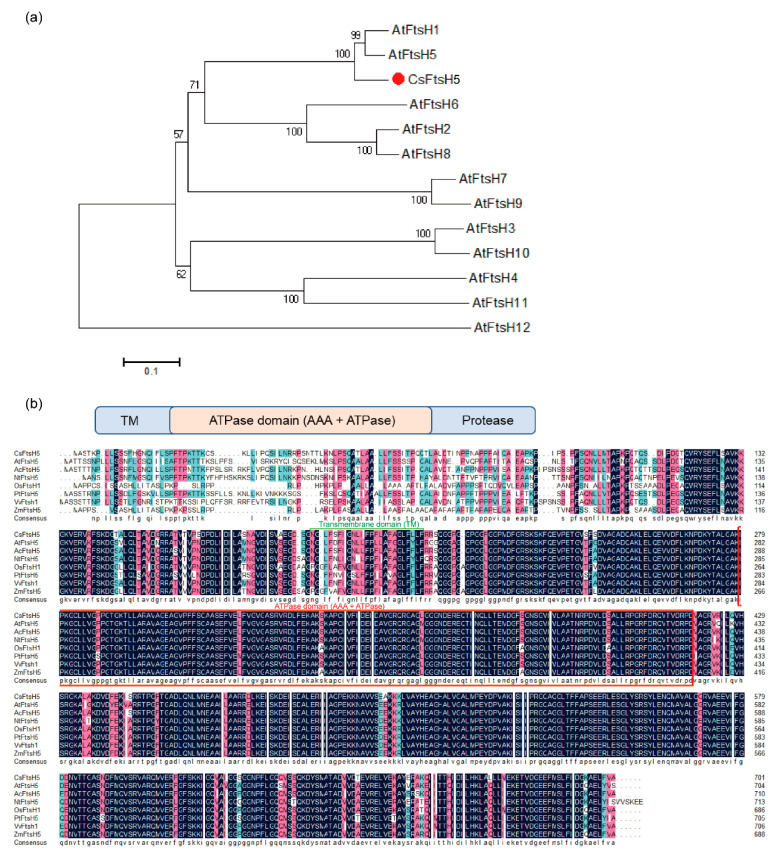
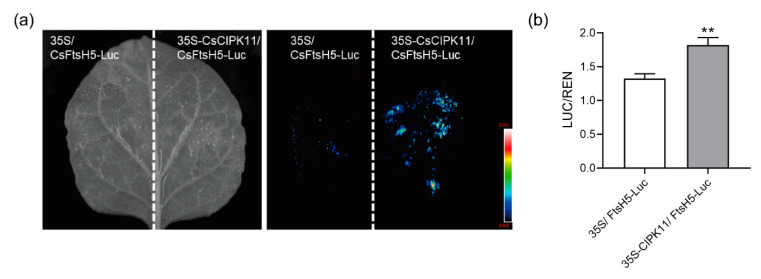
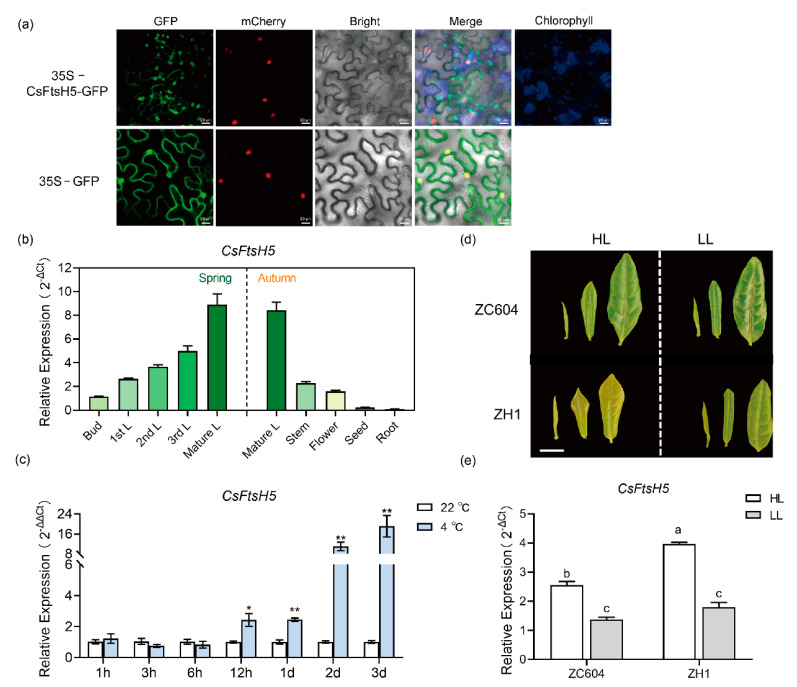
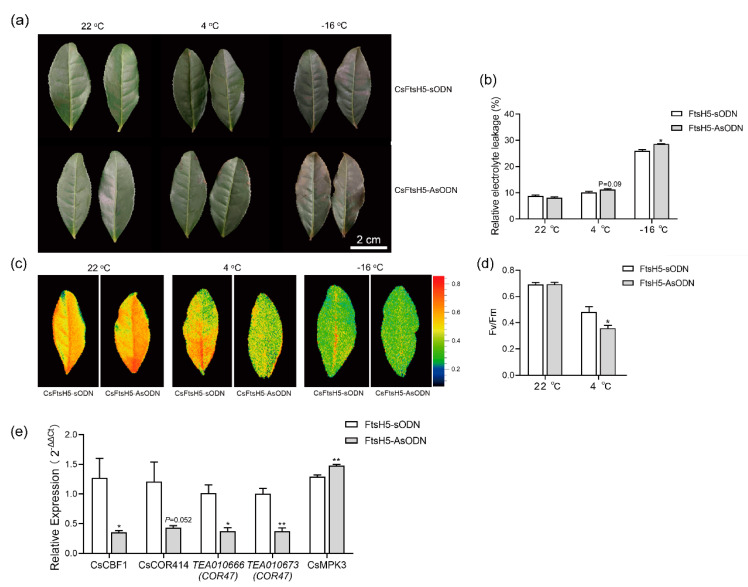
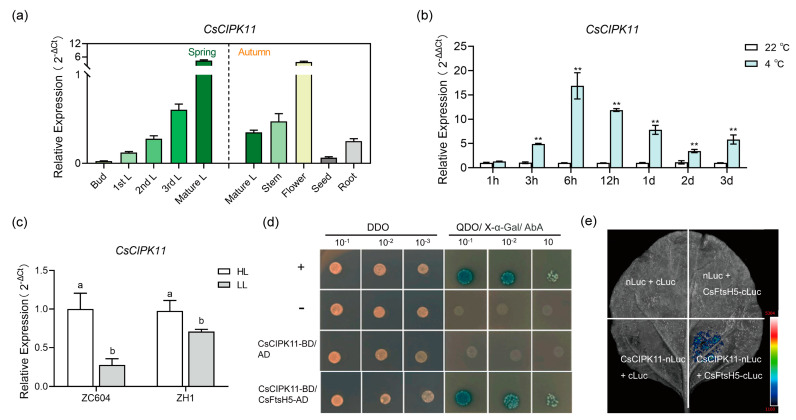
Photosystem II repair in chloroplasts is a critical process involved in maintaining a plant's photosynthetic activity under cold stress. FtsH (filamentation temperature-sensitive H) is an essential metalloprotease that is required for chloroplast photosystem II repair. However, the role of FtsH in tea plants and its regulatory mechanism under cold stress remains elusive. In this study, we cloned a homolog gene in tea plants, named , and found that CsFtsH5 was located in the chloroplast and cytomembrane. RT-qPCR showed that the expression of was increased with leaf maturity and was significantly induced by light and cold stress. Transient knockdown expression in tea leaves using antisense oligonucleotides resulted in hypersensitivity to cold stress, along with higher relative electrolyte leakage and lower values. To investigate the molecular mechanism underlying involvement in the cold stress, we focused on the calcineurin B-like-interacting protein kinase 11 (), which had a tissue expression pattern similar to that of and was also upregulated by light and cold stress. Yeast two-hybrid and dual luciferase (Luc) complementation assays revealed that CsFtsH5 interacted with CsCIPK11. Furthermore, the Dual-Luc assay showed that CsCIPK11-CsFtsH5 interaction might enhance CsFtsH5 stability. Altogether, our study demonstrates that is associated with and plays a positive role in maintaining the photosynthetic activity of tea plants in response to low temperatures.
叶绿体中光系统 II 的修复是一个关键过程,涉及到植物在低温胁迫下维持其光合作用活性。FtsH(丝状温度敏感 H)是一种必需的金属蛋白酶,对于叶绿体光系统 II 的修复是必需的。然而,FtsH 在茶树中的作用及其在低温胁迫下的调控机制仍不清楚。在本研究中,我们克隆了茶树中的一个同源基因,命名为 ,并发现 CsFtsH5 位于叶绿体和质膜中。RT-qPCR 结果表明, 基因的表达随叶片成熟度的增加而增加,并显著受光和低温胁迫诱导。利用反义寡核苷酸瞬时敲低茶树叶片中的 表达,导致对低温胁迫的敏感性增加,同时相对电解质渗漏率升高, 值降低。为了研究 参与低温胁迫的分子机制,我们重点研究了钙调神经磷酸酶 B 样相互作用蛋白激酶 11(),其组织表达模式与 相似,也受到光和低温胁迫的上调。酵母双杂交和双荧光素酶(Luc)互补实验表明 CsFtsH5 与 CsCIPK11 相互作用。此外,双荧光素酶实验表明 CsCIPK11-CsFtsH5 相互作用可能增强 CsFtsH5 的稳定性。总之,我们的研究表明 与 相关,并在维持茶树的光合作用活性以应对低温方面发挥积极作用。