Amirrah Ibrahim N, Zulkiflee Izzat, Mohd Razip Wee M F, Masood Asad, Siow Kim S, Motta Antonella, Fauzi Mh Busra
Centre for Tissue Engineering and Regenerative Medicine, Faculty of Medicine, Universiti Kebangsaan Malaysia, Jalan Yaacob Latiff, Bandar Tun Razak, Cheras, Kuala Lumpur 56000, Malaysia.
Institute of Microengineering and Nanoelectronics (IMEN), Universiti Kebangsaan Malaysia, Bangi 43600, Malaysia.
Materials (Basel). 2023 Mar 29;16(7):2739. doi: 10.3390/ma16072739.
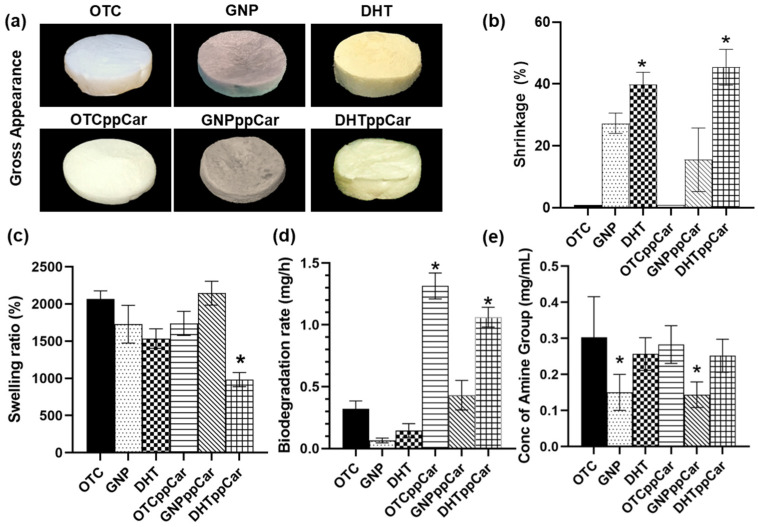
Tissue engineering products have grown in popularity as a therapeutic approach for chronic wounds and burns. However, some drawbacks include additional steps and a lack of antibacterial capacities, both of which need to be addressed to treat wounds effectively. This study aimed to develop an acellular, ready-to-use ovine tendon collagen type I (OTC-I) bioscaffold with an antibacterial coating for the immediate treatment of skin wounds and to prevent infection post-implantation. Two types of crosslinkers, 0.1% genipin (GNP) and dehydrothermal treatment (DHT), were explored to optimise the material strength and biodegradability compared with a non-crosslinked (OTC) control. Carvone plasma polymerisation (ppCar) was conducted to deposit an antibacterial protective coating. Various parameters were performed to investigate the physicochemical properties, mechanical properties, microstructures, biodegradability, thermal stability, surface wettability, antibacterial activity and biocompatibility of the scaffolds on human skin cells between the different crosslinkers, with and without plasma polymerisation. GNP is a better crosslinker than DHT because it demonstrated better physicochemical properties (27.33 ± 5.69% vs. 43 ± 7.64% shrinkage), mechanical properties (0.15 ± 0.15 MPa vs. 0.07 ± 0.08 MPa), swelling (2453 ± 419.2% vs. 1535 ± 392.9%), biodegradation (0.06 ± 0.06 mg/h vs. 0.15 ± 0.16 mg/h), microstructure and biocompatibility. Similarly, its ppCar counterpart, GNPppCar, presents promising results as a biomaterial with enhanced antibacterial properties. Plasma-polymerised carvone on a crosslinked collagen scaffold could also support human skin cell proliferation and viability while preventing infection. Thus, GNPppCar has potential for the rapid treatment of healing wounds.
组织工程产品作为慢性伤口和烧伤的一种治疗方法越来越受欢迎。然而,一些缺点包括额外的步骤和缺乏抗菌能力,这两者都需要解决才能有效治疗伤口。本研究旨在开发一种无细胞、即用型的I型羊肌腱胶原蛋白(OTC-I)生物支架,并带有抗菌涂层,用于皮肤伤口的即时治疗并预防植入后感染。与未交联的(OTC)对照相比,探索了两种交联剂,即0.1%京尼平(GNP)和脱氢热处理(DHT),以优化材料强度和生物降解性。进行香芹酮等离子体聚合(ppCar)以沉积抗菌保护涂层。对不同交联剂、有无等离子体聚合的支架,进行了各种参数测定,以研究其物理化学性质、机械性能、微观结构、生物降解性、热稳定性、表面润湿性、抗菌活性和对人皮肤细胞的生物相容性。GNP是比DHT更好的交联剂,因为它表现出更好的物理化学性质(收缩率27.33±5.69%对43±7.64%)、机械性能(0.15±0.15兆帕对0.07±0.08兆帕)、膨胀率(2453±419.2%对1535±392.9%)、生物降解性(0.06±0.06毫克/小时对0.15±0.16毫克/小时)、微观结构和生物相容性。同样,其ppCar对应物GNPppCar作为一种具有增强抗菌性能的生物材料呈现出有前景的数据。交联胶原支架上的等离子体聚合香芹酮还可以支持人皮肤细胞增殖和活力,同时预防感染。因此,GNPppCar在快速治疗愈合伤口方面具有潜力。