Department of Exercise Physiology, University of Kurdistan, Sanandaj 66177-15175, Iran.
Department of Molecular Biology and Genetics, Federal Research and Clinical Center of Physical-Chemical Medicine of Federal Medical Biological Agency, 119435 Moscow, Russia.
Nutrients. 2023 Mar 28;15(7):1634. doi: 10.3390/nu15071634.
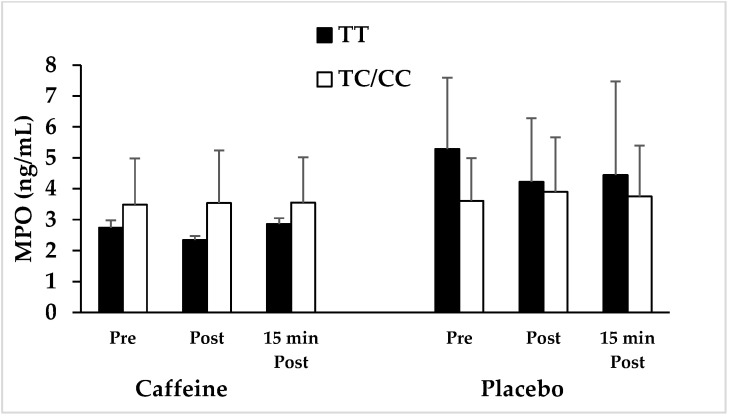
Caffeine is an adenosine A receptor () antagonist with ergogenic and anti-inflammatory effects. Previous studies have reported that the gene regulates glutamate metabolism and immune responses, with the rs5751876 TT genotype (with high sensitivity to caffeine) showing larger ergogenic effect following caffeine ingestion. We therefore hypothesized that the TT genotype would be associated with greater anti-inflammatory effects of caffeine in response to exercise, and with higher coffee intake in physically active individuals. The aim of the present study was twofold: (1) to investigate the association of the variant with the anti-inflammatory effects of caffeine in response to intense resistance exercise (RE), and (2) to analyze the association of the rs5751876 with coffee intake in physically active individuals ( = 134). Fifteen resistance-trained athletes participated in a randomized, double-blind, placebo-controlled cross-over study, where they consumed 6 mg/kg of caffeine or placebo one hour prior to performing an RE protocol. Blood samples were taken immediately from the arterial vein before, immediately after, and 15 min after RE for the analysis of inflammatory markers myeloperoxidase (MPO) and acetylcholinesterase (AChE). We found that the TT genotype carriers experienced lower exercise-induced inflammatory responses ( < 0.05 for AchE) when compared to the C allele carriers (i.e., CC/CT) one hour following the ingestion of caffeine. Furthermore, the TT genotype was positively associated with coffee intake ( = 0.0143; irrespective of rs762551 polymorphism). In conclusion, we found that the gene polymorphism is associated with anti-inflammatory effects of caffeine in response to resistance exercise, as well as with habitual coffee intake in physically active individuals.
咖啡因是一种腺苷 A 受体()拮抗剂,具有促进身体机能和抗炎作用。先前的研究表明,基因调节谷氨酸代谢和免疫反应,而 rs5751876 TT 基因型(对咖啡因高度敏感)在摄入咖啡因后表现出更大的促进身体机能作用。因此,我们假设 TT 基因型与咖啡因在运动后的抗炎作用更大有关,并且与活跃个体的咖啡摄入量更高有关。本研究的目的有两个:(1)研究在剧烈抗阻运动(RE)中,的变体与咖啡因抗炎作用之间的关系,(2)分析 rs5751876 与活跃个体咖啡摄入量之间的关系(= 134)。15 名抗阻训练运动员参加了一项随机、双盲、安慰剂对照交叉研究,他们在进行 RE 方案前 1 小时内摄入 6 毫克/千克的咖啡因或安慰剂。在进行 RE 前、后即刻和 15 分钟后,从动脉静脉采血,用于分析炎症标志物髓过氧化物酶(MPO)和乙酰胆碱酯酶(AChE)。我们发现,与 C 等位基因携带者(即 CC/CT)相比,TT 基因型携带者在摄入咖啡因后 1 小时,经历的运动诱导的炎症反应更低(AchE 时<0.05)。此外,TT 基因型与咖啡摄入量呈正相关(= 0.0143;与 rs762551 多态性无关)。总之,我们发现基因多态性与咖啡因对抵抗运动的抗炎作用有关,也与活跃个体的习惯性咖啡摄入量有关。