Health Sciences PhD Programme, International Doctoral School, Universidad Rey Juan Carlos, 28922 Madrid, Spain.
Kinesiology Department, Faculty of Medicine, Universidad de Concepción, Concepción, 151 Janequeo St., Concepcion 4030000, Chile.
Sensors (Basel). 2023 Mar 24;23(7):3426. doi: 10.3390/s23073426.
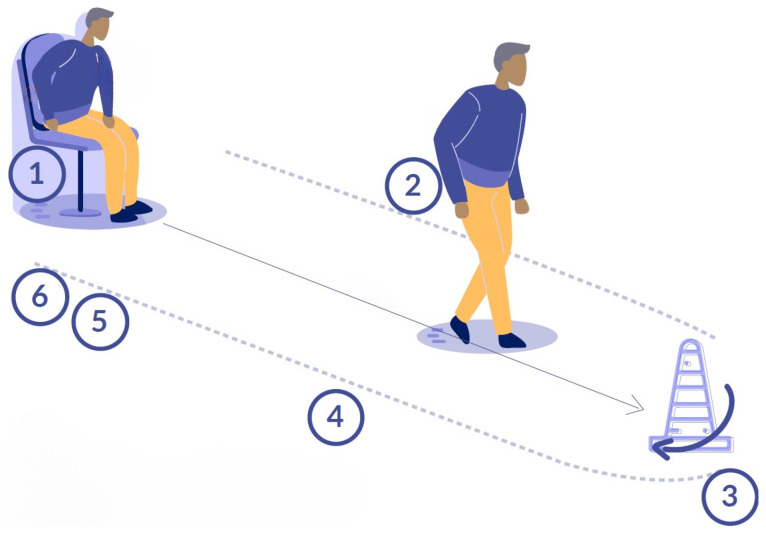
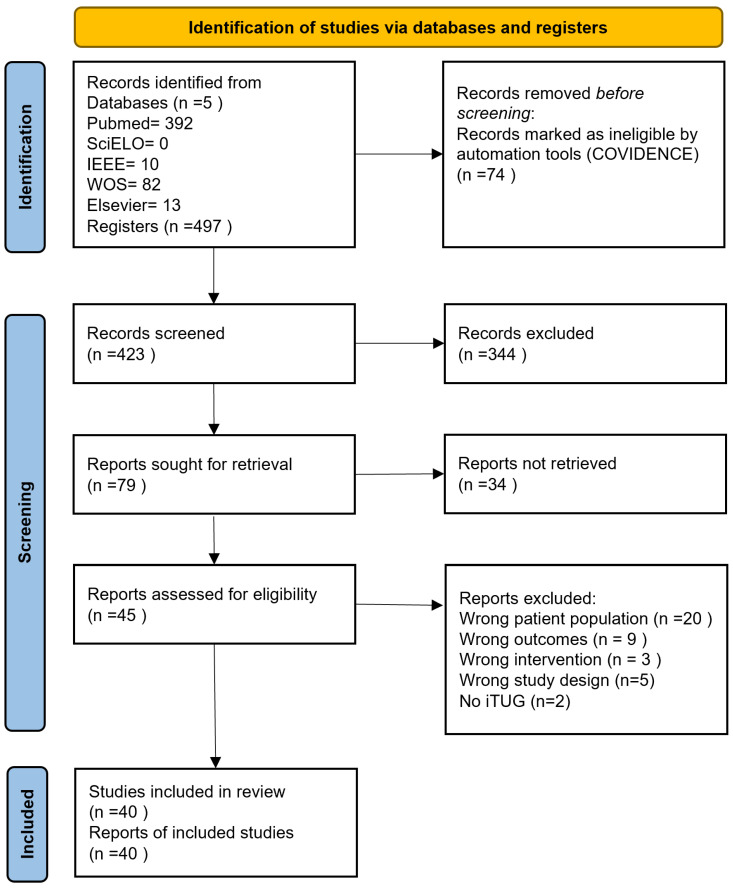
The Timed Up and Go (TUG) test is a widely used tool for assessing the risk of falls in older adults. However, to increase the test's predictive value, the instrumented Timed Up and Go (iTUG) test has been developed, incorporating different technological approaches. This systematic review aims to explore the evidence of the technological proposal for the segmentation and analysis of iTUG in elderlies with or without pathologies. A search was conducted in five major databases, following PRISMA guidelines. The review included 40 studies that met the eligibility criteria. The most used technology was inertial sensors (75% of the studies), with healthy elderlies (35%) and elderlies with Parkinson's disease (32.5%) being the most analyzed participants. In total, 97.5% of the studies applied automatic segmentation using rule-based algorithms. The iTUG test offers an economical and accessible alternative to increase the predictive value of TUG, identifying different variables, and can be used in clinical, community, and home settings.
计时起身行走测试(TUG)是一种广泛用于评估老年人跌倒风险的工具。然而,为了提高测试的预测价值,已经开发出了仪器化计时起身行走测试(iTUG),结合了不同的技术方法。本系统评价旨在探讨 iTUG 分段和分析的技术方案在有无病理情况下老年人中的证据。根据 PRISMA 指南,在五个主要数据库中进行了检索。该综述纳入了符合入选标准的 40 项研究。最常用的技术是惯性传感器(75%的研究),分析的参与者主要是健康老年人(35%)和帕金森病老年人(32.5%)。总的来说,97.5%的研究使用基于规则的算法进行自动分段。iTUG 测试提供了一种经济且易于使用的替代方案,可提高 TUG 的预测价值,识别不同的变量,并可在临床、社区和家庭环境中使用。