Department of Arboviruses, NHC Key Laboratory of Biosafety, National Institute for Viral Disease Control and Prevention, State Key Laboratory for Infectious Disease Prevention and Control, Chinese Center for Disease Control and Prevention, Beijing, PR China.
Yunnan Provincial Key Laboratory for Zoonosis Control and Prevention, Yunnan Institute of Endemic Disease Control and Prevention, Dali, PR China.
PLoS Negl Trop Dis. 2023 Apr 13;17(4):e0011192. doi: 10.1371/journal.pntd.0011192. eCollection 2023 Apr.
Japanese encephalitis virus (JEV; Flaviridae: Flavivirus) causes Japanese encephalitis (JE), which is the most important arboviral disease in Asia and the western Pacific. Among the five JEV genotypes (GI-V), GI has dominated traditional epidemic regions in the past 20 years. We investigated the transmission dynamics of JEV GI through genetic analyses.
We generated 18 JEV GI near full length sequences by using multiple sequencing approaches from mosquitoes collected in natural settings or from viral isolates obtained through cell culture. We performed phylogenetic and molecular clock analyses to reconstruct the evolutionary history by integrating our data with 113 publicly available JEV GI sequences.
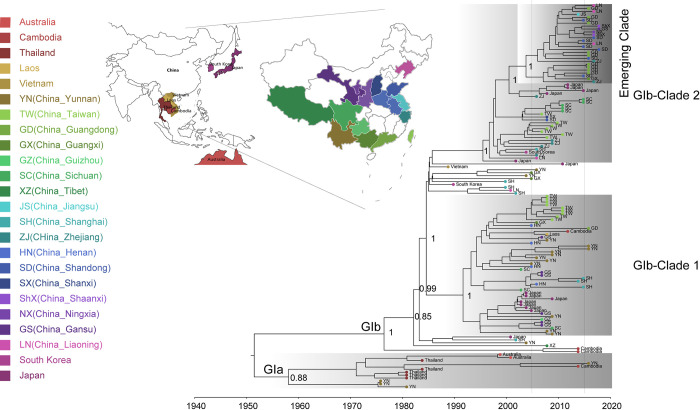
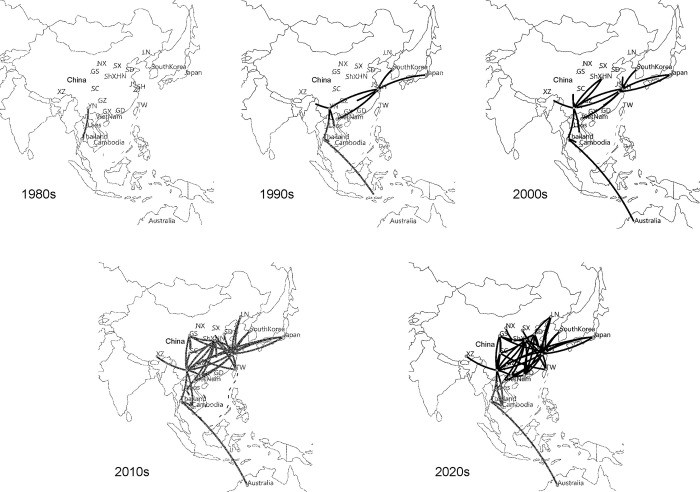
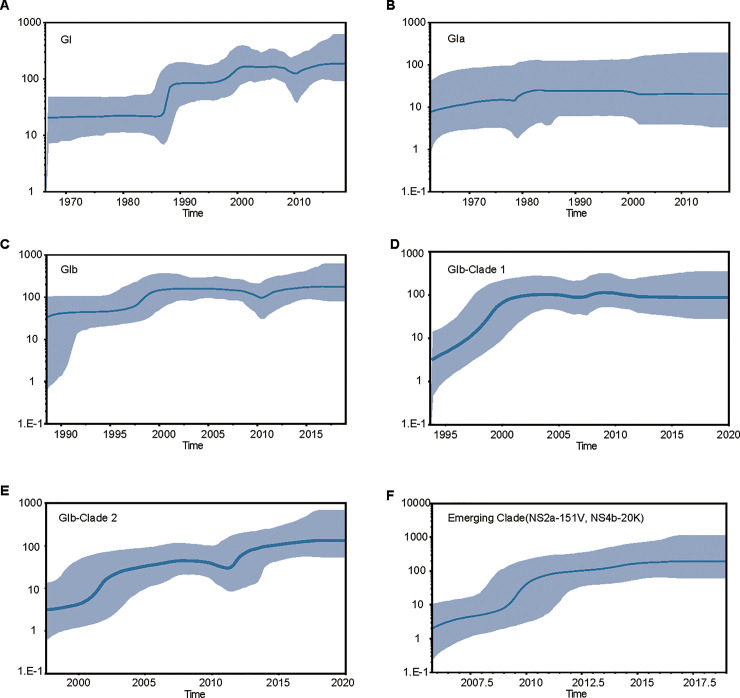
We identified two subtypes of JEV GI (GIa and GIb), with a rate of 5.94 × 10⁻⁴ substitutions per site per year (s/s/y). At present, GIa still circulates within a limited region, exhibited no significant growth, the newest strain was discovered in China (Yunnan) in 2017, whereas most JEV strains circulating belong to the GIb clade. During the past 30 years, two large GIb clades have triggered epidemics in eastern Asia: one epidemic occurred in 1992 [95% highest posterior density (HPD) = 1989-1995] and the causative strain circulates mainly in southern China (Yunnan, Shanghai, Guangdong, and Taiwan) (Clade 1); the other epidemic occurred in 1997 (95% HPD = 1994-1999) and the causative strain has increased in circulation in northern and southern China during the past 5 years (Clade 2). An emerging variant of Clade 2 contains two new amino acid markers (NS2a-151V, NS4b-20K) that emerged around 2005; this variant has demonstrated exponential growth in northern China.
JEV GI stain circulating in Asia have shifted during the past 30 years, spatiotemporal differences were observed among JEV GI subclade. GIa is still circulating within a limited range, exhibite no significant growth. Two large GIb clades have triggered epidemics in eastern Asia, all JEV sequences identified in northern China during the past 5 years were of the new emerging variant of G1b-clade 2.
日本脑炎病毒(JEV;黄病毒科:黄病毒属)引起日本脑炎(JE),是亚洲和西太平洋地区最重要的虫媒病毒病之一。在五个 JEV 基因型(GI-V)中,GI 在过去 20 年中一直主导着传统的流行地区。我们通过遗传分析研究了 JEV GI 的传播动态。
我们通过多种测序方法从自然环境中采集的蚊子或通过细胞培养获得的病毒分离物中生成了 18 个 JEV GI 近全长序列。我们进行了系统发育和分子钟分析,通过整合我们的数据和 113 个公开可用的 JEV GI 序列来重建进化史。
我们鉴定出两种 JEV GI 亚型(GIa 和 GIb),每年每个位点的替换率为 5.94×10⁻⁴ s/s/y。目前,GIa 仍在有限的区域内传播,没有明显的增长,最新的毒株于 2017 年在中国(云南)发现,而循环的大多数 JEV 株属于 GIb 分支。在过去的 30 年中,两个大的 GIb 分支在东亚引发了疫情:一次疫情发生在 1992 年[95%最高后验密度(95% HPD)=1989-1995],主要在我国南方(云南、上海、广东和台湾)循环的致病株(Clade 1);另一次疫情发生在 1997 年(95% HPD=1994-1999),过去 5 年来,在我国北方和南方,致病株的循环量有所增加(Clade 2)。Clade 2 的一个新出现的变体包含两个新的氨基酸标记(NS2a-151V,NS4b-20K),它们大约在 2005 年出现;这种变体在中国北方呈指数增长。
在过去的 30 年中,亚洲循环的 JEV GI 株发生了变化,JEV GI 亚分支之间存在时空差异。GIa 仍在有限的范围内循环,没有明显的增长。两个大的 GIb 分支在东亚引发了疫情,过去 5 年在中国北方鉴定的所有 JEV 序列均为 GIb-1b 新出现的变体 2。