Yang Ying, Li Min, Zhou Bixia, Jiang Xulei, Zhang Dou, Luo Hang
Department of Plastic Surgery, Xiangya Hospital, Central South University, Changsha, 410008, China.
State Key Laboratory of Powder Metallurgy, Central South University, Changsha, 410083, China.
Bioact Mater. 2022 Jul 21;25:594-614. doi: 10.1016/j.bioactmat.2022.07.015. eCollection 2023 Jul.
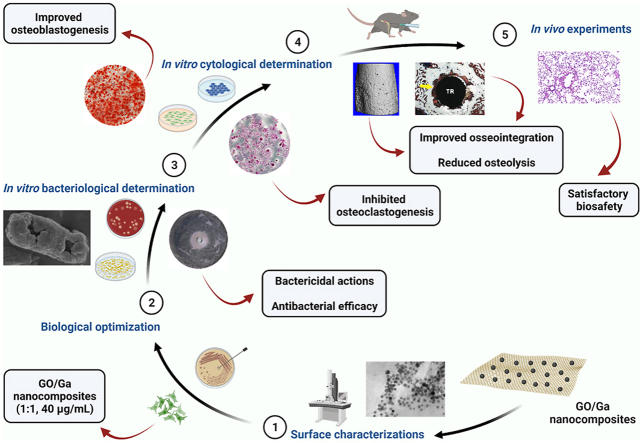
Currently, implant-associated bacterial infections account for most hospital-acquired infections in patients suffering from bone fractures or defects. Poor osseointegration and aggravated osteolysis remain great challenges for the success of implants in infectious scenarios. Consequently, developing an effective surface modification strategy for implants is urgently needed. Here, a novel nanoplatform (GO/Ga) consisting of graphene oxide (GO) and gallium nanoparticles (GaNPs) was reported, followed by investigations of its antibacterial activity and potential bacterium inactivation mechanisms, cytocompatibility and regulatory actions on osteoblastogenesis and osteoclastogenesis. In addition, the possible molecular mechanisms underlying the regulatory effects of GO/Ga nanocomposites on osteoblast differentiation and osteoclast formation were clarified. Moreover, an infectious microenvironment was established in a rat model of implant-related femoral osteomyelitis to determine the therapeutic efficacy and biosafety of GO/Ga nanocomposites. Our results indicate that GO/Ga nanocomposites with excellent antibacterial potency have evident osteogenic potential and inhibitory effects on osteoclast differentiation by modulating the BMP/Smad, MAPK and NF-κB signaling pathways. The experiments revealed that the administration of GO/Ga nanocomposites significantly inhibited bone infections, reduced osteolysis, promoted osseointegration located in implant-bone interfaces, and resulted in satisfactory biocompatibility. In summary, this synergistic therapeutic system could accelerate the bone healing process in implant-associated infections and can significantly guide the future surface modification of implants used in bacteria-infected environments.
目前,植入物相关的细菌感染占骨折或骨缺损患者医院获得性感染的大多数。在感染情况下,植入物的骨整合不良和骨质溶解加剧仍然是植入物成功应用的巨大挑战。因此,迫切需要开发一种有效的植入物表面改性策略。在此,报道了一种由氧化石墨烯(GO)和镓纳米颗粒(GaNPs)组成的新型纳米平台(GO/Ga),随后研究了其抗菌活性、潜在的细菌灭活机制、细胞相容性以及对成骨细胞生成和破骨细胞生成的调节作用。此外,还阐明了GO/Ga纳米复合材料对成骨细胞分化和破骨细胞形成的调节作用的潜在分子机制。此外,在植入物相关股骨骨髓炎大鼠模型中建立了感染微环境,以确定GO/Ga纳米复合材料的治疗效果和生物安全性。我们的结果表明,具有优异抗菌效力的GO/Ga纳米复合材料通过调节BMP/Smad、MAPK和NF-κB信号通路,具有明显的成骨潜力和对破骨细胞分化的抑制作用。实验表明,给予GO/Ga纳米复合材料可显著抑制骨感染、减少骨质溶解、促进植入物-骨界面的骨整合,并具有令人满意的生物相容性。总之,这种协同治疗系统可以加速植入物相关感染中的骨愈合过程,并能显著指导未来在细菌感染环境中使用的植入物的表面改性。