Zeng Chunyuan, Guo Bin, Zhang Shaojuan, Zhou Ziqing, Cai Qijun, Hou Lu, Tan Zhiqiang, Gan Jiefeng, Mai Jinci, Li Ying, Li Yuefeng, Wang Lu, Gong Jian, Xu Hao
Department of Nuclear Medicine, The First Affiliated Hospital of Jinan University, Guangzhou, China.
Guangdong Landau Biotechnology Co., Ltd., Guangzhou, China.
Quant Imaging Med Surg. 2023 Apr 1;13(4):2038-2052. doi: 10.21037/qims-22-763. Epub 2023 Feb 7.
Cynomolgus monkeys are widely used in studies related to osteoporosis, and there is no evidence of age-related changes in volumetric bone mineral density (vBMD) measured using quantitative computed tomography (QCT) in nonhuman primates. This study aimed to describe changes in the characteristics of lumbar vBMD with age, to analyze the relationship between lumbar vBMD and body composition, and to investigate the precision of QCT measurements in healthy female cynomolgus monkeys.
Age-related changes in lumbar vBMD were described using cubic regression models, and the accumulated bone loss rates (ABLR) of the lumbar spine were calculated. Spearman rank correlation and ridge regression analysis were used to investigate the relationship of the average lumbar vBMD and body components. Thirty animals were selected to analyze the short-term precision of the QCT measurements. The precision was expressed as the root-mean-square coefficient of variation (RMS-CV%) or root-mean-square standard deviation (RMS-SD).
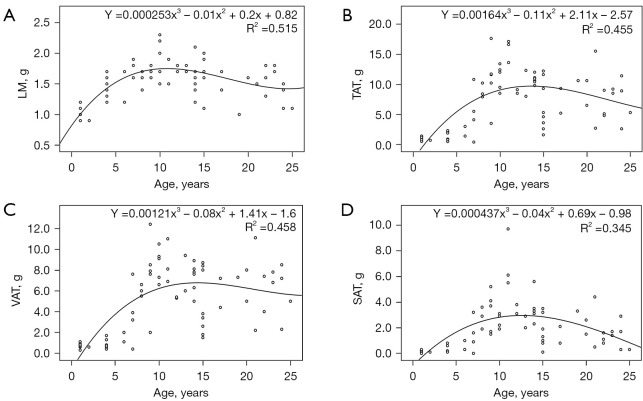
A total of 72 healthy female cynomolgus monkeys, aged 1-25 years, were included in this study. The average lumbar vBMD of female cynomolgus monkeys increased with age until the age of 10 years, around which it reached peak bone mass, with a relatively marked decline after the age of 13 years. The ABLRs of female cynomolgus monkeys in the premenopausal (13-19 years) and postmenopausal age groups (20-25 years) were -4.9% and -21.2%, respectively. Ridge regression analysis showed that age and subcutaneous adipose tissue (SAT) contributed positively to the average lumbar vBMD in animals aged ≤10 years, whereas in animals aged >10 years, age contributed negatively to lumbar vBMD. The RMS-CV% (RMS-SD) of the lumbar vBMD measured using QCT ranged from 0.47% to 1.60% (1.91-6.31 mg/cm).
Age-related changes in lumbar vBMD measured using QCT in healthy female monkeys showed similar trends to those in humans. Age and SAT may affect the lumbar vBMD in female cynomolgus monkeys. QCT revealed good precision in measuring the lumbar vBMD in female cynomolgus monkeys.
食蟹猴广泛应用于骨质疏松相关研究,目前尚无证据表明使用定量计算机断层扫描(QCT)测量非人灵长类动物的体积骨密度(vBMD)存在与年龄相关的变化。本研究旨在描述腰椎vBMD特征随年龄的变化,分析腰椎vBMD与身体成分之间的关系,并研究QCT测量健康雌性食蟹猴的精度。
使用三次回归模型描述腰椎vBMD的年龄相关变化,并计算腰椎的累积骨丢失率(ABLR)。采用Spearman等级相关和岭回归分析来研究平均腰椎vBMD与身体成分的关系。选择30只动物分析QCT测量的短期精度。精度用均方根变异系数(RMS-CV%)或均方根标准差(RMS-SD)表示。
本研究共纳入72只年龄为1至25岁的健康雌性食蟹猴。雌性食蟹猴的平均腰椎vBMD随年龄增长而增加,直至10岁左右达到峰值骨量,13岁后相对明显下降。绝经前(13至19岁)和绝经后年龄组(20至25岁)雌性食蟹猴的ABLR分别为-4.9%和-21.2%。岭回归分析表明,年龄和皮下脂肪组织(SAT)对年龄≤10岁动物的平均腰椎vBMD有正向贡献,而在年龄>10岁的动物中,年龄对腰椎vBMD有负向贡献。使用QCT测量腰椎vBMD的RMS-CV%(RMS-SD)范围为0.47%至1.60%(1.91至6.31mg/cm)。
使用QCT测量健康雌性食蟹猴腰椎vBMD的年龄相关变化与人类相似。年龄和SAT可能影响雌性食蟹猴的腰椎vBMD。QCT在测量雌性食蟹猴腰椎vBMD方面显示出良好的精度。