Kwon Jae Wan, Jeon Yena, Jung Hee-Yeon, Choi Ji-Young, Park Sun-Hee, Kim Chan-Duck, Kim Yong-Lim, Hwang Deokbi, Yun Woo-Sung, Kim Hyung-Kee, Huh Seung, Yoo Eun Sang, Won Dong-Il, Cho Jang-Hee, Lim Jeong-Hoon
Department of Internal Medicine, Kyungpook National University Hospital, School of Medicine, Kyungpook National University, Daegu, Korea.
Department of Pathology, Kyungpook National University Hospital, School of Medicine, Kyungpook National University, Daegu, Korea.
Korean J Transplant. 2023 Mar 31;37(1):19-28. doi: 10.4285/kjt.22.0047. Epub 2023 Feb 23.
The C-reactive protein (CRP)-to-albumin ratio (CAR) is a more effective prognostic indicator than CRP or albumin alone in various diseases. This study aimed to evaluate the predictive value of the CAR for mortality in kidney transplant recipients (KTRs).
A total of 924 patients who underwent their first kidney transplantation at Kyungpook National University Hospital during 2006-2020 were enrolled and classified into quartile (Q) groups according to their pretransplant CAR values. A Cox regression analysis was conducted to analyze the hazard ratios (HRs) of mortality.
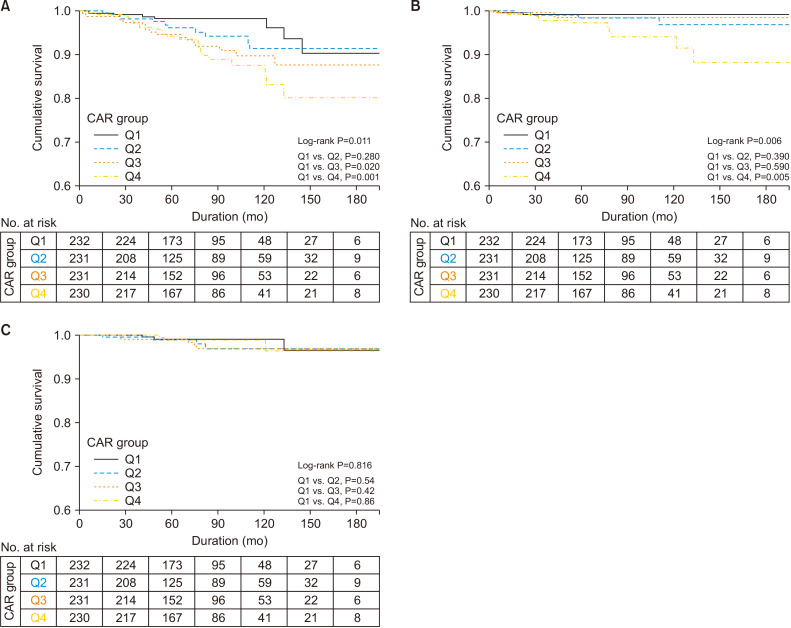
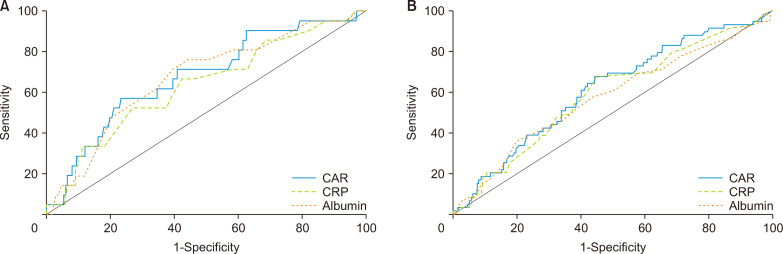
Fifty-nine patients died during the posttransplant period (mean, 85.2±44.2 months). All-cause mortality (Q1, 3.0%; Q2, 4.8%; Q3, 7.8%; Q4, 10.0%; P for trend <0.001) and infection-related mortality increased linearly with an increase in CAR (P for trend=0.004). The Q3 and Q4 had higher risks of all-cause mortality than Q1 after adjusting for confounding factors (Q3 adjusted HR [aHR] 2.49, 95% confidence interval [CI] 1.04-5.99, P=0.041; Q4 aHR 3.09, 95% CI 1.31-7.27, P=0.010). Q4 was also independently associated with infection-related mortality (aHR 5.83, 95% CI 1.27-26.8, P=0.023). The area under the curve of the CAR for all-cause and infection-related mortality was higher than that of CRP or albumin alone. There was no association between CAR and death-censored graft failure or acute rejection.
A higher pretransplant CAR increases the risk of posttransplant mortality, particularly infection-related, in KTRs. Pretransplant CAR can be an effective and easily accessible predictor of posttransplant mortality.
在各种疾病中,C反应蛋白(CRP)与白蛋白比值(CAR)是比单独的CRP或白蛋白更有效的预后指标。本研究旨在评估CAR对肾移植受者(KTRs)死亡率的预测价值。
纳入2006年至2020年期间在庆北国立大学医院接受首次肾移植的924例患者,并根据移植前CAR值将其分为四分位数(Q)组。进行Cox回归分析以分析死亡率的风险比(HRs)。
59例患者在移植后期间死亡(平均85.2±44.2个月)。全因死亡率(Q1为3.0%;Q2为4.8%;Q3为7.8%;Q4为10.0%;趋势P<0.001)和感染相关死亡率随CAR升高呈线性增加(趋势P=0.004)。在调整混杂因素后,Q3和Q4的全因死亡风险高于Q1(Q3调整后HR[aHR]2.49,95%置信区间[CI]1.04-5.99,P=0.041;Q4 aHR 3.09,95%CI 1.31-7.27,P=0.010)。Q4也与感染相关死亡率独立相关(aHR 5.83,95%CI 1.27-26.8,P=0.023)。CAR对全因和感染相关死亡率的曲线下面积高于单独的CRP或白蛋白。CAR与死亡删失的移植失败或急性排斥之间无关联。
移植前较高的CAR增加了KTRs移植后死亡的风险,尤其是感染相关死亡风险。移植前CAR可以作为移植后死亡率的有效且易于获得的预测指标。