Wang Xiran, Chen Dongrui, Du Juan, Cheng Ke, Fang Chang, Liao Xiaoping, Liu Yahong, Sun Jian, Lian Xinlei, Ren Hao
Guangdong Laboratory for Lingnan Modern Agriculture, National Risk Assessment Laboratory for Antimicrobial Resistance of Animal Original Bacteria, College of Veterinary Medicine, South China Agricultural University, Guangzhou, China.
Guangdong Provincial Key Laboratory of Veterinary Pharmaceutics, Development and Safety Evaluation, South China Agricultural University, Guangzhou, China.
Front Microbiol. 2023 Mar 29;14:1117866. doi: 10.3389/fmicb.2023.1117866. eCollection 2023.
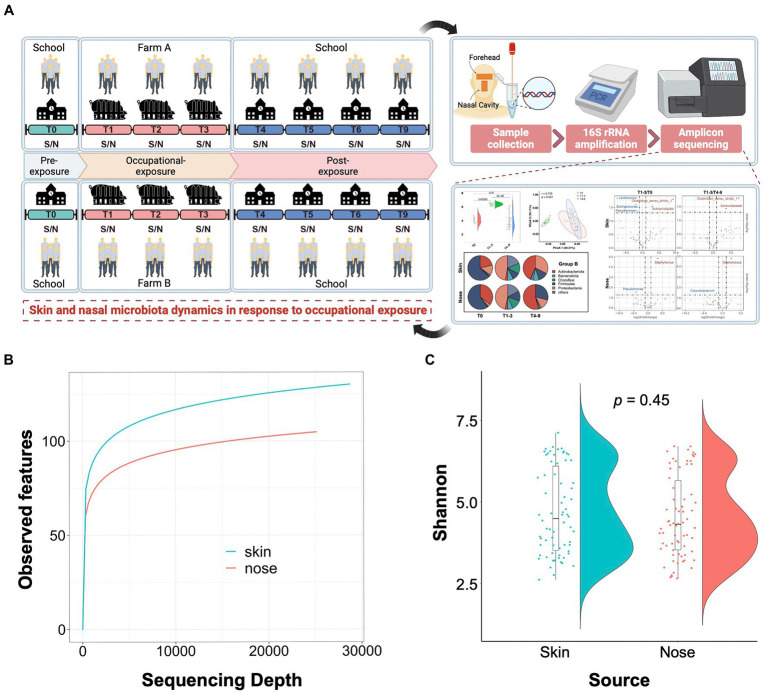
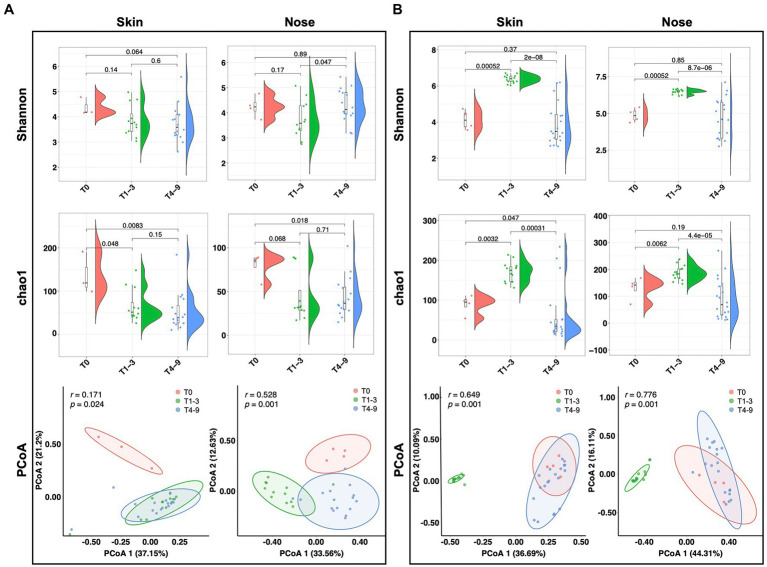
Anthropogenic environments take an active part in shaping the human microbiome. Herein, we studied skin and nasal microbiota dynamics in response to the exposure in confined and controlled swine farms to decipher the impact of occupational exposure on microbiome formation. The microbiota of volunteers was longitudinally profiled in a 9-months survey, in which the volunteers underwent occupational exposure during 3-month internships in swine farms. By high-throughput sequencing, we showed that occupational exposure compositionally and functionally reshaped the volunteers' skin and nasal microbiota. The exposure in farm A reduced the microbial diversity of skin and nasal microbiota, whereas the microbiota of skin and nose increased after exposure in farm B. The exposure in different farms resulted in compositionally different microbial patterns, as the abundance of Actinobacteria sharply increased at expense of Firmicutes after exposure in farm A, yet Proteobacteria became the most predominant in the volunteers in farm B. The remodeled microbiota composition due to exposure in farm A appeared to stall and persist, whereas the microbiota of volunteers in farm B showed better resilience to revert to the pre-exposure state within 9 months after the exposure. Several metabolic pathways, for example, the styrene, aminobenzoate, and N-glycan biosynthesis, were significantly altered through our PICRUSt analysis, and notably, the function of beta-lactam resistance was predicted to enrich after exposure in farm A yet decrease in farm B. We proposed that the differently modified microbiota patterns might be coordinated by microbial and non-microbial factors in different swine farms, which were always environment-specific. This study highlights the active role of occupational exposure in defining the skin and nasal microbiota and sheds light on the dynamics of microbial patterns in response to environmental conversion.
人为环境在塑造人类微生物群方面发挥着积极作用。在此,我们研究了在封闭且可控的养猪场中暴露后皮肤和鼻腔微生物群的动态变化,以解读职业暴露对微生物群形成的影响。在一项为期9个月的调查中,对志愿者的微生物群进行了纵向分析,其中志愿者在养猪场进行了为期3个月的实习,期间经历职业暴露。通过高通量测序,我们发现职业暴露在组成和功能上重塑了志愿者的皮肤和鼻腔微生物群。在A农场的暴露降低了皮肤和鼻腔微生物群的多样性,而在B农场暴露后皮肤和鼻腔的微生物群增加。不同农场的暴露导致了组成上不同的微生物模式,因为在A农场暴露后,放线菌的丰度急剧增加,以厚壁菌门为代价,但在B农场,变形菌门成为志愿者中最主要的菌群。由于在A农场的暴露而重塑的微生物群组成似乎停滞并持续存在,而B农场志愿者的微生物群在暴露后9个月内表现出更好的恢复到暴露前状态的恢复力。通过我们的PICRUSt分析,几种代谢途径,例如苯乙烯、氨基苯甲酸和N-聚糖生物合成,发生了显著改变,值得注意的是,预测β-内酰胺抗性功能在A农场暴露后会富集,而在B农场则会降低。我们提出,不同修饰的微生物群模式可能由不同养猪场中的微生物和非微生物因素协调,这些因素总是特定于环境的。这项研究突出了职业暴露在定义皮肤和鼻腔微生物群方面的积极作用,并揭示了微生物模式对环境转换的动态响应。