Department of Biomedicine, Biotechnology and Public Health, University of Cadiz, Cadiz, Spain.
Department of Mathematics and Statistics, University of Cyprus, Nicosia, Cyprus.
PLoS One. 2023 Apr 17;18(4):e0284433. doi: 10.1371/journal.pone.0284433. eCollection 2023.
We aim to understand the factors that drive citizens of different countries to adhere to recommended self-protective behaviors during the COVID-19 pandemic.
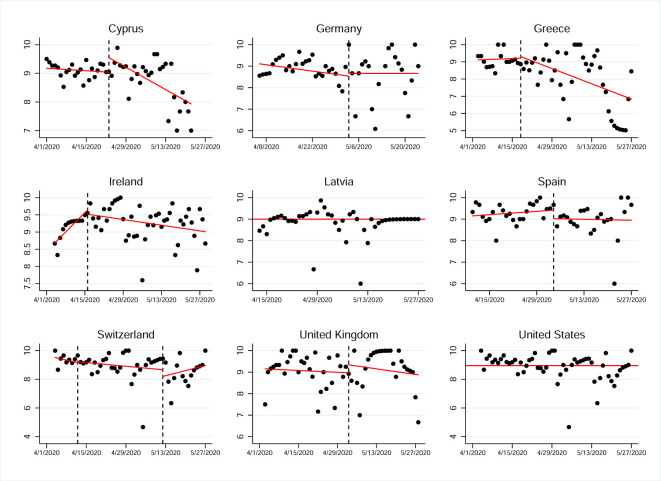
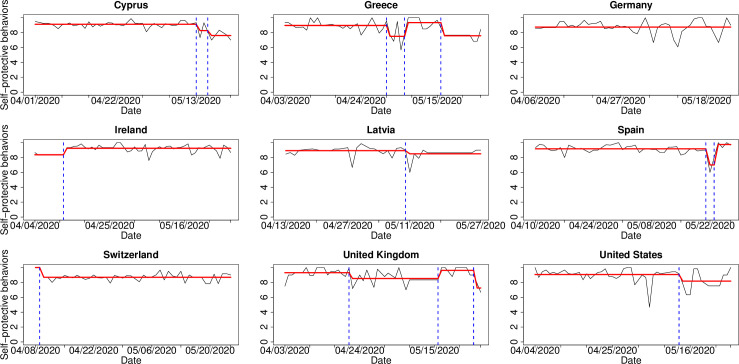
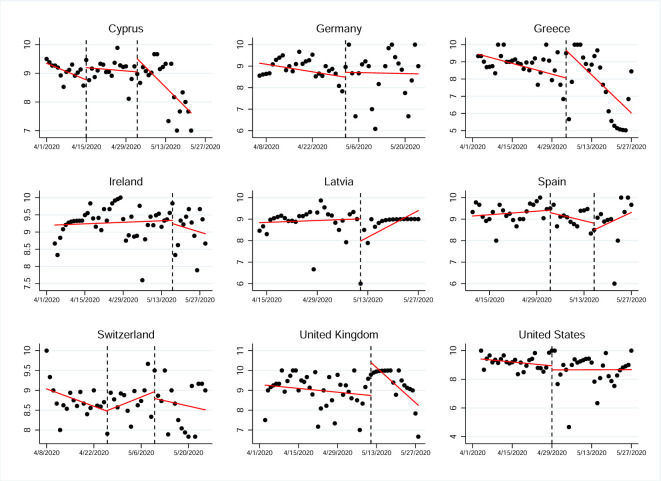
Survey data was obtained through the COVID-19 Impact project. We selected countries that presented a sufficiently complete time series and a statistically relevant sample for running the analysis: Cyprus, Germany, Greece, Ireland, Latvia, Spain, Switzerland, the United Kingdom, and the United States of America. To identify country-specific differences in self-protective behaviors, we used previous evidence and change-point detection analysis to establish variations across participating countries whose effect was then assessed by means of interrupted series analysis.
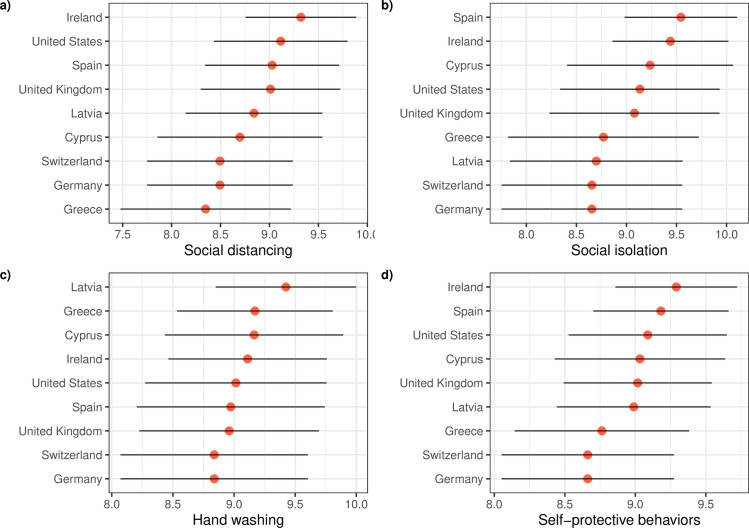
A high level of compliance with health and governmental authorities' recommendations were generally observed in all included countries. The level of stress decreased near the period when countries such as Cyprus, Greece or the United Kingdom relaxed their prevention behavior recommendations. However, this relaxation of behaviors did not occur in countries such as Germany, Ireland, or the United States. As observed in the change-point detection analysis, when the daily number of recorded COVID-19 cases decreased, people relaxed their protective behaviors (Cyprus, Greece, Ireland), although the opposite trend was observed in Switzerland.
COVID-19 self-protective behaviors were heterogeneous across countries examined. Our findings show that there is probably no single winning strategy for exiting future health crises, as similar interventions, aimed to promote self-protective behaviors, may be received differently depending on the specific population groups and on the particular geographical context in which they are implemented.
我们旨在了解不同国家的公民在 COVID-19 大流行期间坚持建议的自我保护行为的因素。
通过 COVID-19 影响项目获得调查数据。我们选择了呈现出足够完整时间序列和具有统计学相关性的样本进行分析的国家:塞浦路斯、德国、希腊、爱尔兰、拉脱维亚、西班牙、瑞士、英国和美国。为了确定自我保护行为方面的国家特定差异,我们使用了先前的证据和变点检测分析来确定参与国家的变化,然后通过中断系列分析评估其效果。
在所有纳入的国家中,普遍观察到对健康和政府当局建议的高度遵守。当塞浦路斯、希腊或英国等国家放宽其预防行为建议时,压力水平下降。然而,德国、爱尔兰或美国等国家并没有放松这些行为。如变点检测分析所示,当记录的 COVID-19 病例的日数量减少时,人们放松了他们的保护行为(塞浦路斯、希腊、爱尔兰),尽管瑞士则出现了相反的趋势。
被检查的国家之间的 COVID-19 自我保护行为存在异质性。我们的研究结果表明,未来退出卫生危机可能没有单一的成功策略,因为类似的旨在促进自我保护行为的干预措施可能会因特定人群和实施它们的特定地理背景而受到不同的对待。