Division of Bio & Medical Big data department (BK4 Program) at Gyeongsang National University, Jinju, Republic of Korea.
Division of Life Science Department at Gyeongsang National University, Jinju, Republic of Korea.
BMC Plant Biol. 2020 Oct 2;20(1):453. doi: 10.1186/s12870-020-02659-y.
Plants have adapted to survive under adverse conditions or exploit favorable conditions in response to their environment as sessile creatures. In a way of plant adaptation, plant hormones have been evolved to efficiently use limited resources. Plant hormones including auxin, jasmonic acid, salicylic acid, and ethylene have been studied to reveal their role in plant adaptation against their environment by phenotypic observation with experimental design such as mutation on hormone receptors and treatment / non-treatment of plant hormones along with other environmental conditions. With the development of Next Generation Sequencing (NGS) technology, it became possible to score the total gene expression of the sampled plants and estimate the degree of effect of plant hormones in gene expression. This allowed us to infer the signaling pathway through plant hormones, which greatly stimulated the study of functional genomics using mutants. Due to the continued development of NGS technology and analytical techniques, many plant hormone-related studies have produced and accumulated NGS-based data, especially RNAseq data have been stored in the sequence read archive represented by NCBI, EBI, and DDBJ.
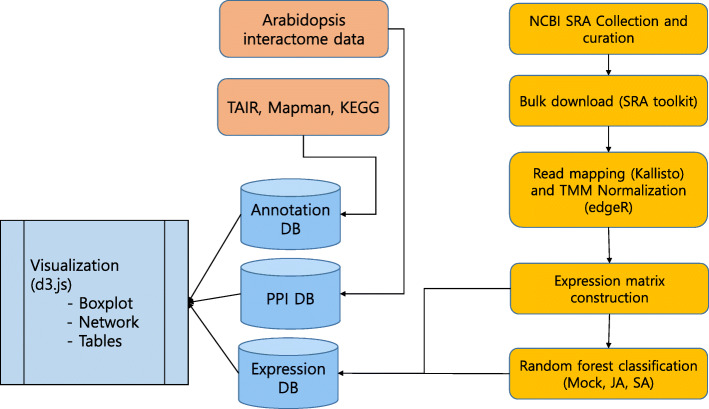
Here, hormone treatment RNAseq data of Arabidopsis (Col0), wild-type genotype, were collected with mock, SA, and MeJA treatments. The genes affected by hormones were identified through a machine learning approach. The degree of expression of the affected gene was quantified, visualized in boxplot using d3 (data-driven-document), and the database was built by Django.
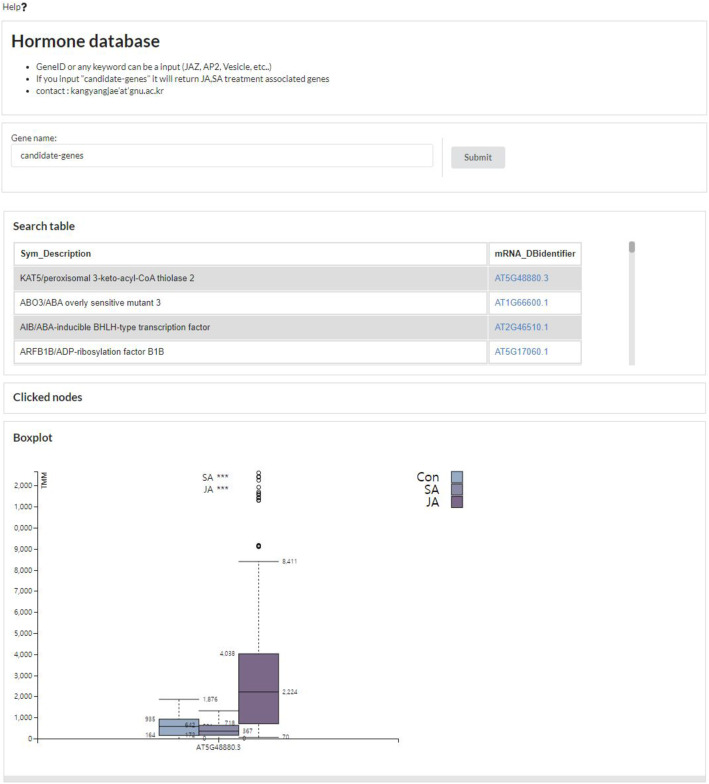
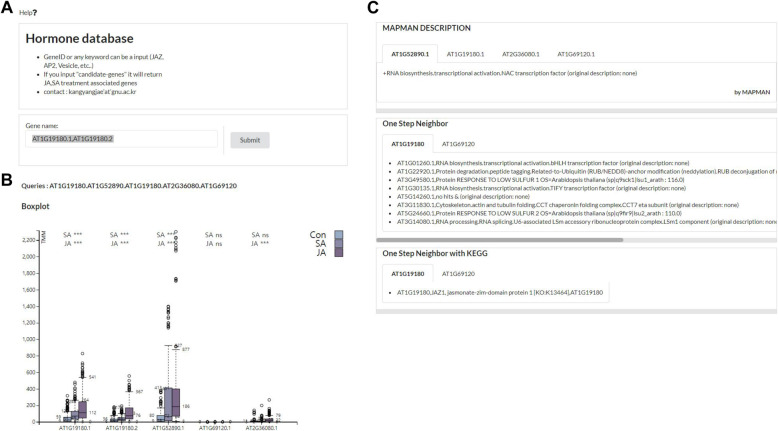
Using this database, we created a web application ( http://pgl.gnu.ac.kr/hormoneDB/ ) that lists hormone-related or hormone-affected genes and visualizes the boxplot of the gene expression of selected genes. This web application eventually aids the functional genomics researchers who want to gather the cases of the gene responses by the hormones.
作为固着生物,植物为了在不利条件下生存或利用有利条件,已经进化出植物激素来有效地利用有限的资源。通过对激素受体的突变以及激素处理/非处理与其他环境条件相结合的实验设计,对包括生长素、茉莉酸、水杨酸和乙烯在内的植物激素进行研究,揭示了它们在植物适应环境方面的作用。随着下一代测序(NGS)技术的发展,对采样植物的总基因表达进行评分,并估计植物激素对基因表达的影响程度成为可能。这使我们能够推断植物激素的信号通路,这极大地刺激了利用突变体进行功能基因组学的研究。由于 NGS 技术和分析技术的不断发展,许多与植物激素相关的研究产生并积累了基于 NGS 的数据,特别是 RNAseq 数据已存储在以 NCBI、EBI 和 DDBJ 为代表的序列读取档案库中。
在这里,收集了拟南芥(Col0)、野生型基因型的激素处理 RNAseq 数据,分别用对照、SA 和 MeJA 处理。通过机器学习方法鉴定受激素影响的基因。用 d3(数据驱动文档)绘制箱线图来量化受影响基因的表达程度,并使用 Django 构建数据库。
使用这个数据库,我们创建了一个网络应用程序(http://pgl.gnu.ac.kr/hormoneDB/),列出了与激素相关或受激素影响的基因,并可视化了选定基因的基因表达箱线图。这个网络应用程序最终为希望通过激素收集基因响应案例的功能基因组学研究人员提供了帮助。