Department of Urology, Tai 'an Central Hospital, Tai 'an, Shandong, China.
Department of Spine Surgery, Tai 'an Central Hospital, Tai 'an, Shandong, China.
PeerJ. 2023 Apr 12;11:e15013. doi: 10.7717/peerj.15013. eCollection 2023.
Approximately 10-20% of patients diagnosed with prostate cancer (PCa) evolve into castration-resistant prostate cancer (CRPC), while nearly 90% of patients with metastatic CRPC (mCRPC) exhibit osseous metastases (BM). These BM are intimately correlated with the stability of the tumour microenvironment.
This study aspires to uncover the metabolism-related genes and the underlying mechanisms responsible for bone metastatic prostate cancer (BMPCa).
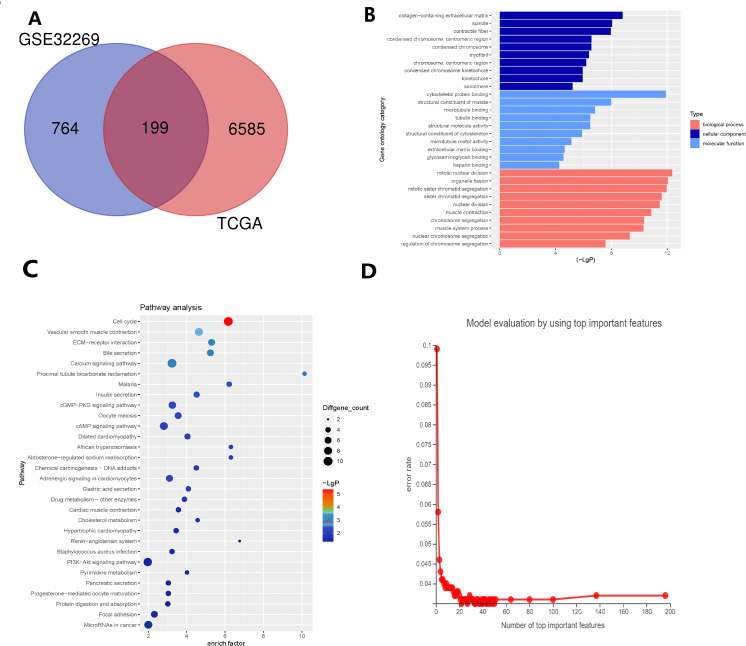
Gene Expression Omnibus (GEO) and The Cancer Genome Atlas (TCGA) datasets of PCa and BM were analyzed through R Studio software to identify differentially expressed genes (DEGs). The DEGs underwent functional enrichment via Kyoto Encyclopedia of Genes and Genomes (KEGG) and Gene Ontology (GO), with key factors screened by a random forest utilized to establish a prognostic model for PCa. The study explored the relationship between DEGs and the stability of the immune microenvironment. The action and specificity of CRISP3 in PCa was validated through western blot analysis, CCK-8 assay, scratch assay, and cellular assay.
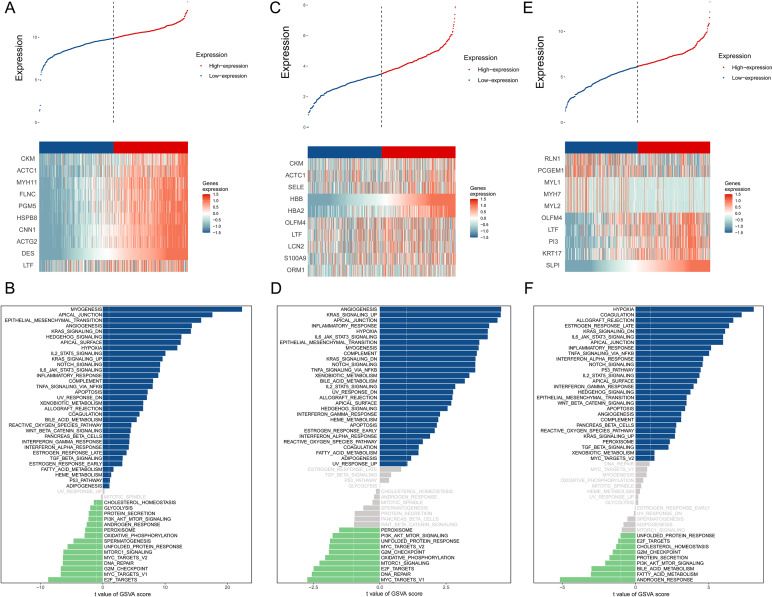
The screening of GEO and TCGA datasets resulted in the identification of 199 co-differential genes. Three DEGs, including DES, HBB, and SLPI, were selected by random forest classification model and cox regression model. Immuno-infiltration analysis disclosed that a higher infiltration of naïve B cells and resting CD4 memory T cells occurred in the high-expression group of DES, whereas infiltration of resting M1 macrophages and NK cells was greater in the low-expression group of DES. A significant infiltration of neutrophils was observed in the high-expression group of HBB, while greater infiltration of gamma delta T cells and M1 macrophages was noted in the low-expression group of HBB. Resting dendritic cells, CD8 T cells, and resting T regulatory cells (Tregs) infiltrated significantly in the high-expression group of SLPI, while only resting mast cells infiltrated significantly in the low-expression group of SLPI. CRISP3 was established as a critical gene in BMPCa linked to DES expression. Targeting CRISP3, d-glucopyranose may impact tumour prognosis. During the mechanistic experiments, it was established that CRISP3 can advance the proliferation and metastatic potential of PCa by advancing epithelial-to-mesenchymal transition (EMT).
By modulating lipid metabolism and maintaining immunological and microenvironmental balance, DES, HBB, and SLPI suppress prostate cancer cell growth. The presence of DES-associated CRISP3 is a harbinger of unfavorable outcomes in prostate cancer and may escalate tumor proliferation and metastatic capabilities by inducing epithelial-mesenchymal transition.
约 10-20%被诊断为前列腺癌 (PCa) 的患者会发展为去势抵抗性前列腺癌 (CRPC),而近 90%的转移性 CRPC (mCRPC) 患者存在骨转移 (BM)。这些 BM 与肿瘤微环境的稳定性密切相关。
本研究旨在揭示与骨转移性前列腺癌 (BMPCa) 相关的代谢相关基因及其潜在机制。
通过 R Studio 软件分析前列腺癌和 BM 的基因表达综合数据库 (GEO) 和癌症基因组图谱 (TCGA) 数据集,以鉴定差异表达基因 (DEGs)。通过京都基因与基因组百科全书 (KEGG) 和基因本体论 (GO) 对 DEGs 进行功能富集分析,利用随机森林筛选关键因素,建立前列腺癌的预后模型。研究还探讨了 DEGs 与免疫微环境稳定性之间的关系。通过 Western blot 分析、CCK-8 检测、划痕实验和细胞实验验证了 CRISP3 在 PCa 中的作用和特异性。
筛选 GEO 和 TCGA 数据集后,共鉴定出 199 个共差异基因。通过随机森林分类模型和 Cox 回归模型,选择了 DES、HBB 和 SLPI 这三个 DEGs。免疫浸润分析显示,DES 高表达组中幼稚 B 细胞和静止 CD4 记忆 T 细胞的浸润增加,而 DES 低表达组中静止 M1 巨噬细胞和 NK 细胞的浸润增加。HBB 高表达组中中性粒细胞的浸润显著增加,而 HBB 低表达组中γδ T 细胞和 M1 巨噬细胞的浸润显著增加。SLPI 高表达组中静止树突状细胞、CD8 T 细胞和静止调节性 T 细胞 (Tregs) 的浸润显著增加,而 SLPI 低表达组中仅静止肥大细胞的浸润显著增加。CRISP3 被确定为与 DES 表达相关的 BMPCa 中的关键基因。靶向 CRISP3 的 d-葡萄糖可能影响肿瘤预后。在机制实验中,发现 CRISP3 通过促进上皮间质转化 (EMT) 来促进前列腺癌细胞的增殖和转移潜力。
DES、HBB 和 SLPI 通过调节脂质代谢和维持免疫及微环境平衡抑制前列腺癌细胞生长。DES 相关的 CRISP3 的存在预示着前列腺癌预后不良,并可能通过诱导上皮间质转化来增加肿瘤的增殖和转移能力。