Somero George N
Department of Biology, Hopkins Marine Station, Stanford University, Pacific Grove, CA 93950 USA.
Mar Life Sci Technol. 2022 Aug 16;4(3):389-413. doi: 10.1007/s42995-022-00140-3. eCollection 2022 Aug.
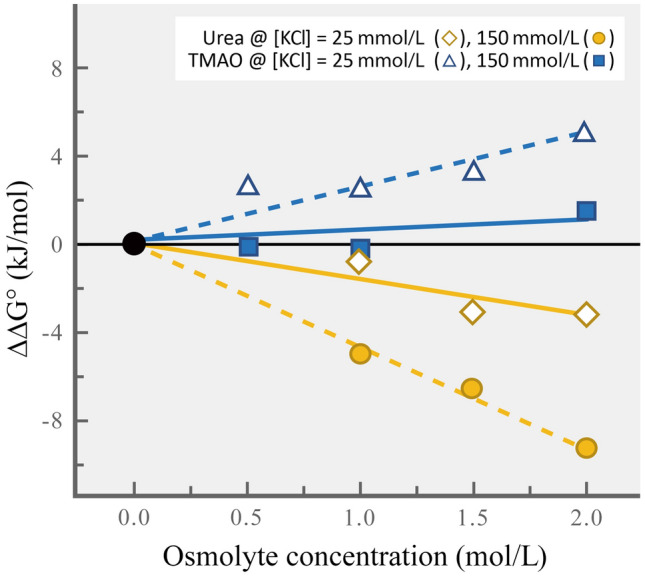
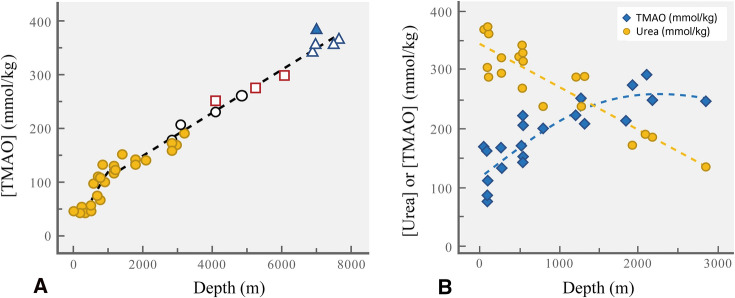
The seas confront organisms with a suite of abiotic stressors that pose challenges for physiological activity. Variations in temperature, hydrostatic pressure, and salinity have potential to disrupt structures, and functions of all molecular systems on which life depends. During evolution, sequences of nucleic acids and proteins are adaptively modified to "fit" these macromolecules for function under the particular abiotic conditions of the habitat. Complementing these macromolecular adaptations are alterations in compositions of solutions that bathe macromolecules and affect stabilities of their higher order structures. A primary result of these "micromolecular" adaptations is preservation of optimal balances between conformational rigidity and flexibility of macromolecules. Micromolecular adaptations involve several families of organic osmolytes, with varying effects on macromolecular stability. A given type of osmolyte generally has similar effects on DNA, RNA, proteins and membranes; thus, adaptive regulation of cellular osmolyte pools has a global effect on macromolecules. These effects are mediated largely through influences of osmolytes and macromolecules on water structure and activity. Acclimatory micromolecular responses are often critical in enabling organisms to cope with environmental changes during their lifetimes, for example, during vertical migration in the water column. A species' breadth of environmental tolerance may depend on how effectively it can vary the osmolyte composition of its cellular fluids in the face of stress. Micromolecular adaptations remain an under-appreciated aspect of evolution and acclimatization. Further study can lead to a better understanding of determinants of environmental tolerance ranges and to biotechnological advances in designing improved stabilizers for biological materials.
海洋使生物面临一系列非生物应激源,这些应激源对生理活动构成挑战。温度、静水压力和盐度的变化有可能破坏生命所依赖的所有分子系统的结构和功能。在进化过程中,核酸和蛋白质序列会进行适应性修饰,以使这些大分子在栖息地特定的非生物条件下发挥功能。与这些大分子适应性相辅相成的是,浸泡大分子的溶液组成发生改变,从而影响其高阶结构的稳定性。这些“微分子”适应性的一个主要结果是保持大分子构象刚性和柔韧性之间的最佳平衡。微分子适应性涉及几个有机渗透剂家族,它们对大分子稳定性有不同影响。给定类型的渗透剂通常对DNA、RNA、蛋白质和膜有类似影响;因此,细胞渗透剂库的适应性调节对大分子有全局性影响。这些影响主要通过渗透剂和大分子对水结构和活性的影响来介导。适应性微分子反应在使生物体在其生命周期中应对环境变化方面通常至关重要,例如在水柱中的垂直迁移过程中。一个物种的环境耐受广度可能取决于它在面对压力时改变其细胞液渗透剂组成的有效性。微分子适应性仍然是进化和适应过程中一个未得到充分重视的方面。进一步的研究可以更好地理解环境耐受范围的决定因素,并在设计改进的生物材料稳定剂方面取得生物技术进展。