Lee Ji-Hyang, Oh Ji-Yoon, Kwon Hyouk-Soo, Kim Tae-Bum, Cho You Sook, Song Woo-Jung
Department of Allergy and Clinical Immunology, Asan Medical Center, University of Ulsan College of Medicine, Seoul, Korea.
ERJ Open Res. 2023 Oct 2;9(5). doi: 10.1183/23120541.00448-2023. eCollection 2023 Sep.
Empirical therapy with oral histamine-1 receptor antagonists (H1RAs) is often used for patients with suspected upper airway cough syndrome. No placebo-controlled trials with nonsedating H1RAs (nsH1RAs) have evaluated validated cough outcomes. The objective of the present study was to assess the effect of an nsH1RA, bepotastine, on cough outcomes in patients with allergic rhinitis and persistent cough.
A randomised, double-blind, placebo-controlled trial was conducted. Adult patients with persistent cough (>3 weeks in duration) and symptomatic allergic rhinitis were recruited and randomly assigned to receive either bepotastine or placebo at a 1:1 ratio. The primary outcome was cough-specific quality of life assessed using the Leicester Cough Questionnaire (LCQ). Secondary outcomes included cough severity visual analogue scale (VAS), throat VAS, Cough Hypersensitivity Questionnaire, Sinonasal Outcome Test-22 score and drug adverse events.
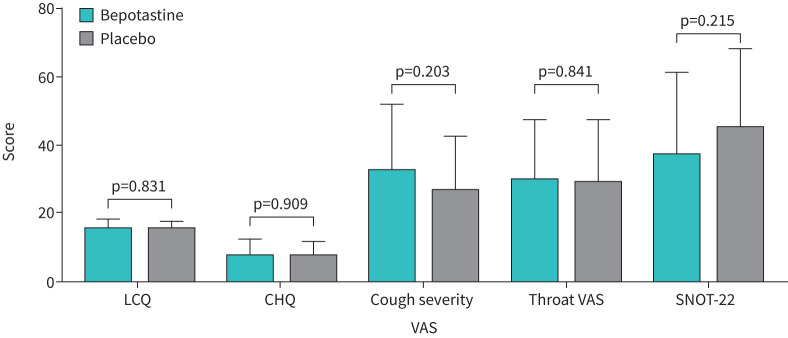
Between October 2021 and September 2022, 50 participants (43 females; mean age 46.28 years; median cough duration 3 months) were assigned to either the bepotastine 10 mg twice daily or placebo group in a 1:1 ratio. After 2 weeks of treatment, both bepotastine and placebo groups showed significant improvements in the LCQ scores, but there was no significant difference in the magnitude of change between the groups (3.45±2.10 3.04±2.94, p=0.576). Secondary outcomes were also comparable.
Despite the relatively small sample size, our study clearly demonstrated that a 2-week treatment with bepotastine did not provide therapeutic benefits for cough outcomes. These findings suggest against the use of nsH1RAs with the intention of improving cough outcomes, even in patients with persistent cough and allergic rhinitis.
口服组胺-1受体拮抗剂(H1RAs)的经验性治疗常用于疑似上气道咳嗽综合征的患者。尚无使用非镇静性H1RAs(nsH1RAs)的安慰剂对照试验评估经过验证的咳嗽结局。本研究的目的是评估一种nsH1RA——贝波司汀对过敏性鼻炎和持续性咳嗽患者咳嗽结局的影响。
进行了一项随机、双盲、安慰剂对照试验。招募了持续性咳嗽(持续时间>3周)且有症状性过敏性鼻炎的成年患者,并以1:1的比例随机分配接受贝波司汀或安慰剂治疗。主要结局是使用莱斯特咳嗽问卷(LCQ)评估的咳嗽特异性生活质量。次要结局包括咳嗽严重程度视觉模拟量表(VAS)、咽喉VAS、咳嗽超敏反应问卷、鼻鼻窦结局测试-22评分和药物不良事件。
在2021年10月至2022年9月期间,50名参与者(43名女性;平均年龄46.28岁;咳嗽持续时间中位数为3个月)以1:1的比例被分配到每日两次服用10mg贝波司汀组或安慰剂组。治疗2周后,贝波司汀组和安慰剂组的LCQ评分均有显著改善,但两组之间的变化幅度无显著差异(3.45±2.10对3.04±2.94,p=0.576)。次要结局也具有可比性。
尽管样本量相对较小,但我们的研究清楚地表明,为期2周的贝波司汀治疗对咳嗽结局没有治疗益处。这些发现表明,即使是对持续性咳嗽和过敏性鼻炎患者,也不建议使用nsH1RAs来改善咳嗽结局。