The Department of Anesthesiology and Intensive Care Medicine, Osaka University Graduate School of Medicine, 2-15 Yamadaoka, Suita, Osaka, 565-0871, Japan.
Crit Care. 2023 Apr 19;27(1):152. doi: 10.1186/s13054-023-04360-6.
Heterogeneity is an inherent nature of ARDS. Recruitment-to-inflation ratio has been developed to identify the patients who has lung recruitablity. This technique might be useful to identify the patients that match specific interventions, such as higher positive end-expiratory pressure (PEEP) or prone position or both. We aimed to evaluate the physiological effects of PEEP and body position on lung mechanics and regional lung inflation in COVID-19-associated ARDS and to propose the optimal ventilatory strategy based on recruitment-to-inflation ratio.
Patients with COVID-19-associated ARDS were consecutively enrolled. Lung recruitablity (recruitment-to-inflation ratio) and regional lung inflation (electrical impedance tomography [EIT]) were measured with a combination of body position (supine or prone) and PEEP (low 5 cmHO or high 15 cmHO). The utility of recruitment-to-inflation ratio to predict responses to PEEP were examined with EIT.
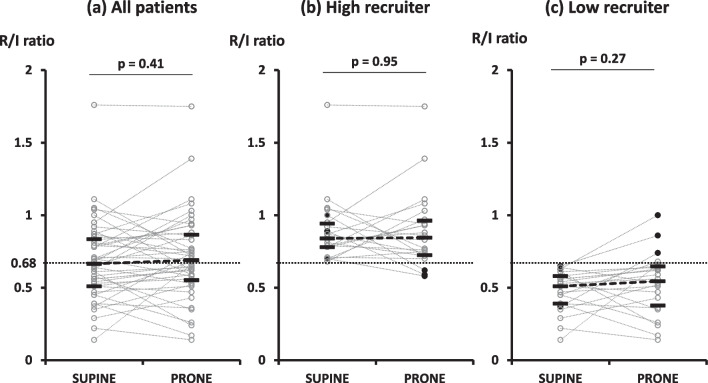
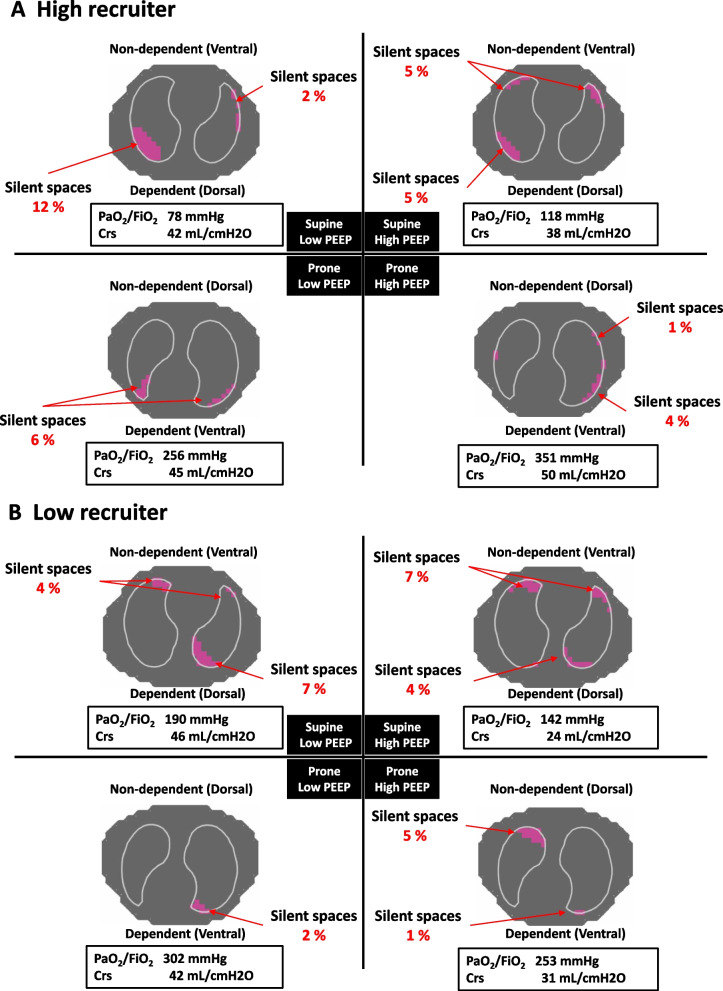
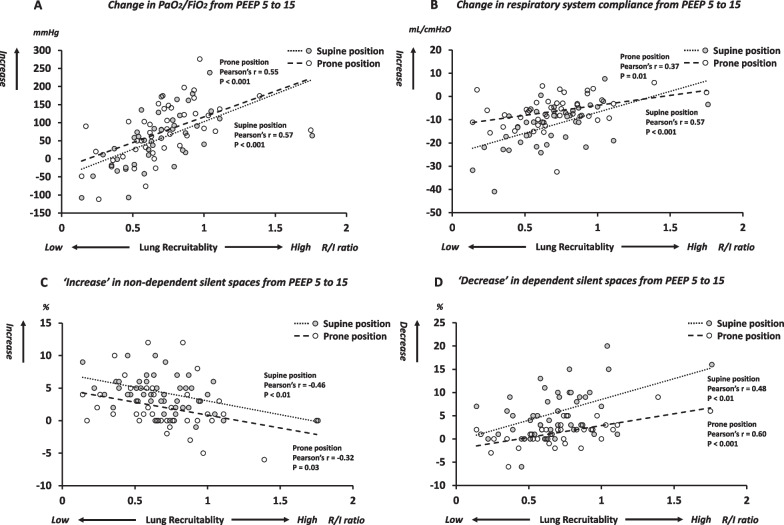
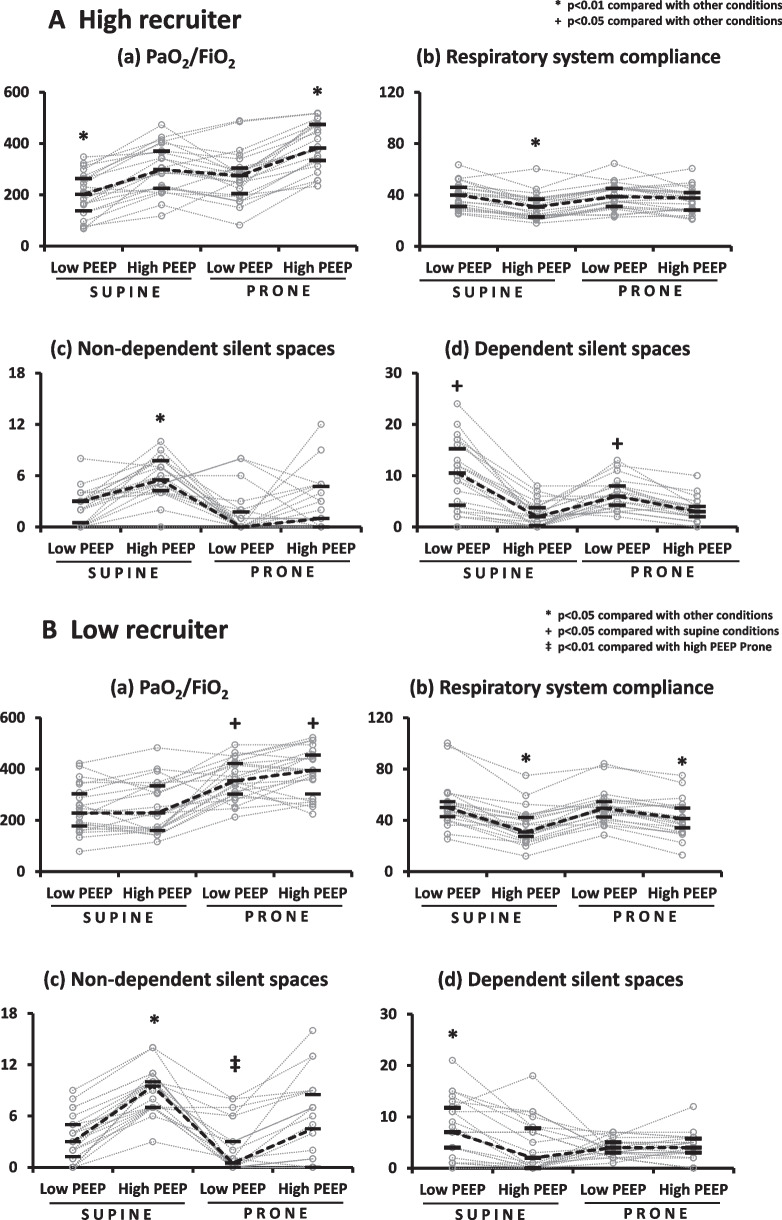
Forty-three patients were included. Recruitment-to-inflation ratio was 0.68 (IQR 0.52-0.84), separating high recruiter versus low recruiter. Oxygenation was the same between two groups. In high recruiter, a combination of high PEEP with prone position achieved the highest oxygenation and less dependent silent spaces in EIT (vs. low PEEP in both positions) without increasing non-dependent silent spaces in EIT. In low recruiter, low PEEP in prone position resulted in better oxygenation (vs. both PEEPs in supine position), less dependent silent spaces (vs. low PEEP in supine position) and less non-dependent silent spaces (vs. high PEEP in both positions). Recruitment-to-inflation ratio was positively correlated with the improvement in oxygenation and respiratory system compliance, the decrease in dependent silent spaces, and was inversely correlated with the increase in non-dependent silent spaces, when applying high PEEP.
Recruitment-to-inflation ratio may be useful to personalize PEEP in COVID-19-associated ARDS. Higher PEEP in prone position and lower PEEP in prone position decreased the amount of dependent silent spaces (suggesting lung collapse) without increasing the amount of non-dependent silent spaces (suggesting overinflation) in high recruiter and in low recruiter, respectively.
ARDS 具有异质性。募集-膨胀比已被开发出来以识别具有肺可募集性的患者。该技术可能有助于识别与特定干预措施(如更高的呼气末正压[PEEP]或俯卧位或两者)相匹配的患者。我们旨在评估 PEEP 和体位对 COVID-19 相关 ARDS 患者肺力学和区域性肺膨胀的生理影响,并基于募集-膨胀比提出最佳通气策略。
连续纳入 COVID-19 相关 ARDS 患者。使用体位(仰卧位或俯卧位)和 PEEP(低 5 cmHO 或高 15 cmHO)相结合的方法测量肺可募集性(募集-膨胀比)和区域性肺膨胀(电阻抗断层成像[EIT])。使用 EIT 检查募集-膨胀比预测 PEEP 反应的效果。
共纳入 43 例患者。募集-膨胀比为 0.68(IQR 0.52-0.84),高募集者与低募集者分离。两组之间的氧合情况相同。在高募集者中,高 PEEP 与俯卧位相结合可实现最高的氧合和 EIT 中最小的依赖区沉默空间(与两种体位下的低 PEEP 相比),而不会增加 EIT 中非依赖区沉默空间。在低募集者中,俯卧位低 PEEP 可改善氧合(与仰卧位时的两种 PEEP 相比),减少依赖区沉默空间(与仰卧位时的低 PEEP 相比),减少非依赖区沉默空间(与两种 PEEP 相比)。应用高 PEEP 时,募集-膨胀比与氧合和呼吸系统顺应性的改善呈正相关,与依赖区沉默空间的减少呈负相关,与非依赖区沉默空间的增加呈负相关。
募集-膨胀比可能有助于 COVID-19 相关 ARDS 患者的个体化 PEEP。在高募集者中,俯卧位高 PEEP 和低募集者中俯卧位低 PEEP 可减少依赖区沉默空间(提示肺塌陷)的量,而不会增加非依赖区沉默空间(提示过度充气)的量。