Fan Ruiyun, Chen Ying, Xu Guopeng, Pan Wen, Lv Yantian, Zhang Zhongwei
Department of Pulmonary and Critical Care, The Affiliated Suzhou Hospital of Nanjing Medical University, Suzhou Municipal Hospital, Gusu School, Nanjing Medical University, Suzhou, Jiangsu, China.
Front Oncol. 2023 Apr 3;13:996312. doi: 10.3389/fonc.2023.996312. eCollection 2023.
Systemic immune-inflammatory index (SII) and prognostic nutritional index (PNI) could evaluate the therapeutic efficacy and prognosis in different tumors. However, no studies investigated the SII-PNI score to predict outcomes in non-small cell lung cancer (NSCLC) patients treated with platinum-doublet chemotherapy. The aim of this study was to investigate the SII-PNI score in predicting outcomes in non-small cell lung cancer (NSCLC) patients treated with platinum-doublet chemotherapy.
Our study retrospectively analyzed clinical data from 124 patients with advanced NSCLC receiving platinum-doublet chemotherapy. The SII and PNI were calculated based on peripheral blood cell counts and serum albumin, and the optimal cut-off values were determined using receiver operating characteristic (ROC). All patients were divided into three groups according to the SII-PNI score. The association between the SII-PNI score and the clinicopathological characteristics of the patients was examined. The Kaplan-Meier and Cox regression models were used to assess progression-free survival (PFS)and overall survival (OS).
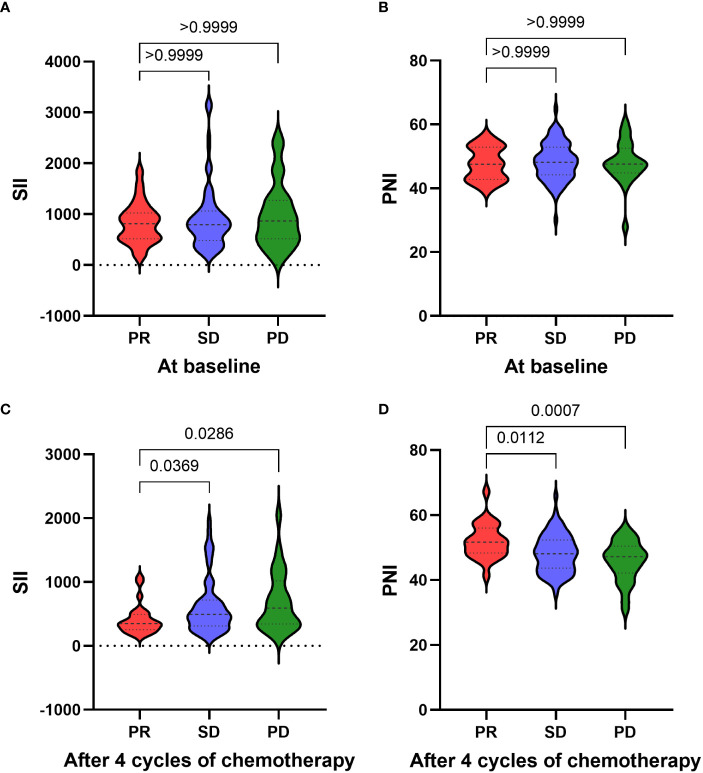
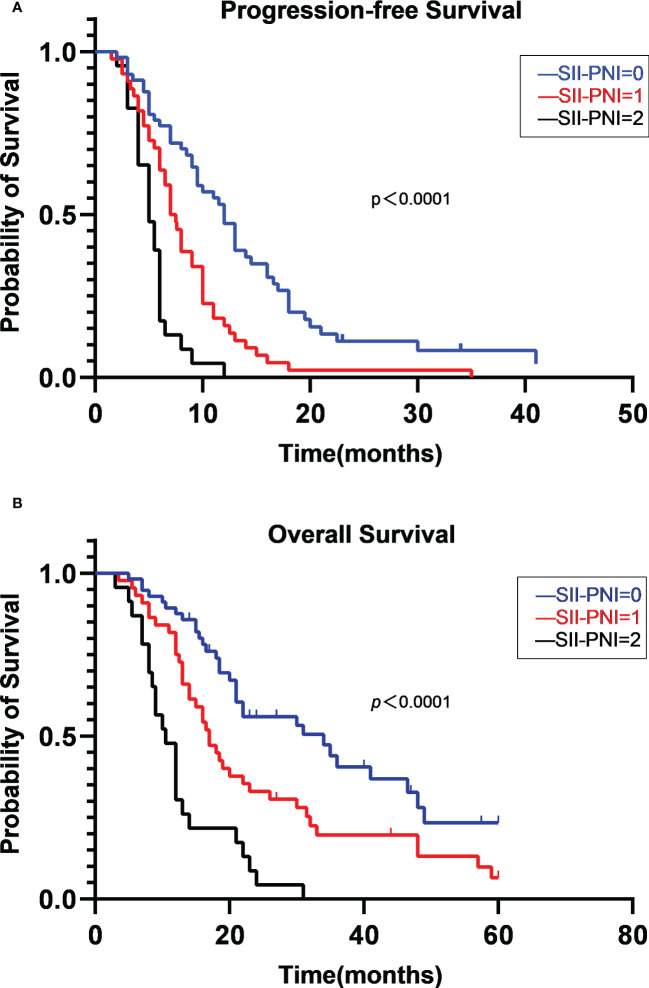
There was no significant correlation between SII, PNI at baseline and chemotherapy response in patients with advanced NSCLC (p>0.05). However, after receiving 4 cycles of platinum-doublet chemotherapy, the SII of the SD group (p=0.0369) and PD group (p=0.0286) was significantly higher than that of the PR group. At the same time, the PNI of the SD group (p=0.0112) and the PD group (p=0.0007) was significantly lower than that of the PR group. The PFS of patients with SII-PNI scores of 0, 1, and 2 were 12.0, 7.0, and 5.0 months, and the OS of patients with SII-PNI scores of 0, 1, and 2 were 34.0, 17.0, and 10.5 months, respectively. There was statistical significance among the three groups (all p <0.001). Multivariate analyses showed that the chemotherapy response of progressive disease (PD) (HR, 3.508; 95% CI, 1.546-7.960; p=0.003) and SII-PNI score of 2 (HR, 4.732; 95% CI, 2.561-8.743; p < 0.001) were independently associated with a shorter OS. The uses of targeted drugs (HR, 0.543; 95% CI, 0.329-0.898; p=0.017) and immune checkpoint inhibitors (HR, 0.218; 95% CI, 0.081-0.584; p=0.002) were protective factors for OS in patients with NSCLC.
Compared with baseline parameters, the correlation between SII, PNI after 4 cycles of chemotherapy and the chemotherapy effect was more significant. The SII-PNI score after 4 cycles of chemotherapy is an effective prognostic biomarker for advanced NSCLC patients treated with platinum-doublet chemotherapy. Patients with a higher SII-PNI score had a worse prognosis.
全身免疫炎症指数(SII)和预后营养指数(PNI)可评估不同肿瘤的治疗效果和预后。然而,尚无研究探讨SII-PNI评分对接受铂类双药化疗的非小细胞肺癌(NSCLC)患者预后的预测价值。本研究旨在探讨SII-PNI评分对接受铂类双药化疗的NSCLC患者预后的预测价值。
本研究回顾性分析了124例接受铂类双药化疗的晚期NSCLC患者的临床资料。根据外周血细胞计数和血清白蛋白计算SII和PNI,并采用受试者工作特征(ROC)曲线确定最佳临界值。根据SII-PNI评分将所有患者分为三组。分析SII-PNI评分与患者临床病理特征之间的相关性。采用Kaplan-Meier法和Cox回归模型评估无进展生存期(PFS)和总生存期(OS)。
晚期NSCLC患者基线时的SII、PNI与化疗反应之间无显著相关性(p>0.05)。然而,接受4周期铂类双药化疗后,疾病稳定(SD)组(p=0.0369)和疾病进展(PD)组(p=0.0286)的SII显著高于部分缓解(PR)组。同时,SD组(p=0.0112)和PD组(p=0.0007)的PNI显著低于PR组。SII-PNI评分为0、1和2的患者的PFS分别为12.0、7.0和5.0个月,OS分别为34.0、17.0和10.5个月。三组之间差异有统计学意义(均p<0.001)。多因素分析显示,疾病进展(PD)的化疗反应(HR,3.508;95%CI,1.546-7.960;p=0.003)和SII-PNI评分为2(HR,4.732;95%CI,2.561-8.743;p<0.001)与较短的OS独立相关。使用靶向药物(HR,0.543;95%CI,0.329-0.898;p=0.017)和免疫检查点抑制剂(HR,0.218;95%CI,0.081-0.584;p=0.002)是NSCLC患者OS的保护因素。
与基线参数相比,化疗4周期后的SII、PNI与化疗效果的相关性更显著。化疗4周期后的SII-PNI评分是接受铂类双药化疗的晚期NSCLC患者有效的预后生物标志物。SII-PNI评分较高的患者预后较差。