Department of Applied Mathematics and Computer Science, Technical University of Denmark, Kgs. Lyngby, Denmark.
Innovation and Research Centre for Multimorbidity, Slagelse Hospital, Slagelse, Denmark.
PLoS One. 2023 Apr 20;18(4):e0284496. doi: 10.1371/journal.pone.0284496. eCollection 2023.
With multimorbidity becoming increasingly prevalent in the ageing population, addressing the epidemiology and development of multimorbidity at a population level is needed. Individuals subject to chronic heart disease are widely multimorbid, and population-wide longitudinal studies on their chronic disease trajectories are few.
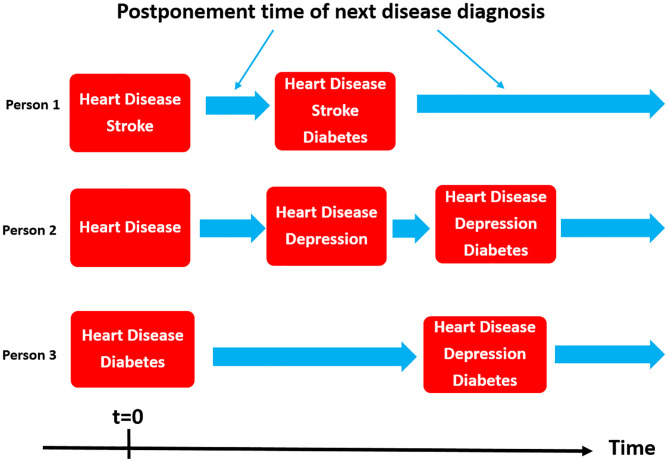
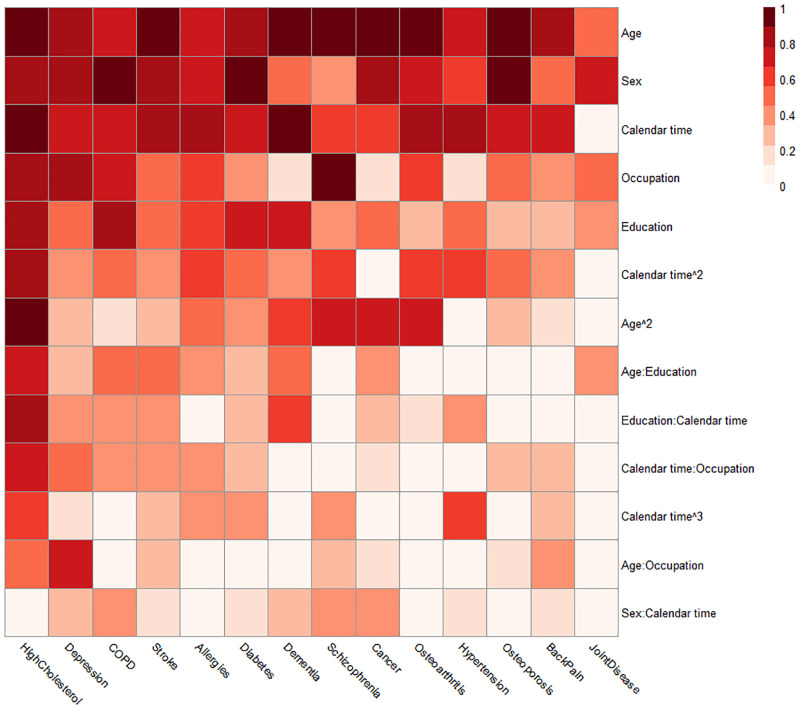
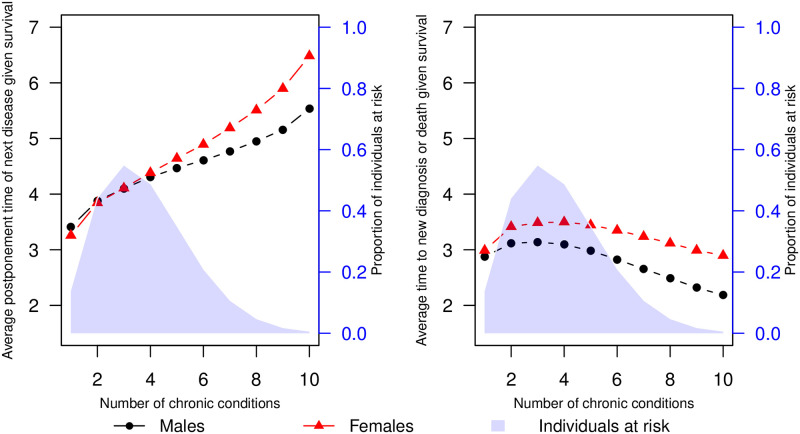
Disease trajectory networks of expected disease portfolio development and chronic condition prevalences were used to map sex and socioeconomic multimorbidity patterns among chronic heart disease patients. Our data source was all Danish individuals aged 18 years and older at some point in 1995-2015, consisting of 6,048,700 individuals. We used algorithmic diagnoses to obtain chronic disease diagnoses and included individuals who received a heart disease diagnosis. We utilized a general Markov framework considering combinations of chronic diagnoses as multimorbidity states. We analyzed the time until a possible new diagnosis, termed the diagnosis postponement time, in addition to transitions to new diagnoses. We modelled the postponement times by exponential models and transition probabilities by logistic regression models.
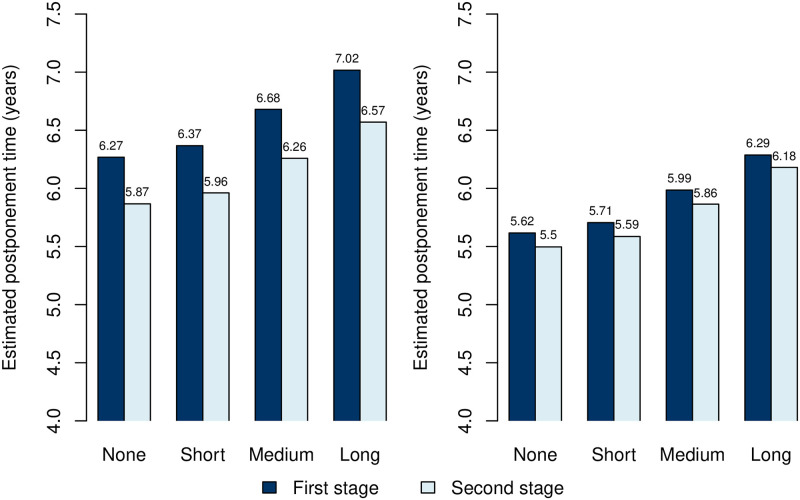
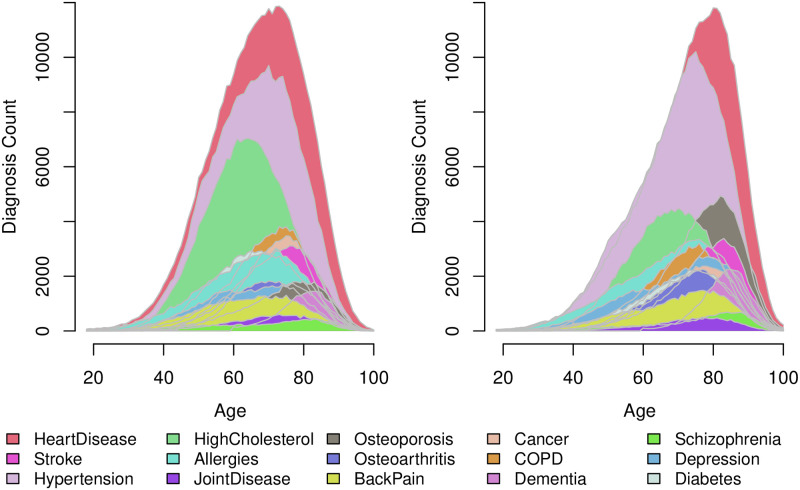
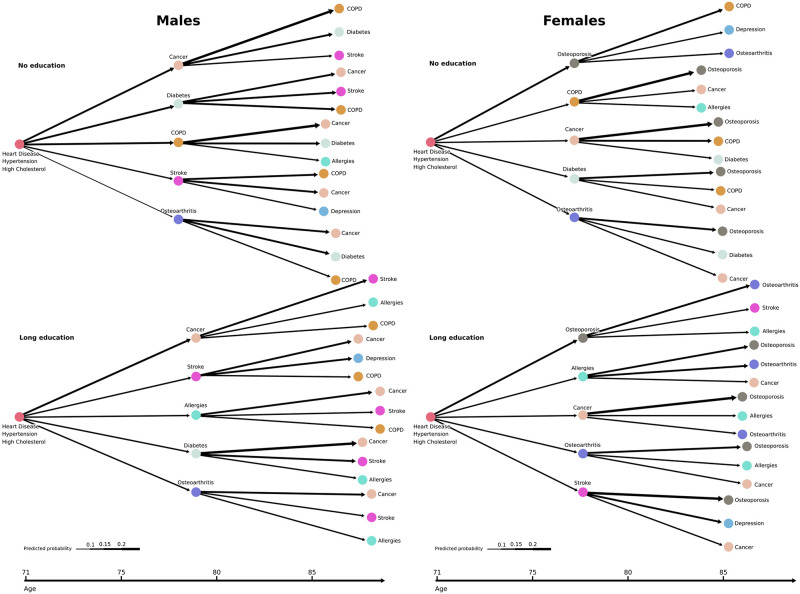
Among the cohort of 766,596 chronic heart disease diagnosed individuals, the prevalence of multimorbidity was 84.36% and 88.47% for males and females, respectively. We found sex-related differences within the chronic heart disease trajectories. Female trajectories were dominated by osteoporosis and male trajectories by cancer. We found sex important in developing most conditions, especially osteoporosis, chronic obstructive pulmonary disease and diabetes. A socioeconomic gradient was observed where diagnosis postponement time increases with educational attainment. Contrasts in disease portfolio development based on educational attainment were found for both sexes, with chronic obstructive pulmonary disease and diabetes more prevalent at lower education levels, compared to higher.
Disease trajectories of chronic heart disease diagnosed individuals are heavily complicated by multimorbidity. Therefore, it is essential to consider and study chronic heart disease, taking into account the individuals' entire disease portfolio.
随着老龄化人口中多病共存的情况日益普遍,需要在人群层面上研究多病共存的流行病学和发展情况。患有慢性心脏病的个体通常患有多种疾病,针对其慢性疾病轨迹的全人群纵向研究较少。
使用预期疾病组合发展和慢性疾病流行率的疾病轨迹网络来描绘慢性心脏病患者的性别和社会经济多病共存模式。我们的数据来源是 1995 年至 2015 年期间任何时候年龄在 18 岁及以上的所有丹麦个体,共包含 6048700 名个体。我们使用算法诊断获得慢性疾病诊断,并纳入接受心脏病诊断的个体。我们使用一般马尔可夫框架考虑慢性诊断的组合作为多病共存状态。我们分析了可能的新诊断的时间,称为诊断延迟时间,以及新诊断的转移。我们通过指数模型来模拟延迟时间,通过逻辑回归模型来模拟转移概率。
在患有慢性心脏病的 766596 名诊断个体的队列中,男性和女性的多病共存患病率分别为 84.36%和 88.47%。我们发现慢性心脏病轨迹内存在性别差异。女性轨迹以骨质疏松症为主,而男性轨迹以癌症为主。我们发现性别对大多数疾病的发展都很重要,尤其是骨质疏松症、慢性阻塞性肺疾病和糖尿病。还观察到了教育程度与诊断延迟时间之间的梯度关系,即教育程度越高,诊断延迟时间越长。在基于教育程度的疾病组合发展方面,男女之间存在差异,与较高的教育程度相比,较低的教育程度更常见慢性阻塞性肺疾病和糖尿病。
患有慢性心脏病的个体的疾病轨迹受到多病共存的严重影响。因此,在考虑和研究慢性心脏病时,考虑到个体的整个疾病组合是至关重要的。