Experimental Psychology, Cognitive Processes and Speech Therapy Department, Faculty of Psychology, Complutense University of Madrid, 28223, Pozuelo de Alarcón, Spain.
Geriatric Department, Hospital Central de La Cruz Roja "San José Y Santa Adela", 28003, Madrid, Spain.
Geroscience. 2023 Jun;45(3):2011-2025. doi: 10.1007/s11357-023-00779-5. Epub 2023 Apr 21.
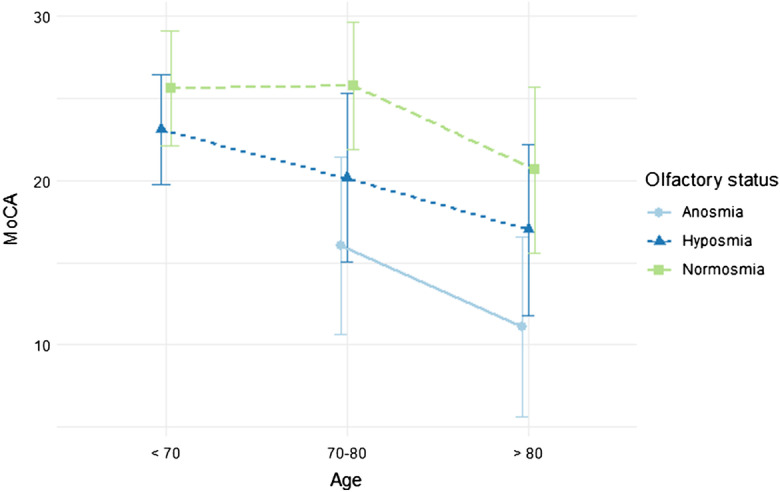
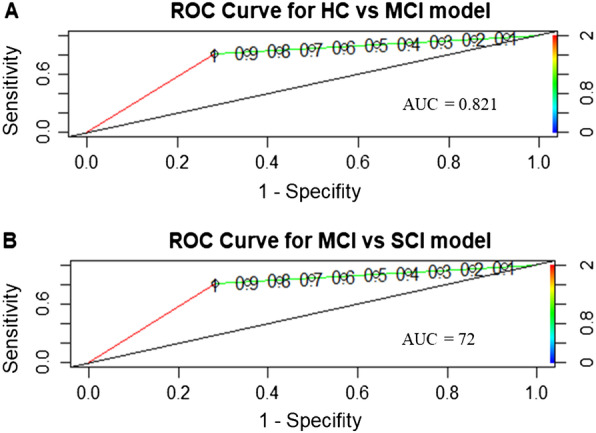
Aging contributes to the deterioration of the olfactory system in humans. Several studies indicate that the olfactory identification test alone may function as a screening test for olfactory dysfunction and they are more feasible to apply in clinical practice. Olfactory identification may be a predictor for cognitive impairment. Multiple studies have considered the use of odor identification as a measure to identify the conversion from normality to mild cognitive impairment or dementia. The objectives were (i) to elucidate the associations between cognitive status and olfactory identification performance in aging; (ii) understand the predictive value of olfactory capacity in identifying subjects with cognitive impairment risk; and (iii) to study how cognitive status and olfactory identification relate with other variables of wellness in aging, such as functional capabilities and clinical measures. For this purpose, a group of 149 participants (77.15 ± 7.29 years; 73 women of 76.7 ± 8 years and 76 men of 77.6 ± 6.52 years) were recruited and were subjected to a sociodemographic questionnaire, a psychological screening tool of general cognitive status, an olfactory identification evaluation, and clinical measures. The participants were divided into groups based on their cutoff scores of previous scientific reports about the Spanish version of Montreal Cognitive Assessment. Our results indicate an age-associated decline in olfactory identification ability and intensity of odor perception. The predictive ability of olfactory identification scores for the risk of mild and severe impairment is around 80%. Olfactory identification decreases with cognitive function. Performance in odor identification is associated with impairment of episodic memory and executive functions. These findings further our current understanding of the association between cognition and olfaction, and support olfactory assessment in screening those at higher risk of dementia.
衰老导致人类嗅觉系统恶化。有几项研究表明,单独的嗅觉识别测试可以作为嗅觉功能障碍的筛查测试,并且在临床实践中更可行。嗅觉识别可能是认知障碍的预测指标。多项研究已经考虑使用气味识别作为一种衡量标准,以识别从正常到轻度认知障碍或痴呆的转变。目的是:(i)阐明衰老过程中认知状态与嗅觉识别表现之间的关系;(ii)了解嗅觉能力在识别认知障碍风险受试者中的预测价值;(iii)研究认知状态和嗅觉识别与衰老过程中其他健康变量(如功能能力和临床指标)之间的关系。为此,招募了一组 149 名参与者(77.15±7.29 岁;73 名女性年龄为 76.7±8 岁,76 名男性年龄为 77.6±6.52 岁),并对他们进行了社会人口学问卷、一般认知状态的心理筛查工具、嗅觉识别评估和临床指标评估。参与者根据之前关于蒙特利尔认知评估西班牙语版本的科学报告的截止分数分为两组。我们的结果表明,嗅觉识别能力和气味感知强度随着年龄的增长而下降。嗅觉识别分数对轻度和重度损害风险的预测能力约为 80%。嗅觉识别随认知功能下降。气味识别的表现与情景记忆和执行功能障碍有关。这些发现进一步加深了我们对认知和嗅觉之间关系的理解,并支持嗅觉评估作为识别痴呆风险较高人群的一种手段。