Department of Nutriomics, Clinical Research Centre, Medical University of Bialystok, Marii Sklodowskiej-Curie 24A, 15-276, Bialystok, Poland.
Clinical Research Support Centre, Medical University of Bialystok, Marii Sklodowskiej-Curie 24A, 15-276, Bialystok, Poland.
Sci Rep. 2023 Apr 21;13(1):6585. doi: 10.1038/s41598-023-33842-4.
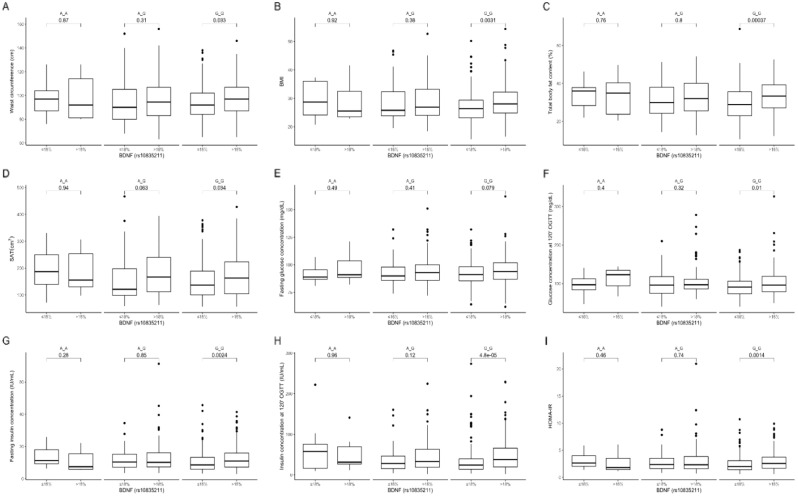
Some common single-nucleotide polymorphisms of the brain-derived neurotrophic factor (BDNF) gene have been associated not only with the neurodegenerative diseases but also with some eating disorders. The aim of this study was to assess the possible differences in the obesity-related and glucose metabolism parameters between some BDNF genotypes', that may depend on the daily energy and macronutrients intake. In 484 adult participants we performed the anthropometric measurements, body composition analysis, and body fat distribution. The daily dietary intake was assessed using the 3-day food intake diaries. Blood glucose and insulin concentrations were measured at fasting and during oral glucose tolerance tests. Moreover, the visceral adipose tissue/subcutaneous adipose tissue (VAT/SAT) ratio and homeostatic model assessment of insulin resistance were calculated. We noted that participants carrying the GG genotype had lower skeletal muscle mass and fat free mass (FFM) when carbohydrate intake was > 48%, whereas they presented higher fat-free mass (FFM), and surprisingly higher total cholesterol and LDL-C concentrations when daily fiber intake was > 18 g. Moreover, in these subjects we noted higher waist circumference, BMI, and fasting glucose and insulin concentrations, when > 18% of total daily energy intake was delivered from proteins, and higher VAT content and HDL-C concentrations when > 30% of energy intake was derived from dietary fat. Our results suggest that glucose homeostasis and obesity-related parameters in carriers of some common variants of BDNF gene, especially in the GG (rs10835211) genotype carriers, may differ dependently on daily energy, dietary macronutrients and fiber intake.
一些常见的脑源性神经营养因子(BDNF)基因单核苷酸多态性不仅与神经退行性疾病有关,还与一些饮食失调有关。本研究旨在评估一些 BDNF 基因型的肥胖相关和葡萄糖代谢参数的差异,这些差异可能取决于日常能量和宏量营养素的摄入。在 484 名成年参与者中,我们进行了人体测量学测量、身体成分分析和体脂分布评估。使用 3 天的食物摄入量日记评估每日饮食摄入。测量空腹和口服葡萄糖耐量试验时的血糖和胰岛素浓度。此外,还计算了内脏脂肪组织/皮下脂肪组织(VAT/SAT)比值和稳态模型评估的胰岛素抵抗。我们注意到,当碳水化合物摄入量超过 48%时,携带 GG 基因型的参与者骨骼肌质量和无脂肪质量(FFM)较低,而当每日纤维摄入量超过 18g 时,他们的无脂肪质量(FFM)较高,令人惊讶的是总胆固醇和 LDL-C 浓度也较高。此外,在这些受试者中,当蛋白质提供的总日能量摄入超过 18%时,我们注意到更高的腰围、BMI、空腹血糖和胰岛素浓度,以及当来自饮食脂肪的能量摄入超过 30%时,更高的 VAT 含量和 HDL-C 浓度。我们的研究结果表明,BDNF 基因某些常见变异体携带者的葡萄糖稳态和肥胖相关参数可能因日常能量、膳食宏量营养素和纤维摄入而异,特别是在 GG(rs10835211)基因型携带者中。