Medical Physics Unit, IRCCS Humanitas Research Hospital, Rozzano, Milan, Italy.
Department of Biomedical Sciences, Humanitas University, Pieve Emanuele, Milan, Italy.
J Appl Clin Med Phys. 2023 Jun;24(6):e13931. doi: 10.1002/acm2.13931. Epub 2023 Apr 21.
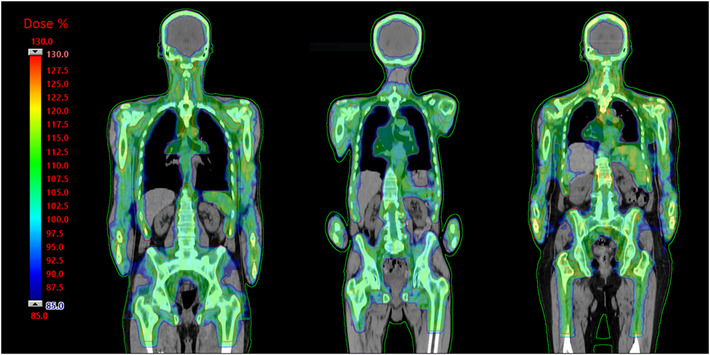
To assess the impact of the planner's experience and optimization algorithm on the plan quality and complexity of total marrow and lymphoid irradiation (TMLI) delivered by means of volumetric modulated arc therapy (VMAT) over 2010-2022 at our institute.
Eighty-two consecutive TMLI plans were considered. Three complexity indices were computed to characterize the plans in terms of leaf gap size, irregularity of beam apertures, and modulation complexity. Dosimetric points of the target volume (D2%) and organs at risk (OAR) (Dmean) were automatically extracted to combine them with plan complexity and obtain a global quality score (GQS). The analysis was stratified based on the different optimization algorithms used over the years, including a knowledge-based (KB) model. Patient-specific quality assurance (QA) using Portal Dosimetry was performed retrospectively, and the gamma agreement index (GAI) was investigated in conjunction with plan complexity.
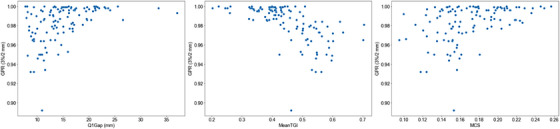
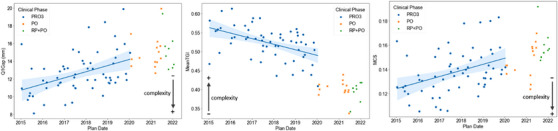
Plan complexity significantly reduced over the years (r = -0.50, p < 0.01). Significant differences in plan complexity and plan dosimetric quality among the different algorithms were observed. Moreover, the KB model allowed to achieve significantly better dosimetric results to the OARs. The plan quality remained similar or even improved during the years and when moving to a newer algorithm, with GQS increasing from 0.019 ± 0.002 to 0.025 ± 0.003 (p < 0.01). The significant correlation between GQS and time (r = 0.33, p = 0.01) indicated that the planner's experience was relevant to improve the plan quality of TMLI plans. Significant correlations between the GAI and the complexity metrics (r = -0.71, p < 0.01) were also found.
Both the planner's experience and algorithm version are crucial to achieve an optimal plan quality in TMLI plans. Thus, the impact of the optimization algorithm should be carefully evaluated when a new algorithm is introduced and in system upgrades. Knowledge-based strategies can be useful to increase standardization and improve plan quality of TMLI treatments.
评估规划师的经验和优化算法对我们机构在 2010 年至 2022 年期间通过容积旋转调强放疗(VMAT)实施全骨髓和淋巴照射(TMLI)计划质量和复杂性的影响。
共考虑了 82 例连续 TMLI 计划。使用叶间隙大小、射束孔径不规则性和调制复杂性三个复杂性指标来描述计划。通过自动提取靶区(D2%)和危及器官(OAR)(Dmean)的剂量学点,将其与计划复杂性相结合,获得综合质量评分(GQS)。该分析基于多年来使用的不同优化算法进行分层,包括基于知识的(KB)模型。回顾性地对患者进行了特定的质量保证(QA)检测,采用伽马一致性指数(GAI)结合计划复杂性进行调查。
计划复杂性在过去几年中显著降低(r = -0.50,p < 0.01)。观察到不同算法之间的计划复杂性和计划剂量学质量存在显著差异。此外,KB 模型可显著改善 OAR 的剂量学结果。在这几年期间,以及在向更新的算法过渡时,计划质量保持相似甚至有所提高,GQS 从 0.019 ± 0.002 增加到 0.025 ± 0.003(p < 0.01)。GQS 与时间之间的显著相关性(r = 0.33,p = 0.01)表明,规划师的经验与提高 TMLI 计划的计划质量相关。还发现 GAI 与复杂性指标之间存在显著相关性(r = -0.71,p < 0.01)。
规划师的经验和算法版本对于实现 TMLI 计划的最佳计划质量都至关重要。因此,在引入新算法和系统升级时,应仔细评估优化算法的影响。基于知识的策略可以有助于提高 TMLI 治疗的标准化和计划质量。